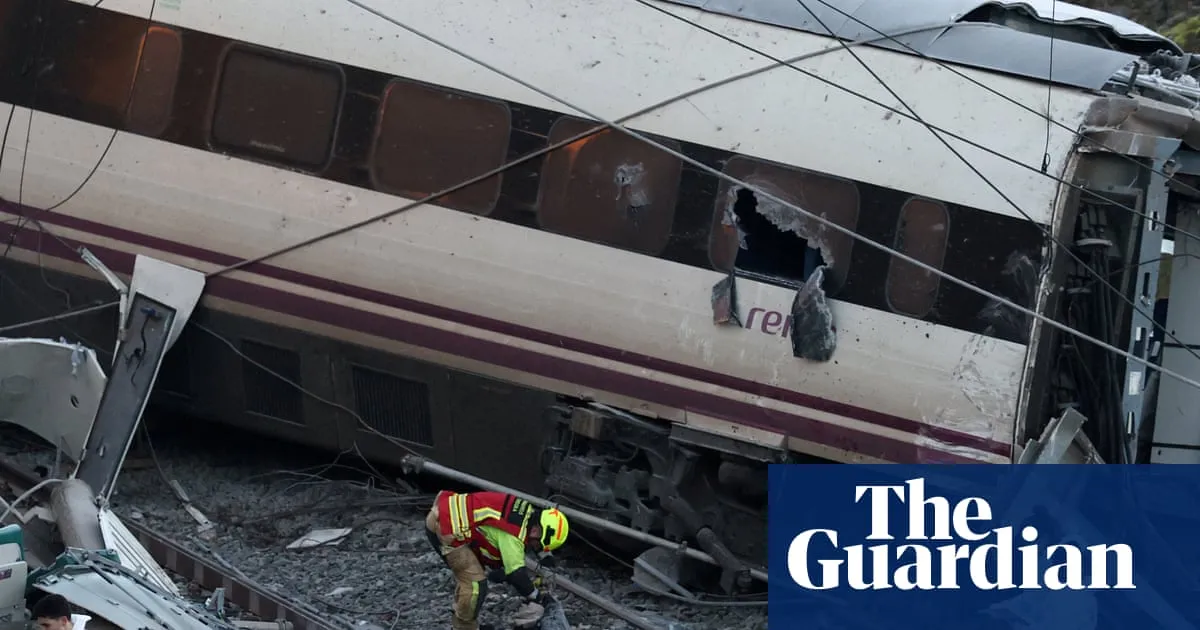
Experts investigating the deadly rail collision in southern Spain, which killed 45 people and left dozens more injured, believe the accident may have happened after one of the trains passed over a damaged section of rail.The disaster occurred near the Andalucían town of Adamuz on Sunday, when a high-speed train operated by Iryo, a private company, derailed and collided with an oncoming high-speed train operated by the state rail company, Renfe.A preliminary report published by the Rail Accidents Investigation Commission (CIAF) on Friday found nicks in the wheels on the right-hand side of the three front carriages of the Iryo train consistent with an impact with the top of the rail.“These nicks in the wheels and the observed deformation in the rail are consistent with the rail being fractured: with the rail’s continuity interrupted, the section before the break would initially bear the full weight of the wheel, causing that part of the rail to sag slightly,” the report said.“Since the section of rail after the break would not be acting in unison with the section before it, a step would momentarily form between the two sides of the fracture, which would strike the wheel rim.”Given the available information, the report added: “We can hypothesise that the rail fracture occurred prior to the passage of the Iryo train involved in the accident and therefore prior to the derailment.” But the CIAF also stressed that the theory was provisional and would be subject to further testing and investigation.Two days after the Adamuz accident, a train driver was killed and 37 people were injured when a train was derailed by the collapse of a retaining wall near Gelida in Catalonia.The two deadly events have led Semaf, Spain’s largest train drivers’ union, to call a three-day strike in February to demand measures to guarantee the safety of railworkers and passengers.Semaf said industrial action was “the only legal avenue left for workers to demand the restoration of safety standards on the railway system and, consequently, guarantee the safety of both railway professionals and passengers”.The tragedy has also been seized on by opposition parties which have accused Spain’s socialist-led coalition government of a chaotic response and a lack of transparency.“The state of the railways is a reflection of the state of the nation,” Alberto Núñez Feijóo, the leader of the conservative People’s party, said on Friday.He added: “Right now, we don’t have the best rail system in our history; what we have is the worst government in our history.”
SRCThe Guardian - World News
LANGEN
LEANCenter-Left
WORDS414
ENT7
FRI · 2026-01-23 · 14:24 GMTBRIEF NSR-2026-0123-10012
NSR-2026-0123-10012News Report·EN·Human Interest
Spain train collision investigators examine rail damage theory
Investigators are exploring whether damaged rails contributed to the deadly train collision near Adamuz, Spain, on Sunday, which killed 45 people. A preliminary report suggests nicks on the Iryo train's wheels align with a fractured rail, potentially causing the derailment and subsequent collision with a Renfe train.
Sam Jones in MadridThe Guardian - World NewsFiled 2026-01-23 · 14:24 GMTLean · Center-LeftRead · 2 min
The Guardian - World NewsFIG 01
Reading time
2min
Word count
414words
Sources cited
4cited
Entities identified
7entities
Quality score
100%
§ 01
Briefing Summary
AI-generatedNEWSAR · AI
Investigators are exploring whether damaged rails contributed to the deadly train collision near Adamuz, Spain, on Sunday, which killed 45 people. A preliminary report suggests nicks on the Iryo train's wheels align with a fractured rail, potentially causing the derailment and subsequent collision with a Renfe train. The Rail Accidents Investigation Commission (CIAF) emphasizes this is a provisional theory requiring further investigation. Following this and another recent train derailment, the Semaf train drivers’ union has called for a three-day strike in February, demanding improved safety measures. Opposition parties have criticized the government's response and transparency regarding the accidents, raising concerns about the overall state of the rail system.
Confidence 0.90Sources 4Claims 5Entities 7
§ 02
Article analysis
Model · rule-basedFraming
Human Interest
Political Strategy
Tone
Measured
AI-assessed
CalmNeutralAlarmist
Factuality
0.70 / 1.00
Factual
LowHigh
Sources cited
4
Well sourced
FewMany
§ 03
Key claims
5 extracted01
Semaf, Spain’s largest train drivers’ union, called a three-day strike in February.
factualSemaf
Confidence
1.00
02
A preliminary report found nicks in the wheels of the Iryo train consistent with impact with the top of the rail.
factualRail Accidents Investigation Commission (CIAF)
Confidence
1.00
03
Industrial action was the only legal avenue left to demand the restoration of safety standards.
quoteSemaf
Confidence
0.90
04
Experts believe the train accident may have happened after a train passed over a damaged section of rail.
factualArticle's own claim based on investigation
Confidence
0.80
05
The state of the railways is a reflection of the state of the nation.
quoteAlberto Núñez Feijóo
Confidence
0.70
§ 04
Full report
2 min read · 414 words§ 05
Entities
7 identifiedKey playerOppositionContextPositiveNeutralNegative
§ 06
Keywords & salience
9 termstrain collision
1.00
rail damage
0.90
derailment
0.80
rail fracture
0.70
rail safety
0.70
investigation
0.60
strike
0.50
train drivers' union
0.50
high-speed train
0.40
§ 07
Topic connections
Interactive graph Network visualization showing 51 related topics
View Full Graph Person Organization Location Event|Click node to navigate|Edge numbers = shared articles