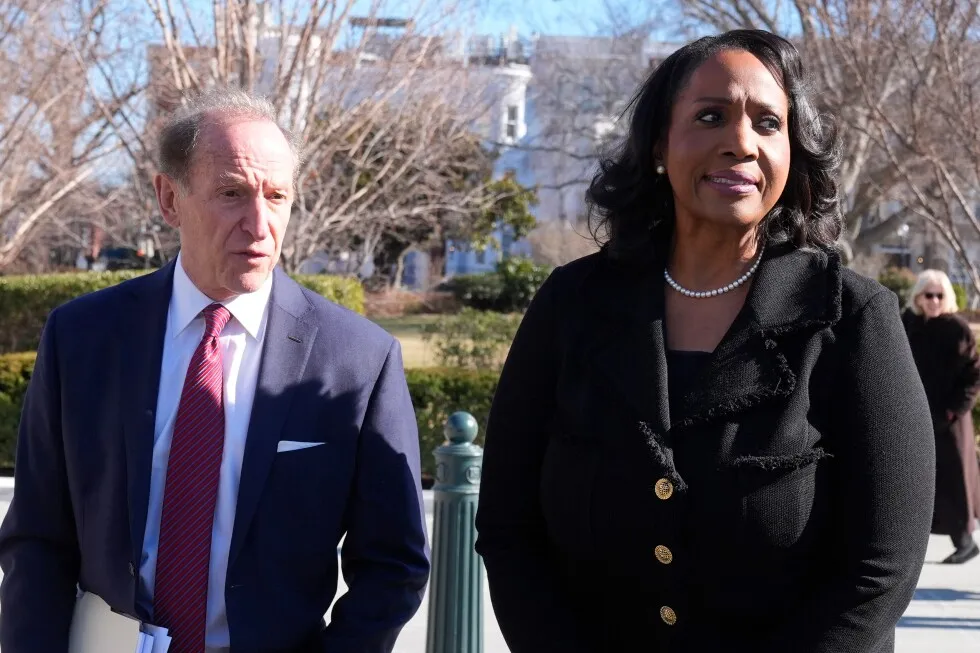
In the case of the Federal Reserve, Supreme Court appears to carve out a murky exception 1 of 3 | Federal Reserve governor Lisa Cook and attorney Abbe Lowell leave the Supreme Court in Washington, Wednesday, Jan. 21, 2026. (AP Photo/Mark Schiefelbein) 2 of 3 | Federal Reserve governor Lisa Cook, left, and her attorneys leave the Supreme Court in Washington, Wednesday, Jan. 21, 2026. (AP Photo/Mark Schiefelbein) 3 of 3 | Federal Reserve governor Lisa Cook, left, and her attorneys leave the Supreme Court in Washington, Wednesday, Jan. 21, 2026. (AP Photo/Mark Schiefelbein) 1 of 3 Federal Reserve governor Lisa Cook and attorney Abbe Lowell leave the Supreme Court in Washington, Wednesday, Jan. 21, 2026. (AP Photo/Mark Schiefelbein) Add AP News on Google Add AP News as your preferred source to see more of our stories on Google. 2 of 3 Federal Reserve governor Lisa Cook, left, and her attorneys leave the Supreme Court in Washington, Wednesday, Jan. 21, 2026. (AP Photo/Mark Schiefelbein) Add AP News on Google Add AP News as your preferred source to see more of our stories on Google. 3 of 3 Federal Reserve governor Lisa Cook, left, and her attorneys leave the Supreme Court in Washington, Wednesday, Jan. 21, 2026. (AP Photo/Mark Schiefelbein) Add AP News on Google Add AP News as your preferred source to see more of our stories on Google. Updated [hour]:[minute] [AMPM] [timezone], [monthFull] [day], [year] Washington (AP) — The Supreme Court for the past year has repeatedly allowed President Donald Trump to fire heads of independent agencies, but it appears to be drawing a line with the Federal Reserve. The court has signaled for months that it sees the Fed in a different light. It has said that the president can fire directors of other agencies for any reason, but can remove Fed governors only “for cause,” which is often interpreted to mean neglect of duty or malfeasance.Last year, the court allowed President Donald Trump to fire — at least temporarily — Gwynne Wilcox, a member of the National Labor Relations Board, and Cathy Harris, a member of the Merit Systems Protection Board, but it carved out a distinction for the Fed. The two officials had argued that if Trump could fire them, he could also fire members of the Fed’s board of governors. “We disagree,” the court said then. “The Federal Reserve is a uniquely structured, quasi-private entity that follows in the distinct historical tradition of the First and Second Banks of the United States.” That is now being put to the test in a case in front of the Supreme Court involving Trump’s attempt to remove Fed governor Lisa Cook. On Wednesday during oral arguments, the court seemed inclined to keep Cook in her job. Allowing Cook’s firing to go forward “would weaken, if not shatter, the independence of the Federal Reserve,” said Justice Brett Kavanaugh, one of three Trump appointees on the nation’s highest court. But the court largely skirted a key issue: What, exactly, is the legal principle that protects the Fed, but not the other agencies?Several legal experts say the justices are on shaky ground. The Fed, they argue, is similar in many ways to the Federal Trade Commission or the National Labor Relations Board, agencies Congress intended to be independent but whose officials Trump has been able to fire without pushback from the high court. “There’s no historical grounds for distinguishing the Fed from other independent agencies that Congress has designed,” said Jane Manners, a law professor at Fordham University. “The whole argument was premised on the idea that the Fed is different. They haven’t explained exactly why.”Peter Conti-Brown, a professor of financial regulation at the University of Pennsylvania, added, “I’ll say as a legal scholar and as a historian I think that differentiation is hocus pocus.”Just last month, the court signaled in a separate oral argument that it would likely allow Trump to fire FTC Commissioner Rebecca Slaughter. The conservative majority on the court also suggested it would overturn a 90-year-old precedent that sharply limited the president’s ability to fire top officials at independent agencies.Chief Justice John Roberts and many of his colleagues support the “unitary executive” theory, which holds that the president should have full sway over the staffing of agencies in the executive branch. Agency directors, like Slaughter, “are exercising massive power over individual liberty and billion-dollar industries” without being accountable to anyone, Kavanaugh said at the December oral argument. With the Federal Reserve, however, the Supreme Court’s conservative justices have applied a different view: that the Fed’s monetary policy — the setting of short-term interest rates and management of the money supply — historically hasn’t been overseen by the executive branch. Some legal experts have likewise drawn a distinction between the Fed and other independent agencies. In a brief filed in the Cook case, Aaron Nielson, a law professor at the University of Texas, and formerly a top lawyer in Texas government, wrote that, “Whereas the modern FTC indisputably exercises executive power, the Fed’s core function is monetary policy, which need not and often does not require executive power.” The First and Second Banks of the United States were nationwide banks that were the closest the United States had to a central bank in the first few decades after the nation’s founding, and both “conducted early monetary policy,” Nielson wrote, but weren’t executive branch agencies. But Lev Menand, a law professor at Columbia University and author of a book about the Fed, argued that the Fed does exercise executive power when it regulates the banking system. And monetary policy, when it adjusts the money supply, is part of that regulation, he said. There are also only three types of government authority, Menand argues: legislative, executive, and judicial, and the Fed belongs in the executive category. “There is no fourth type of government power,” Menand said. “There is no other place to locate the Fed.”Still, the justices mostly avoided addressing why the Fed is different during Wednesday’s oral argument, in part, Menand noted, because neither side pushed it. Cook’s lawyers had no reason to question a distinction that appeared to favor them. And even the government’s own top Supreme Court lawyer, D. John Sauer, acknowledged that Trump could only fire Cook “for cause,” while in the other cases the White House had sought to remove officials for any reason, including policy differences. The distinction made it harder for the White House to argue that Cook should immediately be removed from office.“There is a long tradition of having this exercise of monetary policy be exercised independent of executive influence,” Sauer said. “And we don’t dispute that that’s what Congress was doing.” Paul Clement, one of Cook’s lawyers, told the justices, “it’s kind of why this case is, I think, problematic for the government because they could have come in here and said, you know, Fed, schmed, it’s not that different. This is just like the FTC.”Instead, Clement added, “they come in and say, no, we’re going to accept that the Fed is different, at least for purposes of this case.”The Supreme Court will initially rule on the narrow question of whether Cook can remain in her position while the larger dispute over her firing is fought in the lower courts. Still, at some point it may have to issue more comprehensive rulings that could include a fuller explanation of why the justices see the Fed as different. For now, the Fed’s size and impact on the financial markets may be offering it a measure of protection. “I don’t mean to denigrate any other agency, but there’s a reason that monetary policy has been treated differently, for lo these many years,” Clement said. “And there’s a reason that the markets watch the Fed a little more closely than they watch really any other agency of government.” Rugaber has covered the Federal Reserve and the U.S. economy for the AP for 16 years. He is a two-time finalist for the Gerald Loeb award for business reporting.
SRCAssociated Press (AP)
LANGEN
LEANCenter
WORDS1 333
ENT7
FRI · 2026-01-23 · 15:53 GMTBRIEF NSR-2026-0123-10026
NSR-2026-0123-10026News Report·EN·Legal & Judicial
In the case of the Federal Reserve, Supreme Court appears to carve out a murky exception
In January 2026, the Supreme Court heard arguments regarding the Federal Reserve's independence. While the court has previously allowed President Trump to remove heads of other independent agencies, it appears to be making an exception for the Fed.
By
CHRISTOPHER RUGABERAssociated Press (AP)Filed 2026-01-23 · 15:53 GMTLean · CenterRead · 6 min
Associated Press (AP)FIG 01
Reading time
6min
Word count
1 333words
Sources cited
3cited
Entities identified
7entities
Quality score
100%
§ 01
Briefing Summary
AI-generatedNEWSAR · AI
In January 2026, the Supreme Court heard arguments regarding the Federal Reserve's independence. While the court has previously allowed President Trump to remove heads of other independent agencies, it appears to be making an exception for the Fed. The court signaled it views the Federal Reserve differently, suggesting the president can only remove Fed governors "for cause," such as neglect of duty or malfeasance. This distinction was highlighted in a previous ruling where the court allowed the firing of officials from the National Labor Relations Board and the Merit Systems Protection Board, but differentiated the Fed due to its "uniquely structured, quasi-private entity" status. The case raises questions about the extent of presidential power over independent agencies.
Confidence 0.90Sources 3Claims 5Entities 7
§ 02
Article analysis
Model · rule-basedFraming
Legal & Judicial
Political Strategy
Tone
Measured
AI-assessed
CalmNeutralAlarmist
Factuality
0.70 / 1.00
Factual
LowHigh
Sources cited
3
Well sourced
FewMany
§ 03
Key claims
5 extracted01
Allowing Cook’s firing to go forward “would weaken, if not shatter, the independence of the Federal Reserve.”
quoteJustice Brett Kavanaugh
Confidence
1.00
02
The Federal Reserve is a uniquely structured, quasi-private entity that follows in the distinct historical tradition.
quotethe court
Confidence
1.00
03
The court has said that the president can fire directors of other agencies for any reason.
factual
Confidence
1.00
04
The president can remove Fed governors only “for cause,” which is often interpreted to mean neglect of duty or malfeasance.
factual
Confidence
0.90
05
The Supreme Court appears to be drawing a line with the Federal Reserve regarding presidential power to fire agency heads.
factual
Confidence
0.90
§ 04
Full report
6 min read · 1 333 words§ 05
Entities
7 identifiedKey playerOppositionContextPositiveNeutralNegative
People3
Organizations3
Locations1
§ 06
Keywords & salience
8 termsfederal reserve
1.00
supreme court
0.90
independent agencies
0.70
president donald trump
0.60
removal power
0.60
governors
0.50
for cause
0.50
quasi-private entity
0.40
§ 07
Topic connections
Interactive graph Network visualization showing 51 related topics
View Full Graph Person Organization Location Event|Click node to navigate|Edge numbers = shared articles