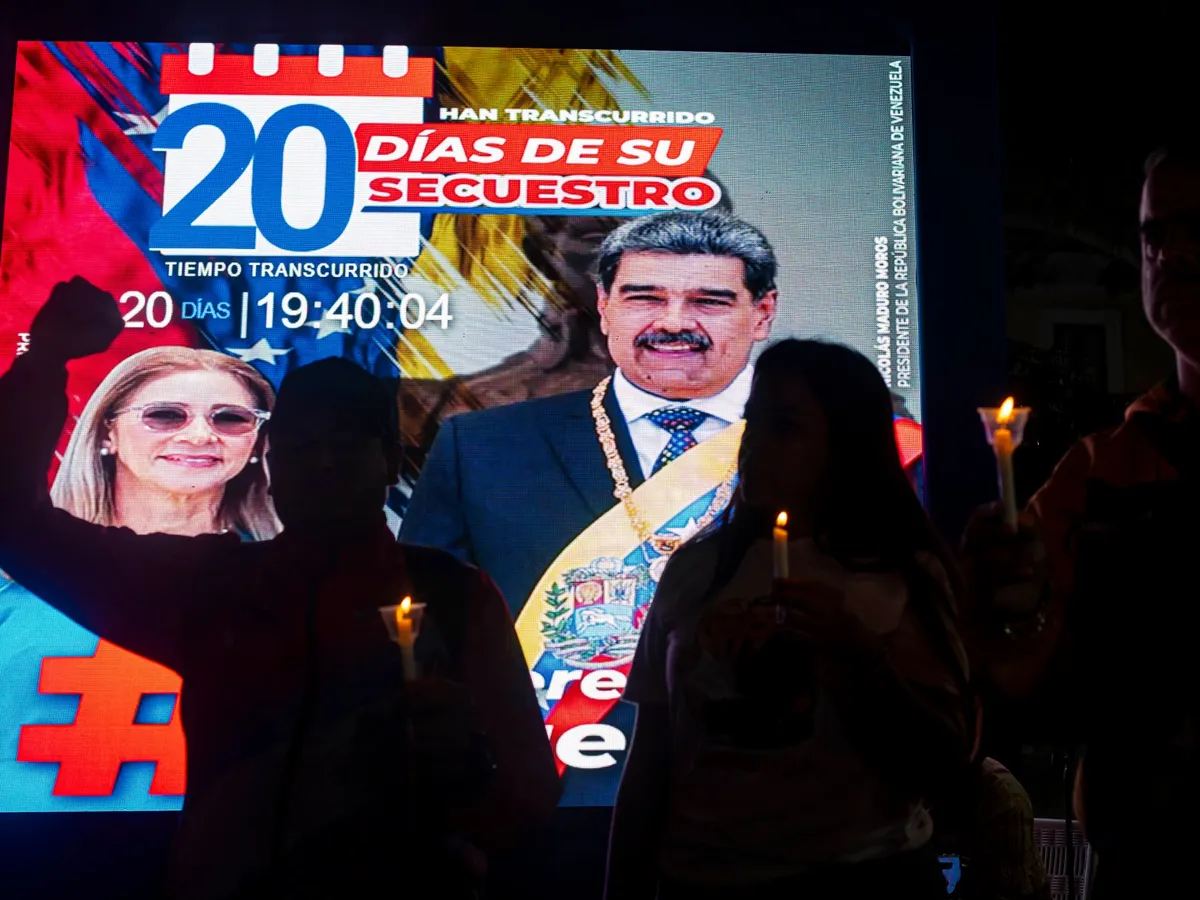
EXPLAINERThree weeks since attack, US plans focus on oil, but little clarity emerges, as analysts warn of Venezuela faultlines.People hold candles during a vigil in Plaza Bolivar in Caracas, Venezuela, January 22, 2026 [EPA/Miguel Gutierrez]Published On 24 Jan 2026It was an extraordinary beginning to the new year: A deadly United States military operation on Venezuelan soil. The abduction of the country’s longtime leader, Nicolas Maduro.But in the three weeks since the operation, widely condemned as an affront to international law and a potential opening salvo in the administration of Donald Trump’s stated goal of “preeminence” in the Western Hemisphere, only a vague framework of Washington’s plan for the South American country has emerged.Recommended Stories list of 3 itemslist 1 of 3US forces seize a seventh Venezuela-linked oil tankerlist 2 of 3The US attack on Venezuela and the collapse of international lawlist 3 of 3‘The end of the world as we know it’: Is the rules-based order finished?end of listMeanwhile, relative calm in Venezuela has overlaid deep-seated anxieties over what comes next, analysts told Al Jazeera. Faultlines in the country’s leadership remain active, with the situation subject to devolve based on how Trump and his top officials proceed.Here’s where things stand, and what could come next.‘Operating with a gun to its head’Maduro has sat in prison in New York since the January 3 operation, awaiting trial on drug trafficking and so-called conspiracy to commit “narcoterrorism” charges.But many of the circumstances leading up to his abduction have endured. A massive portion of the US’s military arsenal has remained deployed off the coast of Venezuela. A blockade on US-sanctioned oil tankers has stayed in place. The Trump administration has promised to continue strikes on alleged drug smuggling boats in the Caribbean, while not ruling out future Venezuela land operations.“What we’re seeing is not a fully formed [US] strategy, but an evolving one,” Francesca Emanuele, a senior international policy associate at the Center for Economic and Policy Research, told Al Jazeera.Trump initially promised to “run” Venezuela, while dousing the prospect of seeking to install an opposition-led government. He has continued to downplay the proposition of opposition involvement, following a meeting last week with Maria Corina Machado, instead focusing on coordinating with interim President and former Maduro deputy Delcy Rodriguez.The president’s early manoeuvres, which have included his first direct call with Rodriguez and the deployment of his CIA director to Caracas, have unabashedly emphasised US oil access to the country.In that, Trump has sought to establish a “control mechanism”, according to Begum Zorlu, a research fellow at City, University of London, that “depends on fear: sanctions, oil leverage, and the threat of renewed force”.“What emerges is not governance but a strategy of remote coercion, forcing the post-Maduro leadership to comply with US demands, particularly around oil access.”Or as Emmanuel put it: “The Venezuelan government is operating with a gun to its head, and that cannot be bracketed out of any serious analysis.”Emphasis on oilIn that context, the administration has made some early moves to access Venezuelan oil. Just days after Maduro’s abduction, Washington and Caracas announced plans to export up to $2bn worth of crude stuck at Venezuelan ports due to the ongoing US blockade.Last week, the US announced the first $500m sale of the resource, with Rodriguez saying Caracas had received $300m in proceeds. She said the funds would be used to “stabilise” the foreign exchange markets.But Phil Gunson, a senior analyst at the International Crisis Group focusing on the Andes Region, said the current scheme by which the US is acquiring and selling Venezuela’s oil remains opaque. Several questions – made the more pressing by a history of corruption and patronage in Venezuela – have gone unanswered.US lawmakers, meanwhile, have demanded that Trump officials “immediately disclose any financial interests” they have in the companies involved.“Selling the oil is the easy part,” he told Al Jazeera. “But who determines how that money is spent? How will the goods and services purchased be administered, by what criteria and under whose direction?”Meanwhile, Trump’s vision of US companies accessing and exploiting Venezuela’s vast oil reserves has run into headwinds from market realities, even as Venezuela’s parliament has opened debate on amending a hydrocarbon law to allow more foreign investment in the country’s state-run oil industry.Just six days after Maduro’s abduction, Trump invited 17 oil companies to the White House to discuss investments in Venezuela, which he promised would meet “at least 100 billion dollars”. But even among a friendly crowd, top industry leaders pointed to a list of major reforms needed before the country was seen as investable.Trump, in turn, has pledged security for US companies operating in the country, including reportedly considering using private defence contractors. Little clarity has emerged.The administration’s high-pressure approach to Venezuela, Zorlu explained, creates a “central contradiction: the coercive model designed to secure US control over Venezuelan oil may ultimately undermine the investment climate required to extract that oil at scale.”How have Venezuela’s leaders responded?In the streets of Caracas, the atmosphere has remained “tense but calm”, according to Crisis Group’s Gunson.“There is an unusually active presence on the streets of the capital of colectivos,” Gunson said, referring to pro-government paramilitary groups often deployed to smother dissent, “and the elite DAE unit of military counter-intelligence (DGCIM), which appears to be intended to send a message that no political opening is contemplated, at least for now.”“No one is on the streets either celebrating or protesting, and for the most part, people are in a ‘wait and see’ frame of mind.”Meanwhile, there has been little in the way of public discourse from the “three power centres” that dominate Venezuela’s government, as Gunson described: The civilian flank of Rodriguez and her brother, president of the National Assembly Jorge Jesus Rodriguez; the military under Defence Minister Padrino Lopez; and Interior Minister Diosdado Cabello, who controls the police and much of the intelligence apparatus, has influence in the army, and who “can also call on the colectivos”.In their relatively staid response during the weeks since the US operation, “a government that is usually outspoken in denouncing US imperialism is clearly biting its tongue to avoid provoking Trump and [US Secretary of State] Rubio”, analyst Emanuele explained.Rodriguez has shifted from early public – if performative – defiance to a more conciliatory tone towards the Trump administration. That has included a reshuffle that saw longtime Maduro ally and regular US target Alex Saab sacked as the minister of industry and national production.Rodriguez has vocally supported plans to open the country’s oil industry to foreign investors, as her government has begun gradually releasing political prisoners arrested following an opposition crackdown in the wake of Maduro’s contested 2024 election victory claim.The harshest condemnations of US actions have been left for other officials, including Cabello and Foreign Minister Yvan Gil, “though even those statements have been noticeably moderated”, Emanuele said.As an example, she pointed to Trump’s claim that longtime ally Cuba would no longer receive oil or financial support from Venezuela. In response, Venezuela’s Ministry of Foreign Affairs reaffirmed its support for Havana, but avoided any direct reference to its future plans for oil.
SRCAl Jazeera
LANGEN
LEANCenter
WORDS1 181
ENT8
SAT · 2026-01-24 · 14:24 GMTBRIEF NSR-2026-0124-10242
NSR-2026-0124-10242Analysis·EN·Political Strategy
‘Remote coercion’: What has US approach been since abduction of Maduro?
Three weeks after a US military operation abducted Venezuelan President Nicolas Maduro on January 3, 2026, the US approach remains unclear. Maduro is imprisoned in New York awaiting trial on drug trafficking and narcoterrorism charges.
Joseph StepanskyAl JazeeraFiled 2026-01-24 · 14:24 GMTLean · CenterRead · 5 min
Al JazeeraFIG 01
Reading time
5min
Word count
1 181words
Sources cited
2cited
Entities identified
8entities
Quality score
100%
§ 01
Briefing Summary
AI-generatedNEWSAR · AI
Three weeks after a US military operation abducted Venezuelan President Nicolas Maduro on January 3, 2026, the US approach remains unclear. Maduro is imprisoned in New York awaiting trial on drug trafficking and narcoterrorism charges. Despite international condemnation, the US maintains a significant military presence off the Venezuelan coast and continues its blockade of sanctioned oil tankers. The Trump administration has promised further strikes on alleged drug smuggling boats and has not ruled out future land operations. While initially promising to "run" Venezuela, Trump is now coordinating with interim President Delcy Rodriguez, Maduro's former deputy, focusing on oil and downplaying opposition involvement. Analysts warn of underlying tensions within Venezuela and the potential for instability depending on US actions.
Confidence 0.90Sources 2Claims 5Entities 8
§ 02
Article analysis
Model · rule-basedFraming
Political Strategy
National Security
Tone
Mixed Tone
AI-assessed
CalmNeutralAlarmist
Factuality
0.60 / 1.00
Mixed
LowHigh
Sources cited
2
Limited
FewMany
§ 03
Key claims
5 extracted01
What we’re seeing is not a fully formed [US] strategy, but an evolving one.
quoteFrancesca Emanuele, Center for Economic and Policy Research
Confidence
1.00
02
A massive portion of the US military arsenal has remained deployed off the coast of Venezuela.
factual
Confidence
1.00
03
Maduro is awaiting trial in New York on drug trafficking and narcoterrorism charges.
factual
Confidence
1.00
04
US military operation on Venezuelan soil resulted in the abduction of Nicolas Maduro.
factual
Confidence
1.00
05
Trump has unabashedly emphasised US oil access to the country.
factual
Confidence
0.80
§ 04
Full report
5 min read · 1 181 words§ 05
Entities
8 identifiedKey playerOppositionContextPositiveNeutralNegative
People4
§ 06
Keywords & salience
10 termsvenezuela
1.00
nicolas maduro
0.90
us intervention
0.90
abduction
0.80
military operation
0.70
oil sanctions
0.70
donald trump
0.60
international law
0.60
political instability
0.60
drug trafficking
0.50
§ 07
Topic connections
Interactive graph Network visualization showing 51 related topics
View Full Graph Person Organization Location Event|Click node to navigate|Edge numbers = shared articles