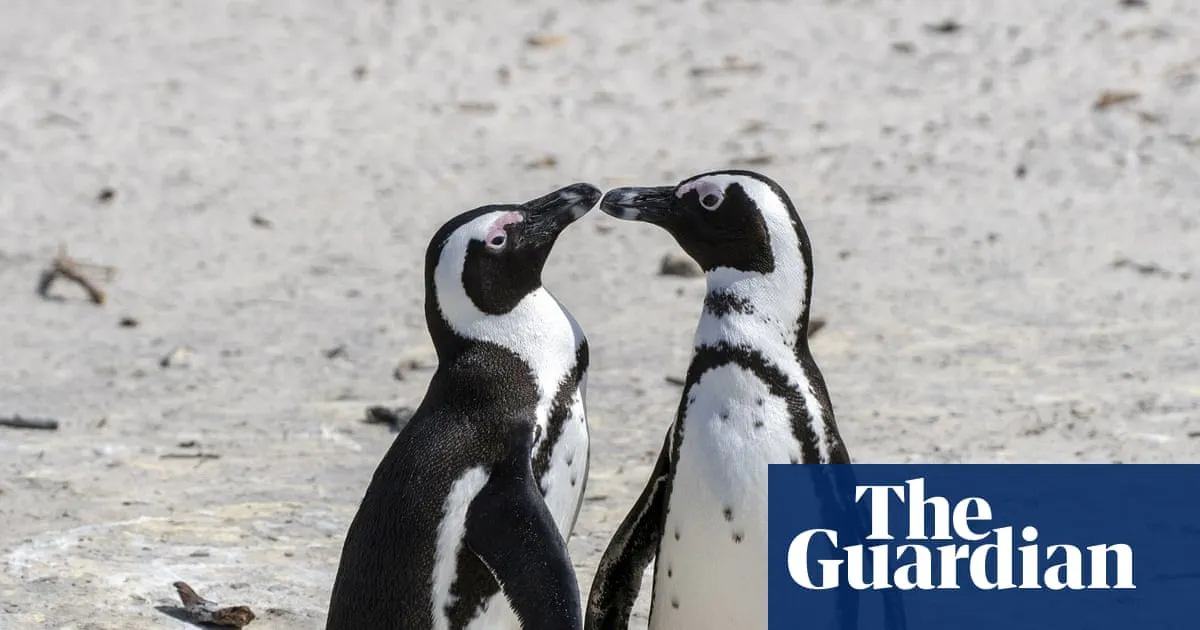
More than 60,000 penguins in colonies off the coast of South Africa have starved to death as a result of disappearing sardines, a new paper has found.More than 95% of the African penguins in two of the most important breeding colonies, on Dassen Island and Robben Island, died between 2004 and 2012. The breeding penguins probably starved to death during the moulting period, according to the paper, which said the climate crisis and overfishing were driving declines.The losses that researchers recorded in those colonies were not isolated, said the paper, which was published in Ostrich: Journal of African Ornithology. “These declines are mirrored elsewhere,” said Dr Richard Sherley, from the Centre for Ecology and Conservation at the University of Exeter. The African penguin species has undergone a population decline of nearly 80% in 30 years.African penguins shed and replace their worn-out feathers every year to protect their insulation and waterproofing. However, during the moulting period, which takes about 21 days, they have to stay on land. To survive this fasting period, they need to fatten up beforehand. “If food is too hard to find before they moult or immediately afterwards, they will have insufficient reserves to survive the fast,” said Sherley. “We don’t find large rafts of carcasses – our sense is that they probably die at sea,” he said.A protest last year in Simon’s Town, South Africa. Photograph: ER Lombard/Gallo Images/Getty ImagesFor every year except three since 2004, the biomass of the sardine species Sardinops sagax had fallen to 25% of its maximum abundance off the coast of western South Africa, the study found. The fish are a key food for African penguins. Changes in the temperature and salinity off the west coast of Africa have made the fishes’ spawning less successful. Levels of fishing, however, have remained high in the region.In 2024, African penguins were classified as critically endangered, with fewer than 10,000 breeding pairs left.More sustainable fisheries management could improve the penguins’ chances of survival. Conservationists are taking action on the ground, by building artificial nests to shelter chicks, managing predators and hand-rearing adults and chicks who need rescuing. Commercial purse-seine fishing, which involves encircling a school of fish with a large net and then trapping them by closing the bottom, has been banned around the six largest penguin-breeding colonies in South Africa.It is hoped this will “increase access to prey for penguins at critical parts of their life cycle”, said the study co-author Dr Azwianewi Makhado, from the Department of Forestry, Fisheries and the Environment in South Africa.Lorien Pichegru, a professor of marine biology at Nelson Mandela University in South Africa, who was not involved in the study, said the results were “extremely concerning” and highlighted decades-long mismanagement of small fish populations in South Africa. “The results of the study are only based on penguins’ survival until 2011, but the situation has not improved over time,” she said.Pichegru said addressing extremely low levels of small fish stocks required urgent action, “not only for African penguins but also for other endemic species depending on these stocks”.Find more age of extinction coverage here, and follow the biodiversity reporters Phoebe Weston and Patrick Greenfield in the Guardian app for more nature coverage
SRCThe Guardian - World News
LANGEN
LEANCenter-Left
WORDS533
ENT3
FRI · 2025-12-05 · 06:00 GMTBRIEF NSR-2025-1205-1067
NSR-2025-1205-1067News Report·EN·Environmental
60,000 African penguins starved to death after sardine numbers collapsed – study
A study revealed that over 60,000 African penguins starved to death in colonies off the South African coast between 2004 and 2012 due to a collapse in sardine populations, a primary food source. The decline, impacting colonies on Dassen and Robben Islands, is attributed to climate change affecting sardine spawning and continued high levels of fishing.
Phoebe WestonThe Guardian - World NewsFiled 2025-12-05 · 06:00 GMTLean · Center-LeftRead · 3 min
The Guardian - World NewsFIG 01
Reading time
3min
Word count
533words
Sources cited
4cited
Entities identified
3entities
Quality score
100%
§ 01
Briefing Summary
AI-generatedNEWSAR · AI
A study revealed that over 60,000 African penguins starved to death in colonies off the South African coast between 2004 and 2012 due to a collapse in sardine populations, a primary food source. The decline, impacting colonies on Dassen and Robben Islands, is attributed to climate change affecting sardine spawning and continued high levels of fishing. The reduced sardine biomass left penguins without sufficient reserves to survive their annual moulting period. The African penguin population has declined nearly 80% in 30 years, leading to a critically endangered classification in 2024 with fewer than 10,000 breeding pairs remaining. Conservation efforts, including artificial nests and predator management, are underway, and purse-seine fishing has been banned around major breeding colonies to improve the penguins' survival chances.
Confidence 0.90Sources 4Claims 5Entities 3
§ 02
Article analysis
Model · rule-basedFraming
Environmental
Economic Impact
Tone
Mixed Tone
AI-assessed
CalmNeutralAlarmist
Factuality
0.80 / 1.00
Factual
LowHigh
Sources cited
4
Well sourced
FewMany
§ 03
Key claims
5 extracted01
The results were “extremely concerning” and highlighted decades-long mismanagement of small fish populations in South Africa.
quoteLorien Pichegru, a professor of marine biology at Nelson Mandela University in South Africa
Confidence
1.00
02
In 2024, African penguins were classified as critically endangered, with fewer than 10,000 breeding pairs left.
factual
Confidence
1.00
03
The African penguin species has undergone a population decline of nearly 80% in 30 years.
statisticDr Richard Sherley, from the Centre for Ecology and Conservation at the University of Exeter
Confidence
1.00
04
More than 95% of the African penguins in two of the most important breeding colonies died between 2004 and 2012.
statisticnew paper
Confidence
1.00
05
More than 60,000 penguins in colonies off the coast of South Africa have starved to death as a result of disappearing sardines.
factualnew paper
Confidence
1.00
§ 04
Full report
3 min read · 533 words§ 05
Entities
3 identifiedKey playerOppositionContextPositiveNeutralNegative
Organizations1
§ 06
Keywords & salience
10 termsafrican penguins
1.00
sardine collapse
0.90
starvation
0.80
overfishing
0.70
population decline
0.70
breeding colonies
0.60
climate crisis
0.60
moulting period
0.50
critically endangered
0.50
fisheries management
0.40
§ 07
Topic connections
Interactive graph Network visualization showing 51 related topics
View Full Graph Person Organization Location Event|Click node to navigate|Edge numbers = shared articles