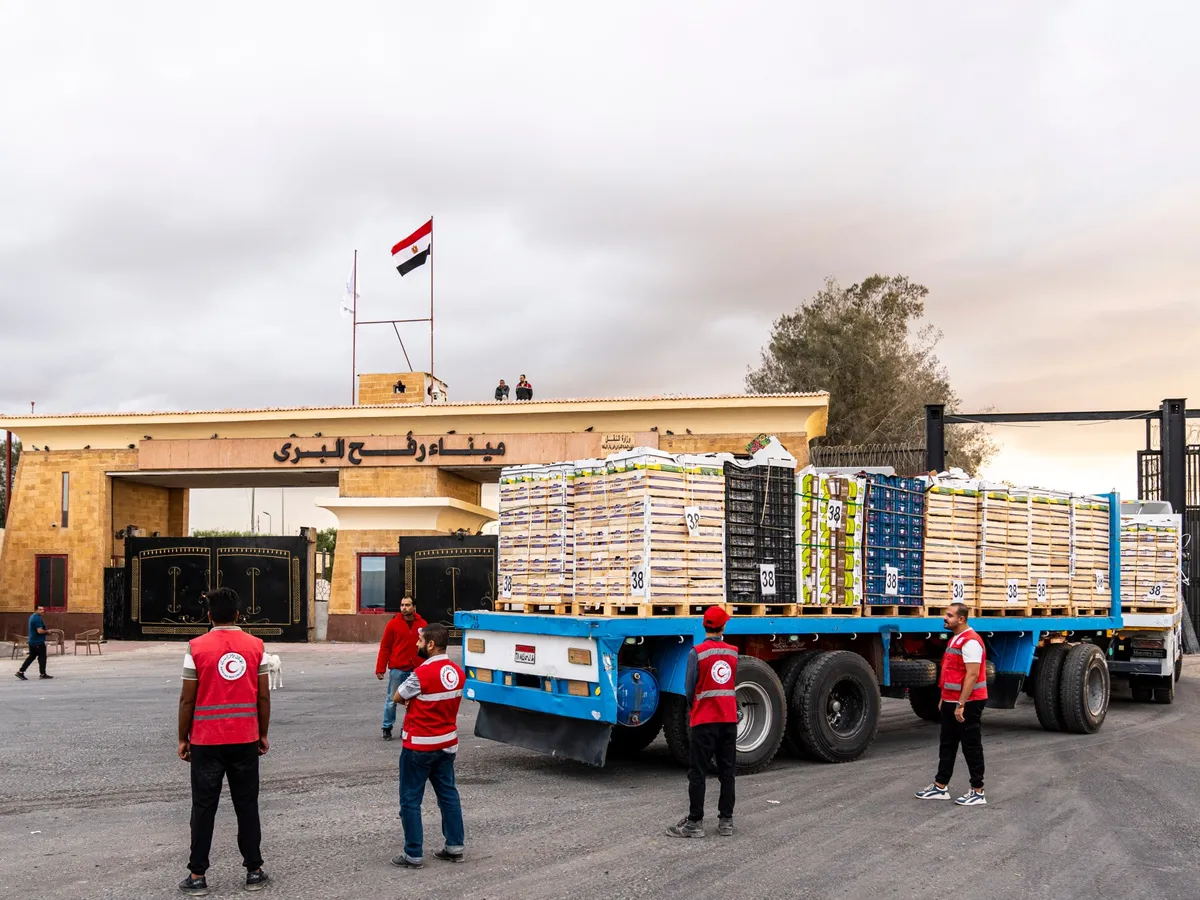
Among those Palestinians seeking an exit from a Gaza destroyed by Israel: severely ill children, a mother trying to reunite family with her husband, and a student with overseas academic aspirations.A truck carrying aid enters Gaza through the border crossing from Rafah, Egypt into Gaza [File: Ali Moustafa/Getty Image]Published On 27 Jan 2026Deir el-Balah and Khan Younis, Gaza – For the past two years, Khitam Hameed has clung to the hope of a single sliver of news that could fundamentally change the fate of her entire family.The reopening of the Rafah crossing, shut and controlled by Israel as part of its genocidal war on Gaza in spite of a ceasefire agreement, would allow her family to travel and reunite with her husband outside Gaza.Recommended Stories list of 4 itemslist 1 of 4Israel’s genocide wiped out over 2,700 families in Gazalist 2 of 4Investigation reveals Israeli campaign to flatten Gaza town of Beit Hanoonlist 3 of 4‘Yellow line’, the de facto Israeli buffer zone shaping life in Gazalist 4 of 4Gaza’s Rafah crossing to reopen when final Israeli body is returnedend of listBut for this family, the reopening is not just about freedom of movement. It represents both a chance for reunion after a long separation, and an opportunity to secure treatment for their son, whose life, schooling, and normal childhood have all been destroyed by the two-year war.With the United States pushing a deeply intransigent Israel to progress to phase two of the ceasefire that began on October 10, the reopening of the Rafah crossing was directly tied by the far-right government to the recovery of the remains of the final Israeli captive, and only partially for pedestrian use under strict military supervision.On Monday, the retrieval of the last Israeli captive’s body appeared to open that locked door, with thousands in urgent need of treatment or family reunification in a state of anxious anticipation.From her family’s displacement site in the Nuseirat refugee camp near Deir el-Balah in central Gaza, Khitam, 50, a mother of six, sits trying to organise her thoughts as news circulates about Rafah.Next to her is her 14-year-old son, Yousef, unable to walk, suffering from a rare genetic disorder called Ehlers-Danlos Syndrome (EDS), a painful condition primarily affecting his bone development, with potential cardiac complications.“Yousef has been undergoing treatment for this syndrome since he was very young … he has had around 16 surgeries,” Khitam tells Al Jazeera.“We got used to hospitals, but before the war, there was some monitoring and a little hope.”Since long before October 2023, the Rafah crossing between Gaza and Egypt has been a lifeline for Palestinians, not only as a natural exit and entry point, but also as a symbol of connection with the outside world.Before the war, the crossing was heavily used by patients seeking medical treatment, families visiting relatives abroad, and the movement of goods and supplies that helped ease Gaza’s economic pressure under Israeli blockade.Its closure, beginning in May 2024 after Israeli forces took control, marked a dramatic turning point in the humanitarian crisis.The shutdown affected not just the movement of people, but also significantly reduced the flow of medical aid and essential supplies, impacting thousands of patients waiting for treatment outside Gaza, including children and the wounded, amid a severe shortage of health services and medical equipment.‘Opening the crossing shouldn’t be a miracle’Before the war, Khitam and her family monitored Yousef’s condition regularly, and he could walk and move.But the war halted everything. Hospitals were routinely bombed by Israel, and most ceased functioning. Medics were killed by the hundreds, medications ran out, and medical checkups became nearly impossible.“Since the war, Yousef’s condition has deteriorated. His legs are weaker, walking is harder, he uses crutches,” Khitam pauses before continuing: “He falls often… and my heart is in my throat every time.”The mother no longer knows the full extent of her son’s health. “I don’t know if he has heart complications, or if his spine has worsened … we are living with him with no answers.”The war also separated the family. Weeks before the conflict erupted, Khitam’s 52-year-old husband, Hatim, had left Gaza for Egypt, as an initial step to secure a chance for the family to migrate and access advanced medical care for Yousef.“Since then, I’ve been alone. Six children, one with a special medical condition, war, displacement, hunger,” Khitam says, her voice exhausted.“Being displaced alone is so difficult. You don’t know where to go, how to protect your children, how to provide food or safety. The constant anxiety and fear have affected everyone, but Yousef suffers the most.”“No school, no play, no outings, no treatment … even psychologically, he is exhausted. A child his age should be living his life, not caught between war and illness.”But, she adds, “just the idea of travelling eases us a bit psychologically. It feels like a door might open” for treatment outside of the besieged enclave.She still fears how the crossing will operate, even as hope keeps her going.“Even if the crossing opens, not everyone can leave, and not every case will be approved,” she adds. “Opening the crossing shouldn’t be a miracle… it’s a right.”Yousef’s story intersects with those of hundreds of families of sick children in Gaza, for whom Rafah is not just a crossing, but a lifeline.‘The family started a new battle against time’Local estimates indicate that more than 22,000 patients and injured people, including about 5,200 children, are unable to travel for treatment due to the Israeli closure, with thousands more waiting for approved medical transfers that cannot be executed.Among them is Hur Qeshta, a newborn girl only 15 days old, born with a large, unusual tumour in her neck, affecting breathing and swallowing.She requires urgent surgery outside Gaza, according to doctors at Nasser Hospital in Khan Younis, in southern Gaza.Her mother, Doaa Qeshta, 32 and a mother of five, tells Al Jazeera, “From the first moment she was born, the family started a new battle against time to ensure she could urgently travel for treatment.”Hur was delivered via Caesarean section and now lies in the Nasser Hospital neonatal ICU, on oxygen and fed via a tube from her abdomen.“She can’t breastfeed, everything is through a tube, and the mass is growing rapidly … all within 15 days,” says her mother.Doctors confirmed that surgery inside Gaza is currently impossible due to a lack of facilities.Doaa links her daughter’s condition to the circumstances during her pregnancy, including displacement in a tent in al-Mawasi, exposure to nearby shelling, smoke, gunpowder, hunger, and lack of nutrition.“I was pregnant during famine … no food, no vitamins, no safety,” she recalls. “Shelling was nearby, 300 metres (980 feet) away… the tent shook; we thought we were dead.”“Opening the crossing means saving my daughter’s life,” she says. “I’ve registered the whole family as companions … the most important thing is Hur goes, gets treatment, and survives.”Of the reopening of the Rafah crossing, Doaa says, “We hear news and live on hope, but we are really in a limbo… we don’t know what’s happening or when. We just pray this is true.”‘Our lives and futures hang on a hope’The effects of Rafah’s closure go beyond medical access, affecting an entire generation of youth whose education has been halted at a closed gate.Among those affected is Rana Bana, a 20-year-old from the Daraj neighbourhood in Gaza City.She graduated from high school in 2023 with a 98 percent average in the science track, with a focus on pharmacy. Within a single year, she received multiple opportunities abroad, but none materialised due to Rafah’s closure.“In 2024, I was accepted for a scholarship in Egypt, ready to leave, but the crossing closed. A year later, I got a scholarship to Turkiye, did the online interviews, was accepted, and since then I’ve been stuck,” Rana tells Al Jazeera.
SRCAl Jazeera
LANGEN
LEANCenter
WORDS1 298
ENT7
TUE · 2026-01-27 · 04:58 GMTBRIEF NSR-2026-0127-10871
NSR-2026-0127-10871News Report·EN·Human Interest
Lives on hold for two years: Hope, fear stuck behind Gaza’s Rafah crossing
For two years, the Rafah crossing between Gaza and Egypt has remained largely closed due to the ongoing war with Israel, severely impacting the lives of Palestinians seeking to leave. The closure, despite a ceasefire agreement, has prevented people like Khitam Hameed from reuniting with her husband abroad and seeking medical treatment for her son Yousef, who suffers from a rare genetic disorder requiring specialized care.
Maram HumaidAl JazeeraFiled 2026-01-27 · 04:58 GMTLean · CenterRead · 6 min
Al JazeeraFIG 01
Reading time
6min
Word count
1 298words
Sources cited
2cited
Entities identified
7entities
Quality score
100%
§ 01
Briefing Summary
AI-generatedNEWSAR · AI
For two years, the Rafah crossing between Gaza and Egypt has remained largely closed due to the ongoing war with Israel, severely impacting the lives of Palestinians seeking to leave. The closure, despite a ceasefire agreement, has prevented people like Khitam Hameed from reuniting with her husband abroad and seeking medical treatment for her son Yousef, who suffers from a rare genetic disorder requiring specialized care. The reopening of the Rafah crossing was linked to the recovery of the remains of the final Israeli captive, creating a sense of anxious anticipation for thousands needing urgent medical care or family reunification. While the retrieval of the body has seemingly opened the door, access is expected to be limited and under strict military supervision. The situation leaves many Gazans in displacement camps, their lives on hold, hoping for a chance to leave and rebuild.
Confidence 0.90Sources 2Claims 5Entities 7
§ 02
Article analysis
Model · rule-basedFraming
Human Interest
Human Rights
Tone
Mixed Tone
AI-assessed
CalmNeutralAlarmist
Factuality
0.70 / 1.00
Factual
LowHigh
Sources cited
2
Limited
FewMany
§ 03
Key claims
5 extracted01
Khitam Hameed's son, Yousef, suffers from Ehlers-Danlos Syndrome (EDS).
factualArticle
Confidence
1.00
02
Since long before October 2023, the Rafah crossing between Gaza and Egypt has been a lifeline for Palestinians.
factualArticle
Confidence
0.90
03
Yousef has been undergoing treatment for this syndrome since he was very young … he has had around 16 surgeries.
quoteKhitam Hameed
Confidence
0.90
04
The reopening of the Rafah crossing was directly tied by the government to the recovery of the remains of the final Israeli captive.
factualArticle
Confidence
0.80
05
The Rafah crossing has been shut and controlled by Israel as part of its war on Gaza.
factualArticle
Confidence
0.80
§ 04
Full report
6 min read · 1 298 words§ 05
Entities
7 identifiedKey playerOppositionContextPositiveNeutralNegative
§ 06
Keywords & salience
8 termsrafah crossing
1.00
gaza
0.90
family reunification
0.80
medical treatment
0.70
ceasefire
0.60
ehlers-danlos syndrome
0.50
israeli captive
0.50
humanitarian aid
0.40
§ 07
Topic connections
Interactive graph No topic relationship data available yet. This graph will appear once topic relationships have been computed.