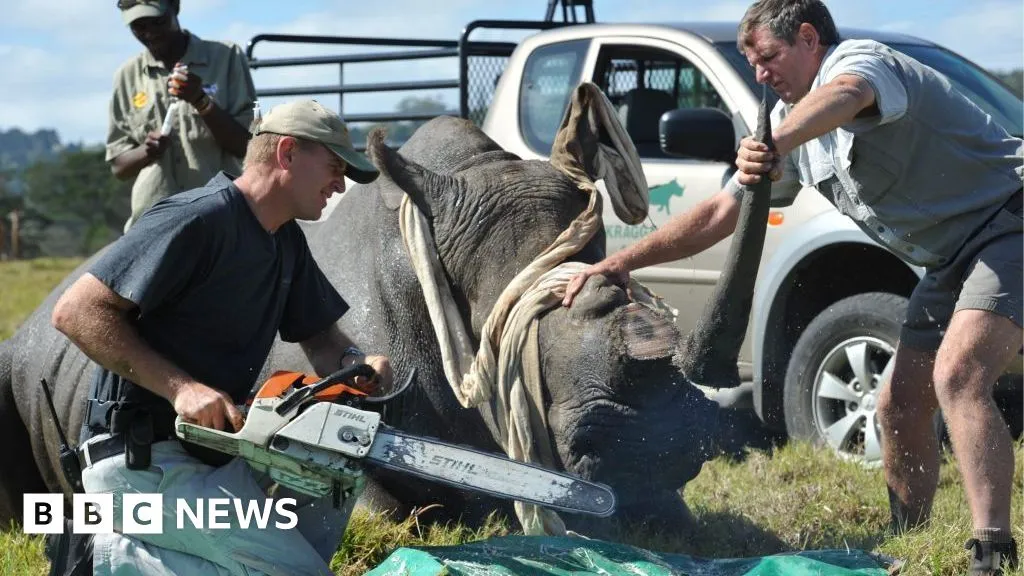
3 hours agoNavin Singh KhadkaEnvironment correspondent, BBC World ServiceGetty ImagesNamibia pioneered dehorning of rhinos to deal with their poaching Namibia's proposals to lift the ban on the international trade in black and white rhino horns have been rejected at a key conservation meeting.The result of the voting at the Convention on International Trade in Endangered Species of Wild Fauna and Flora (Cites) earlier this week was adopted by the conference on Thursday in Samarkand, Uzbekistan.Namibia had also proposed overturning the ban on African savanna elephant ivory - this too was defeated.Eyebrows were raised about the rhino horn trade proposals mainly because Namibia pioneered the practice of cutting the horns off rhinos in 1989 so they no longer have value for poachers. Dehorning was followed by other southern African countries, such as Zimbabwe, Eswatini and South Africa.Rhino horns are prized in traditional Asian medicine and are also status symbols in China, Vietnam, and some other south-east Asian countries.Namibia tabled two separate proposals - one for black rhinos and the other for southern white rhino.Both were resoundingly defeated, with only around 30 votes out of about 120 in favour.Cites regulations require a two-thirds majority for a proposal to be adopted.Getty ImagesBlack rhinos are listed as critically endangered speciesBlack rhinos are listed as a critically endangered species by the International Union for Conservation of Nature (IUCN). In 2023, there were only 6,421 alive - a decline of more than 90% since 1960, according to an IUCN report.The southern white rhinos are not in quite such danger - they are listed as near threatened, with a population of 15,752. But this is down 11% since 2023 and at its lowest point since the current rhino poaching crisis began nearly two decades ago.Cites banned the trade in the horns and other rhino parts in 1977 but their poaching continued with more than 8,000 lost in the last decade, according to Save the Rhino International.In Namibia, the number of rhinos poached was the highest on record in 2022, with 87 killed - almost twice as many as the year before, government data shows.Getty ImagesSome countries like India and Kenya destroy rhino horns stockpilesAlthough this was the first time that Namibia tabled the two proposals seeking the lifting of the ban on the rhino horn trade, the country has backed similar proposals by other southern African countries including South Africa, Eswatini and Zimbabwe in the past.Experts say the main reason these countries want the ban to be lifted is because of the huge stockpiles of rhino horns they have amassed over the years."Namibia and other pro-trade rhino range states have amassed large stockpiles of rhino horn they wish to trade," Taylor Tench, senior wildlife policy analyst with the Environmental Investigation Agency, told the BBC."Namibia's stockpiles are an estimated 6.45 tonnes of white rhino horn and an estimated 4.6 tonnes of black rhino horn. South Africa, on the other hand, likely has at least four times as much."The main reason why these countries have rapidly growing stockpiles of horns is believed to be the dehorning programme.The idea is that if a rhino does not have a horn, it is of no value to poachers and so won't be killed.The horn is removed above the growth plate, just like humans cut their nails, which means it is painless.But it also means that the horns grow back and need to be sawed off repeatedly.As a result their stockpiles are rapidly accumulating."The reason for not destroying the horn is speculative stockpiling, by both governments and private individuals," said Mr Tench."Some countries, like Kenya, destroy their rhino horn stockpiles, while others, like Namibia and South Africa, stockpile the horn in the hopes of cashing in if international trade is ever legalised."The governments of both countries have been approached for comment.Getty ImagesWildlife campaigners say legalising rhino horn trade will fuel demand and that will increase poaching Supporters of the rhino horn trade argue that it would generate revenues that could be used to support conservation efforts.Experts say many private rhino owners in Africa support legalisation because of the high cost of anti-poaching measures.But those opposing the idea of opening up the trade argue that it would stimulate demand that would lead to a significant increase in poaching.They say the legal trade in rhino horn - especially domestic markets in countries like China and Vietnam - was a primary driver of the rhino poaching crisis of the 1970s and 1980s.Rhino populations around the world remain at risk from poaching and the illegal trade continues.Between 2021 and 2023, there were more than 150 rhino horn seizures, with an estimated 1.8 tonnes of horn - the equivalent of 716 whole horns - recovered globally, according to a recent report by Traffic and the IUCN.South Africa accounted for 66% of the seizures by weight, with significant shipments destined for Malaysia and Vietnam, the report said.
SRCBBC News - World
LANGEN
LEANCenter
WORDS808
ENT3
FRI · 2025-12-05 · 14:24 GMTBRIEF NSR-2025-1205-1143
NSR-2025-1205-1143News Report·EN·Environmental
Namibia loses bid to overturn ban on rhino horn trade
At a Convention on International Trade in Endangered Species (CITES) meeting in Uzbekistan, Namibia's proposals to overturn the ban on international trade in black and white rhino horns were rejected. Namibia argued that lifting the ban, initially implemented in 1977, could help manage rhino populations, especially since they pioneered dehorning to deter poachers.
BBC News - WorldFiled 2025-12-05 · 14:24 GMTLean · CenterRead · 4 min
BBC News - WorldFIG 01
Reading time
4min
Word count
808words
Sources cited
1cited
Entities identified
3entities
Quality score
100%
§ 01
Briefing Summary
AI-generatedNEWSAR · AI
At a Convention on International Trade in Endangered Species (CITES) meeting in Uzbekistan, Namibia's proposals to overturn the ban on international trade in black and white rhino horns were rejected. Namibia argued that lifting the ban, initially implemented in 1977, could help manage rhino populations, especially since they pioneered dehorning to deter poachers. The proposals failed to gain the required two-thirds majority vote. Rhino horns are highly valued in traditional Asian medicine and as status symbols, fueling poaching that has decimated rhino populations. Despite dehorning efforts and Namibia's rising poaching numbers, concerns about endangering the critically endangered black rhino and near-threatened southern white rhino led to the rejection of the proposals.
Confidence 0.90Sources 1Claims 5Entities 3
§ 02
Article analysis
Model · rule-basedFraming
Environmental
Political Strategy
Tone
Measured
AI-assessed
CalmNeutralAlarmist
Factuality
0.80 / 1.00
Factual
LowHigh
Sources cited
1
Limited
FewMany
§ 03
Key claims
5 extracted01
In 2023, there were only 6,421 black rhinos alive.
statisticIUCN report
Confidence
1.00
02
Black rhinos are listed as a critically endangered species by the IUCN.
factual
Confidence
1.00
03
Namibia pioneered the practice of cutting the horns off rhinos in 1989.
factual
Confidence
1.00
04
Namibia's proposals to lift the ban on the international trade in black and white rhino horns have been rejected.
factual
Confidence
1.00
05
Namibia's stockpiles are an estimated 6.45 tonnes of white rhino horn and an estimated 4.6 tonnes of black rhino
statisticTaylor Tench, Environmental Investigation Agency
Confidence
0.90
§ 04
Full report
4 min read · 808 words§ 05
Entities
3 identifiedKey playerOppositionContextPositiveNeutralNegative
§ 06
Keywords & salience
10 termsrhino horn trade
1.00
poaching
0.80
namibia
0.80
cites
0.70
endangered species
0.60
dehorning
0.60
white rhino
0.50
black rhino
0.50
conservation
0.40
ivory trade
0.40
§ 07
Topic connections
Interactive graph Network visualization showing 5 related topics
View Full Graph Person Organization Location Event|Click node to navigate|Edge numbers = shared articles