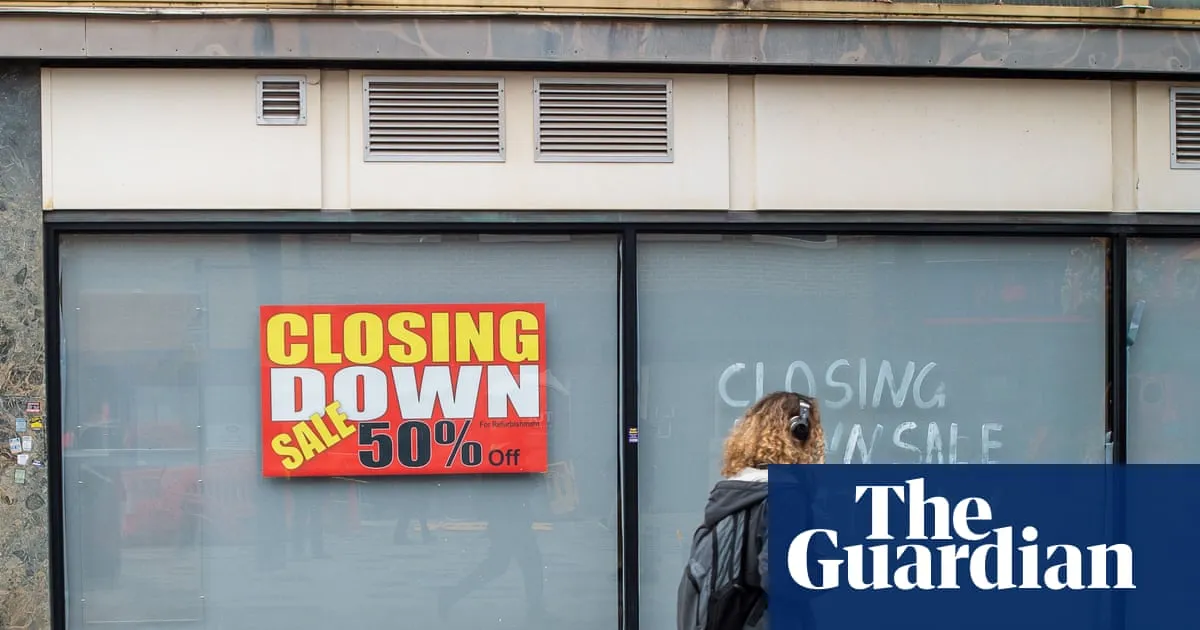
Up and down Britain there are boarded-up shops. Banks and department stores have been replaced by vape shops, barbers and bookmakers. Shoplifting is at a record high, local services cut, and public frustration is mounting.Politically, high street decline is perfect campaign fodder for Nigel Farage’s Reform UK.Research shows support for Reform is higher in places with the biggest rise in persistent high street vacancy rates. Across the UK in 2024 almost 13,000 shops – about 37 a day – pulled down their shutters for good. Closures have been most pronounced in the north of England, the Midlands and deprived coastal towns where Reform ran Labour closest at the general election.In-depth polling by YouGov and researchers at Faster Horses shows 62% of voters considering backing Reform think their local area is in decline. “It’s just soul destroying to watch your local area turn to shit,” one focus group participant told the researchers.For many, this decay reflects the country at large. Britain has “gone to the dogs”, with its best days in the past – despite the promises of successive Tory and Labour governments to turn things around. For millions, levelling up has not materialised. Why not give someone else a try?Analysis by the University of Warwick professor Thiemo Fetzer – whose previous research has linked austerity and Brexit – shows the places with the highest rates of shop closures in England and Wales are more likely to back rightwing populist parties.In total, retail accounts for 5% of the UK economy and less than a 10th of employment. But its visible position on the high street gives it outsize influence on public perception.“It has channelled people’s anger at the structural change around them. They don’t always personally perceive things to be negative for them. They say: ‘I’m doing fine.’ But they see and feel their community around them eroding. That for me is one of the main drivers of populism,” Fetzer said.“You almost have a non-linear tipping point where you cascade into oblivion. It happens in the UK; in Europe, in Germany, everywhere. And it is particularly concentrated in the midsize towns.”Some of the decline is self-inflicted. Almost half of Britons do not visit their high street or shopping area at least once a week. The top barriers people list are also self-reinforcing: not enough interesting shops, and too many empty ones.However, there are deeper reasons – reflecting the UK’s geography, consumer preferences, economics and policy choices.Over the past two decades the internet has transformed the high street. Online spending has rocketed from less than 3% of total retail sales in Great Britain in 2006 to more than 25%, in a shift accelerated by the Covid pandemic. Despite the dominance of US e-commerce companies such as Amazon and eBay, Britons are more likely to shop online than Americans, where long distances limit doorstep delivery.Retailers have suffered from weaker levels of consumer demand amid the cost of living crisis. Real wages flatlined in the 2010s, inflation hit a 40-year high, growth in living standards has slowed, and many consumers are prioritising spending on experiences over physical goods. Some experts believe Britain reached “peak stuff” years ago.Retailers also complain that elevated inflation, interest rates, tax increases, government regulations, and a rising minimum wage have made it harder to turn a profit. Rents and utility costs have also risen sharply.Bricks-and-mortar shops also have a disadvantage to online retail through the business rates system – a tax based on commercial property values. As is the case with other overheads, this makes a chain of high street shops more expensive than a warehouse on the outskirts of town.Labour promised to replace the business rates system in England before coming to power. But that has not happened. At the autumn budget, Rachel Reeves said she was introducing the “lowest tax rates since 1991” for the system. But hospitality businesses warn their bills are rising – putting high street pubs, cafes and restaurants at risk.Underinvestment in transport, policing, healthcare and social services has also contributed. Homelessness has risen and shoplifting offences have jumped – with an increase by 13% to more than half a million offences in the year to June 2025.Fetzer believes these factors and the rise of online shopping have fuelled social isolation and fear of others, further discouraging high street visits in a doom loop exploited by the far right.“People have lost their ability to speak to one another.”Some places buck the trend – typically where there is a higher concentration of independent retail, hospitality and tourism to lure in visitors. However, big cities and affluent areas find this easier to sustain – adding to the sense of Britain as an increasingly divided nation.Ministers highlight efforts to turn things around. Labour has announced £5bn of “Pride in Place” funding for communities to invest in local priorities, including buying community spaces and revamping high streets. The government has also established a taskforce to tackle dodgy high street stores and a licensing scheme so that only legitimate shops can legally sell tobacco and vapes.Still, the danger for Keir Starmer is the depth and complexity of the economic challenge facing the high street. Any turnaround before a make-or-break set of May local elections looks tough.
SRCThe Guardian - World News
LANGEN
LEANCenter-Left
WORDS866
ENT8
THU · 2026-01-29 · 10:45 GMTBRIEF NSR-2026-0129-11559
NSR-2026-0129-11559Analysis·EN·Economic Impact
Doom loop of decline: how struggling high streets fuel far-right sympathies in UK
A study shows a correlation between the decline of British high streets and increased support for right-wing populist parties like Reform UK. The research indicates that areas with high shop vacancy rates, particularly in the north of England, the Midlands, and deprived coastal towns, are more likely to support Reform.
Richard Partington Senior economics correspondentThe Guardian - World NewsFiled 2026-01-29 · 10:45 GMTLean · Center-LeftRead · 4 min
The Guardian - World NewsFIG 01
Reading time
4min
Word count
866words
Sources cited
3cited
Entities identified
8entities
Quality score
100%
§ 01
Briefing Summary
AI-generatedNEWSAR · AI
A study shows a correlation between the decline of British high streets and increased support for right-wing populist parties like Reform UK. The research indicates that areas with high shop vacancy rates, particularly in the north of England, the Midlands, and deprived coastal towns, are more likely to support Reform. Voters who perceive their local areas as declining are more inclined to back the party. The visible decay of high streets fuels public frustration and a sense that the country is deteriorating, despite promises of improvement. While retail accounts for a small portion of the economy, its prominent presence influences public perception and contributes to a feeling of community erosion, driving support for populist movements.
Confidence 0.90Sources 3Claims 5Entities 8
§ 02
Article analysis
Model · rule-basedFraming
Economic Impact
Political Strategy
Tone
Mixed Tone
AI-assessed
CalmNeutralAlarmist
Factuality
0.70 / 1.00
Factual
LowHigh
Sources cited
3
Well sourced
FewMany
§ 03
Key claims
5 extracted01
Online spending has rocketed from less than 3% of total retail sales in Great Britain in 2006 to more than 25%.
statisticArticle's own claim
Confidence
1.00
02
Across the UK in 2024 almost 13,000 shops – about 37 a day – pulled down their shutters for good.
statisticArticle's own claim
Confidence
1.00
03
62% of voters considering backing Reform think their local area is in decline.
statisticYouGov and Faster Horses
Confidence
0.90
04
Support for Reform UK is higher in places with the biggest rise in persistent high street vacancy rates.
factualResearch
Confidence
0.90
05
The places with the highest rates of shop closures in England and Wales are more likely to back rightwing populist parties.
factualThiemo Fetzer, University of Warwick
Confidence
0.80
§ 04
Full report
4 min read · 866 words§ 05
Entities
8 identifiedKey playerOppositionContextPositiveNeutralNegative
Organizations4
§ 06
Keywords & salience
10 termshigh street decline
1.00
far-right sympathies
0.90
populism
0.70
shop closures
0.70
reform uk
0.60
local area decline
0.60
public frustration
0.50
economic decline
0.50
uk economy
0.40
voter sentiment
0.40
§ 07
Topic connections
Interactive graph No topic relationship data available yet. This graph will appear once topic relationships have been computed.