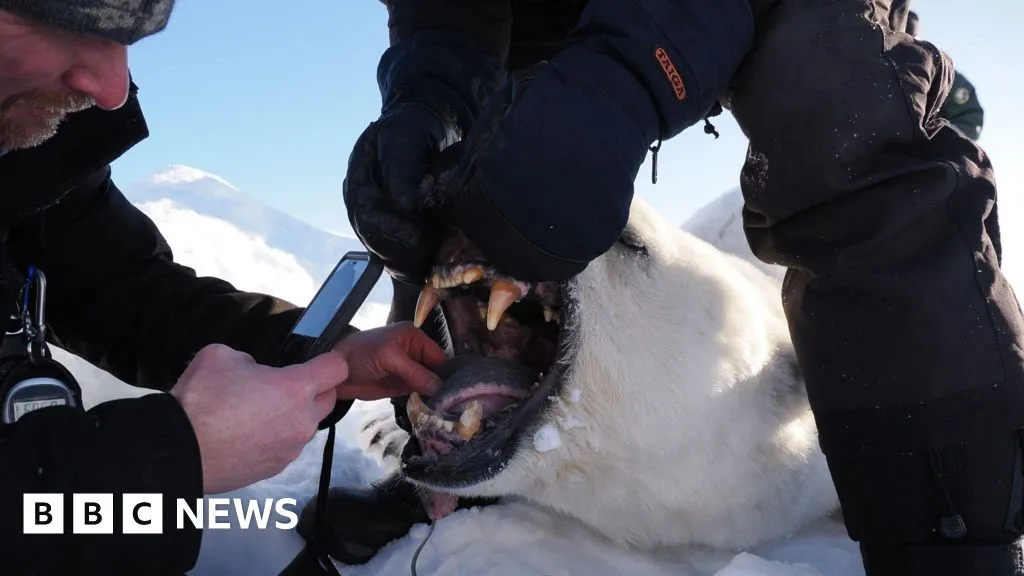
Polar bears on Norwegian islands fatter and healthier despite ice loss, scientists say3 hours agoVictoria GillScience correspondent Watch: The BBC's Victoria Gill looks at why are these Norwegian polar bears getting fatterScientists expected the opposite, but polar bears in the Norwegian Arctic archipelago of Svalbard have become fatter and healthier since the early 1990s, all while sea ice has steadily declined due to climate change.Polar bears rely on sea ice as a platform from which to hunt the seals that they rely on for blubber-rich meals. The bears' fat reserves provide energy and insulation and allow mothers to produce rich milk for cubs.Researchers weighed and measured 770 adults in Svalbard between 1992 and 2019 and found that bears had become significantly fatter.They think that Svalbard bears have adapted to recent ice loss by eating more land-based prey, including reindeer and walruses.Jon Aars/Norwegian Polar InstituteResearchers weighed, measured and assessed the body condition of 770 polar bearsWatch: Where the Polar Bears Wait on BBC Iplayer Trouble in Arctic town as polar bears and people face a warming worldDuring the same period that this research was carried out, global temperature rise has increased the number of ice-free days per year in the region by almost 100 - at a rate of about four days each year. "The fatter a bear is the better it is," explained lead researcher Dr Jon Aars from the Norwegian Polar Institute. "And I would have expected to see a decline in body condition when the loss of sea ice has been so profound."Trine Lise Sviggum Helgerud/Norwegian Polar InstituteWalruses have been officially protected in Norway since the 1950s, after they were hunted to near extinction. That protection has boosted their numbers, and apparently provided a new source of fatty food for polar bears."There are a lot more walruses around [for them to hunt] these days," said Aars. "It is also possible that they are able to hunt seals more efficiently." He explained that, if seals have smaller areas of sea ice available to them, they will congregate in those smaller areas, presenting easier collective pickings for bears.Jon Aars/Norwegian Polar InstituteOther recent research on Svalbard bears showed that more ice-free days reduced survival in cubsWhile this is unexpected good news for these Arctic predators, the researchers think it is unlikely to last. As the sea ice continues to decline, bears will have to travel further to access hunting grounds, using more energy and depleting precious fat reserves.The charity Polar Bears International points out that Svalbard's polar bears were some of the most heavily-hunted in the world, until international protections were introduced in the 1970s. Experts think the new findings could be linked to the population recovering from that hunting pressure. That, combined with an increase in the number of walruses - and of reindeer - in recent decades, appears to have provided the bears with a temporary boost. Victoria Gill/BBC NewsElsewhere in the Arctic, the decline in sea ice is bringing bears closer to human communities as they search for food. Dr John Whiteman, chief research scientist at PBI said the results were "positive in the short term"."But body condition is only one piece of the puzzle. Other recent research on these bears found that more ice-free days reduced survival in cubs and in subadult and old females."Elsewhere in the Arctic, climate change is having a very different effect on polar bears. There are 20 known sub-populations of polar bears across the Arctic. In Canada's Western Hudson Bay, where the most southerly and best studied bears live, a decline in the population has been directly linked to warming temperatures.Whiteman added that that the long-term picture for polar bears was clear - they need sea ice to survive. "Ice loss ultimately means bear declines, but [this study shows] that the short-term picture can be very region-specific.""In the long term," he told BBC News, "if ice loss continues unchecked, we know the bears will eventually disappear."
SRCBBC News - World
LANGEN
LEANCenter
WORDS654
ENT4
THU · 2026-01-29 · 16:00 GMTBRIEF NSR-2026-0129-11719
NSR-2026-0129-11719News Report·EN·Environmental
Polar bears on Norwegian islands fatter and healthier despite ice loss, scientists say
A study of polar bears in Svalbard, a Norwegian archipelago, revealed that they have become fatter and healthier between 1992 and 2019, despite a significant decline in sea ice due to climate change. Researchers from the Norwegian Polar Institute weighed and measured 770 adult bears, finding a significant increase in their body fat.
BBC News - WorldFiled 2026-01-29 · 16:00 GMTLean · CenterRead · 3 min
BBC News - WorldFIG 01
Reading time
3min
Word count
654words
Sources cited
2cited
Entities identified
4entities
Quality score
100%
§ 01
Briefing Summary
AI-generatedNEWSAR · AI
A study of polar bears in Svalbard, a Norwegian archipelago, revealed that they have become fatter and healthier between 1992 and 2019, despite a significant decline in sea ice due to climate change. Researchers from the Norwegian Polar Institute weighed and measured 770 adult bears, finding a significant increase in their body fat. This unexpected outcome is attributed to the bears adapting to ice loss by hunting more land-based prey, such as reindeer and a growing population of walruses, which have been protected in Norway since the 1950s. While increased ice-free days have negatively impacted cub survival, the adult bears have seemingly benefited from new food sources and potentially more efficient seal hunting due to concentrated populations. However, researchers caution that this positive trend is unlikely to continue as sea ice continues to diminish, forcing bears to travel farther for food.
Confidence 0.90Sources 2Claims 5Entities 4
§ 02
Article analysis
Model · rule-basedFraming
Environmental
Human Interest
Tone
Measured
AI-assessed
CalmNeutralAlarmist
Factuality
0.80 / 1.00
Factual
LowHigh
Sources cited
2
Limited
FewMany
§ 03
Key claims
5 extracted01
Walruses have been officially protected in Norway since the 1950s.
factual
Confidence
1.00
02
The fatter a bear is the better it is.
quoteDr Jon Aars
Confidence
1.00
03
Global temperature rise has increased the number of ice-free days per year in the region by almost 100.
statistic
Confidence
1.00
04
Researchers weighed and measured 770 adults in Svalbard between 1992 and 2019.
factualResearchers
Confidence
1.00
05
Polar bears in Svalbard have become fatter and healthier since the early 1990s.
factualScientists
Confidence
0.90
§ 04
Full report
3 min read · 654 words§ 05
Entities
4 identifiedKey playerOppositionContextPositiveNeutralNegative
Organizations1
§ 06
Keywords & salience
9 termspolar bears
1.00
sea ice loss
0.90
svalbard
0.80
climate change
0.70
body condition
0.60
walruses
0.50
hunting
0.50
reindeer
0.40
arctic
0.40
§ 07
Topic connections
Interactive graph Network visualization showing 9 related topics
View Full Graph Person Organization Location Event|Click node to navigate|Edge numbers = shared articles