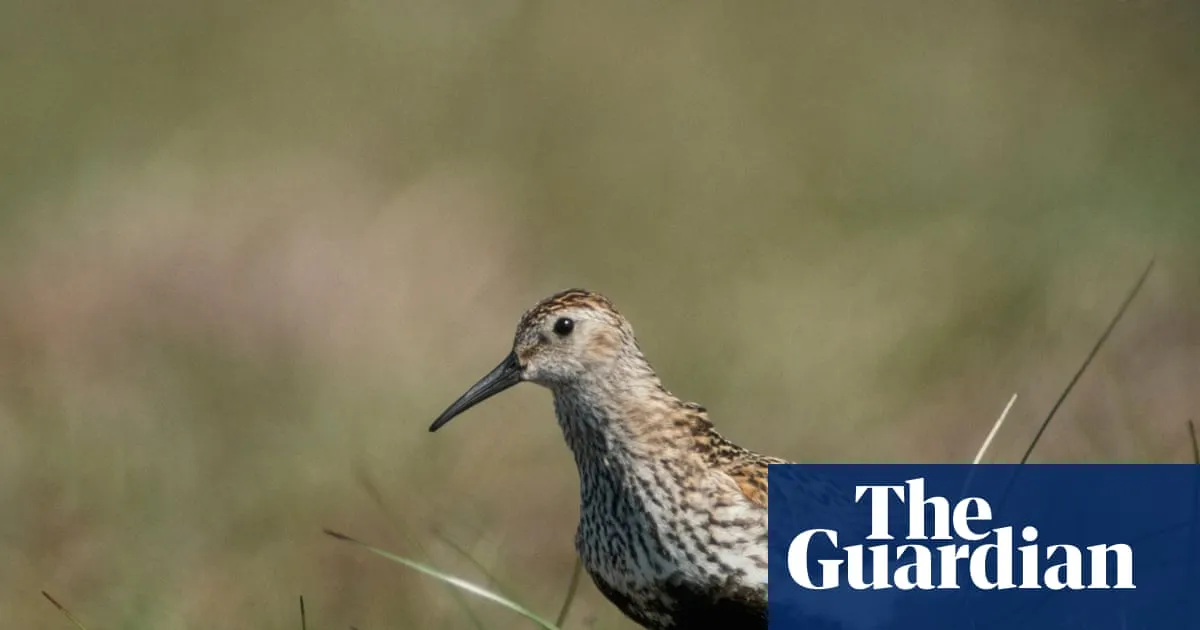
Deep in the Cumbrian Pennines, walkers might be lucky enough to spot small birds with spindly legs, long beaks and bodies like feathered balls hopping through the peat bogs.These are endangered dunlins – at risk in England because their favoured soggy landscapes are drained and burned for farming and grouse shooting.These birds fly an astonishing distance to breed in the far reaches of the heather moorlands in Cumbria, travelling thousands of miles to and from West Africa.But a new collaboration between conservationists and landowners has resulted in the breeding success of the wading birds. A team from bird conservation charity the RSPB used drones to survey the hard-to-reach areas of the Pennines in the first survey of its kind, which was funded by Natural England.They were delighted to find tiny chicks, including on the High Helbeck estate where the landowners have been creating habitat for the birds to thrive in. The estate managers have created 79 hectares of peatland restoration and 25 new wader “scrapes”, which are the shallow pools the birds pick through to find food.In one video, which particularly charmed the conservationists, chicks were seen feeding in a newly-created bog pool.Dunlins have declined by at least 20% globally since the early 2000s and the IUCN Red List now classify the species globally as near threatened. In the UK, the species is now red-listed, meaning it is one of the country’s rarest birds.Conservationists have long been raising the alarm over declining UK wader populations, pointing to the climate crisis and degraded habitats as key threats.Kath Milnes, higher officer for Natural England in Cumbria, said: “This fantastic work across the Cumbrian Pennines clearly demonstrates how investing in nature delivers multiple benefits for everyone. By working with landowners and conservation partners to restore and re-wet peatlands, we’re creating the right conditions for species like dunlin to thrive.”Out of 14 locations the conservationists surveyed, the birds were found in eight of them, and their presence corresponded with how high-quality the habitat was.Nicolete Blackett-Ord, joint landowner High Helbeck, said: “It has been extremely rewarding to take part in this project. We’ve learnt such a lot about this threatened species’ distribution and habitat needs.“To confirm breeding at High Helbeck is particularly special because we have worked with the RSPB and partners for several years, improving habitat, to enable wading birds to thrive.”
SRCThe Guardian - World News
LANGEN
LEANCenter-Left
WORDS388
ENT5
TUE · 2026-02-03 · 15:32 GMTBRIEF NSR-2026-0203-13027
NSR-2026-0203-13027News Report·EN·Environmental
Pennines delight as drone survey offers hope for one of UK’s rarest birds
A team from the RSPB used drones to survey the Cumbrian Pennines, a region of England known for its peat bogs and habitats of the endangered dunlin bird. The survey, funded by Natural England, found tiny chicks in hard-to-reach areas, including on the High Helbeck estate where landowners had created habitat for the birds.
Helena Horton Environment reporterThe Guardian - World NewsFiled 2026-02-03 · 15:32 GMTLean · Center-LeftRead · 2 min
The Guardian - World NewsFIG 01
Reading time
2min
Word count
388words
Sources cited
4cited
Entities identified
5entities
Quality score
75%
§ 01
Briefing Summary
AI-generatedNEWSAR · AI
A team from the RSPB used drones to survey the Cumbrian Pennines, a region of England known for its peat bogs and habitats of the endangered dunlin bird. The survey, funded by Natural England, found tiny chicks in hard-to-reach areas, including on the High Helbeck estate where landowners had created habitat for the birds. The estate managers restored 79 hectares of peatland and created 25 new wader "scrapes", shallow pools where the birds pick through to find food. Dunlins have declined globally by at least 20% since the early 2000s, with the UK species now classified as red-listed due to habitat loss and climate change. The survey found that high-quality habitats corresponded with the presence of dunlin chicks. This project demonstrates how investing in nature can deliver benefits for everyone, according to Natural England officials.
Confidence 0.90Sources 4Claims 5Entities 5
§ 02
Article analysis
Model · rule-basedFraming
Environmental
Human Interest
Tone
Measured
AI-assessed
CalmNeutralAlarmist
Factuality
0.80 / 1.00
Factual
LowHigh
Sources cited
4
Well sourced
FewMany
§ 03
Key claims
5 extracted01
Out of 14 locations surveyed, dunlins were found in eight of them.
factualArticle
Confidence
1.00
02
Dunlins have declined by at least 20% globally since the early 2000s.
statisticArticle
Confidence
1.00
03
A team from the RSPB used drones to survey the Pennines, funded by Natural England.
factualArticle
Confidence
1.00
04
By working with landowners and conservation partners to restore and re-wet peatlands, we’re creating the right conditions for species like dunlin to thrive.
quoteKath Milnes, Natural England
Confidence
0.90
05
Endangered dunlins are at risk in England because their landscapes are drained and burned for farming and grouse shooting.
factualArticle
Confidence
0.90
§ 04
Full report
2 min read · 388 words§ 05
Entities
5 identifiedKey playerOppositionContextPositiveNeutralNegative
Organizations1