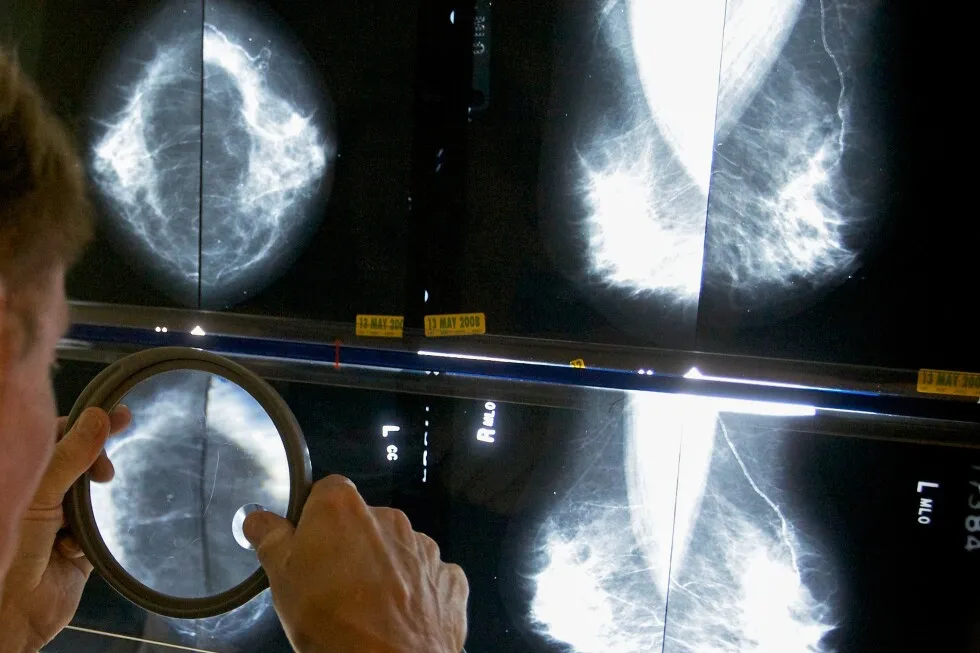
A radiologist uses a magnifying glass to check mammograms for breast cancer in Los Angeles, May 6, 2010. (AP Photo/Damian Dovarganes, File) Updated [hour]:[minute] [AMPM] [timezone], [monthFull] [day], [year] NEW YORK (AP) — During the early years of the COVID-19 pandemic, experts worried that disruptions to cancer diagnosis and treatment would cost lives. A new study suggests they were right.The federally funded study published Thursday by the medical journal JAMA Oncology is being called the first to assess the effects of pandemic-related disruptions on the short-term survival of cancer patients.Researchers found that people diagnosed with cancer in 2020 and 2021 had worse short-term survival than those diagnosed between 2015 and 2019. That was true across a range of cancers, and whether they were diagnosed at a late or early stage.Of course, COVID-19 itself was especially dangerous to patients already weakened by cancer, but the researchers worked to filter out deaths mainly attributed to the coronavirus, so they could see if other factors played a role. The researchers were not able to definitively show what drove worse survival, said Todd Burus of the University of Kentucky, the study’s lead author.“But disruptions to the health care system were probably a key contributor,” said Burus, who specializes in medical data analysis. COVID-19 forced many people to postpone cancer screenings — colonoscopies, mammograms and lung scans — as the coronavirus overwhelmed doctors and hospitals, especially in 2020.Earlier research had shown that overall cancer death rates in the U.S. continued to decline throughout the pandemic, and there weren’t huge shifts in late diagnoses. Recinda Sherman, a researcher on that earlier paper, applauded the new work.“As this study is the first to document pandemic-related, cause-specific survival, I think it is important,” said Sherman, of the North American Association of Central Cancer Registries. “The more we understand about the impact of COVID-19, the better we will be able to prepare for the next one.” How could overall cancer death rates decline in 2020 and 2021, while short-term survival worsen for newly diagnosed patients?Cancer prevention, diagnosis and treatment measures that for years had been pushing cancer death rates down did not suddenly disappear during the pandemic, Burus noted.“We didn’t forget how to do those things,” he said. “But disruptions could have changed access, could have changed how quickly people were getting treated.”Further research will show if any impact was lasting, said Hyuna Sung, senior principal scientist and cancer epidemiologist at the American Cancer Society.“Transient declines in survival that quickly recover may have little impact on long-term mortality trends,” she said.The new study tapped national cancer registry data to focus more specifically on patients who had a first diagnosis of a malignant cancer in 2020 and 2021. More than 1 million people were diagnosed with cancer in those two years, and about 144,000 died within one year, according to the researchers’ data.The researchers looked at one-year survival rates for those patients, checking for what stage they were at the time of diagnosis. They calculated that one-year survival was lower for both early- and late-stage diagnoses, for all cancer sites combined. Most worrisome were large differences seen in colorectal, prostate and pancreatic cancers, they said.Overall, the researchers found that more than 96% of people who got an early-stage cancer diagnosis in 2020 and 2021 — and more than 74% of those with a late-stage diagnosis — survived more than a year. Those rates were slightly lower than would have been expected based on 2015-2019 trends, resulting in about 17,400 more deaths than expected.The Associated Press Health and Science Department receives support from the Howard Hughes Medical Institute’s Department of Science Education and the Robert Wood Johnson Foundation. The AP is solely responsible for all content. Stobbe mainly covers public health for The Associated Press.
SRCAssociated Press (AP)
LANGEN
LEANCenter
WORDS624
ENT4
THU · 2026-02-05 · 17:53 GMTBRIEF NSR-2026-0205-13673
NSR-2026-0205-13673News Report·EN·Public Health
Pandemic disruptions to health care worsened cancer survival, study suggests
A federally funded study published in JAMA Oncology found that cancer patients diagnosed during 2020 and 2021 had worse short-term survival rates compared to those diagnosed between 2015 and 2019. The study, conducted by researchers at the University of Kentucky, accounted for COVID-19 deaths to isolate other contributing factors.
By
MIKE STOBBEAssociated Press (AP)Filed 2026-02-05 · 17:53 GMTLean · CenterRead · 3 min
Associated Press (AP)FIG 01
Reading time
3min
Word count
624words
Sources cited
4cited
Entities identified
4entities
Quality score
100%
§ 01
Briefing Summary
AI-generatedNEWSAR · AI
A federally funded study published in JAMA Oncology found that cancer patients diagnosed during 2020 and 2021 had worse short-term survival rates compared to those diagnosed between 2015 and 2019. The study, conducted by researchers at the University of Kentucky, accounted for COVID-19 deaths to isolate other contributing factors. While the exact causes remain unclear, researchers suggest disruptions to healthcare systems, including postponed screenings like mammograms and colonoscopies, likely played a significant role. The findings highlight the pandemic's impact on cancer care, even as overall cancer death rates continued to decline. Experts emphasize the importance of understanding these effects to better prepare for future health crises.
Confidence 0.90Sources 4Claims 10Entities 4
§ 02
Article analysis
Model · rule-basedFraming
Public Health
Tone
Measured
AI-assessed
CalmNeutralAlarmist
Factuality
0.80 / 1.00
Factual
LowHigh
Sources cited
4
Well sourced
FewMany
§ 03
Key claims
10 extracted01
Overall cancer death rates in the U.S. continued to decline throughout the pandemic.
factualEarlier research
Confidence
1.00
02
People diagnosed with cancer in 2020 and 2021 had worse short-term survival than those diagnosed between 2015 and 2019.
factualResearchers
Confidence
1.00
03
More than 1 million people were diagnosed with cancer in 2020 and 2021.
statisticThe article itself, based on the study
Confidence
1.00
04
Overall cancer death rates in the U.S. continued to decline throughout the pandemic.
factualEarlier research
Confidence
1.00
05
People diagnosed with cancer in 2020 and 2021 had worse short-term survival than those diagnosed between 2015 and 2019.
factualResearchers
Confidence
1.00
06
COVID-19 forced many people to postpone cancer screenings.
factualArticle
Confidence
0.90
07
The study is the first to document pandemic-related, cause-specific survival.
quoteRecinda Sherman, of the North American Association of Central Cancer Registries
Confidence
0.90
08
Transient declines in survival that quickly recover may have little impact on long-term mortality trends.
quoteHyuna Sung, American Cancer Society
Confidence
0.80
09
Disruptions to the health care system were probably a key contributor to worse cancer survival.
quoteTodd Burus of the University of Kentucky
Confidence
0.70
10
Disruptions to the health care system were probably a key contributor to worse cancer survival.
quoteTodd Burus of the University of Kentucky
Confidence
0.70
§ 04
Full report
3 min read · 624 words§ 05
Entities
4 identifiedKey playerOppositionContextPositiveNeutralNegative
Organizations1
§ 06
Keywords & salience
8 termscancer survival
0.90
covid-19 pandemic
0.80
healthcare disruptions
0.70
short-term survival
0.60
cancer diagnosis
0.60
cancer treatment
0.60
cancer screenings
0.50
death rates
0.40
§ 07
Topic connections
Interactive graph Network visualization showing 28 related topics
View Full Graph Person Organization Location Event|Click node to navigate|Edge numbers = shared articles