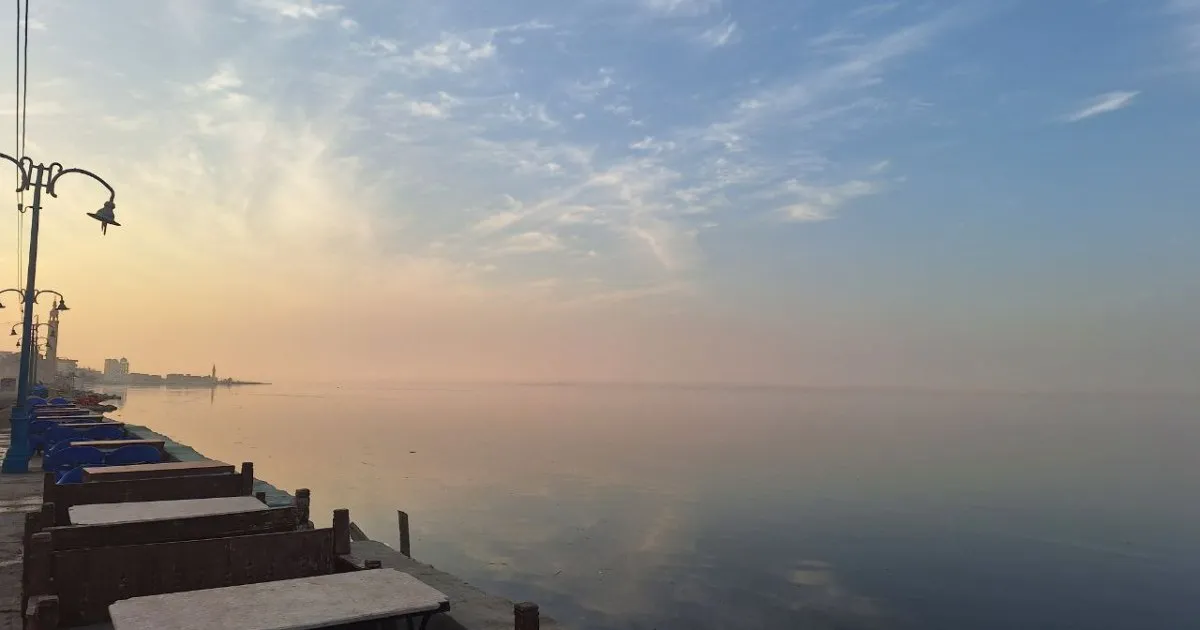
The Egyptian government believes that it should be given credit for its work to clean up the country's lakes.El-Raghy said the Lake Qarun project began in 2018 and has run for about six years, aiming to limit deterioration and restore the lake’s natural capacity to support aquatic life. Phase one included dredging the Bahr Youssef canal – which carries Nile water to Fayoum agriculture before discharging into Qarun – to ensure unobstructed flow and maintain suitable lake levels.The project also incorporates sewage infrastructure, including eight sewage treatment stations for villages around the lake, as well as rehabilitation of a treatment plant at the previously mentioned Kom Oshim complex, with a capacity of 19,000 cubic metres per day.Funding, el-Raghy said, includes a 300 million euro ($361.2m) loan from the European Bank for Reconstruction and Development and 100 million euros ($120.4m) from various government bodies within the restoration committee.He identified industrial discharge and sewage as the main sources of pollution, saying the Kom Oshim industrial complex had previously discharged waste into a treatment plant not designed to handle industrial effluent.The Ministry of Environment, he said, worked with 13 factories to cut pollution loads by half, and the upgrade of the main Kom Oshim treatment plant is now 65 percent complete, with full operation - which would end the discharge of untreated waste into the lake - expected in the second half of 2026.As part of restoring ecological balance, the government cleanup project has introduced new fish stocks, including mother sole fish in 2022 and shrimp fry during the 2024–2025 seasons.El-Raghy said the isotope parasite that had been one of the main reasons for the drop in fish numbers cannot be eradicated, and that the current strategy is to prevent its hosts from returning. “Mullet and tilapia will not be reintroduced,” he said, referring to two fish that are hosts to the parasite. But, he added, “shrimp production increased, and sole reproduced inside the lake. This is a strong indicator of improvement.”In late 2024, the Ministry of Environment announced the reopening of Lake Qarun to fishing after years of partial or full closure.But, as the lack of activity testifies, the issues that put a stop to fishing here have not been fully resolved, even if the sight of flamingoes has led outsiders to be optimistic.If anything, the debate over flamingos remains secondary to daily survival. People here are still waiting for the lake restoration to mean clean water, living fish, and the provision of livelihoods with which they can again sustain their families.El-Raghy asked for patience, saying that fishermen needed "time to adapt", as "the composition of fish stocks and ... fishing techniques are changing".But for the fishermen of Lake Qarun, patience is a luxury they do not have.Yasser Eid is one of them. Like most men here, fishing has shaped Yasser’s life since childhood. Now about 40 years old, he said he first went out on the lake at the age of seven, dropping out of school at a time when fishing promised steady income and a future for entire families.Sitting on the shore of Lake Qarun in Shakshouk with his father and a friend, Yasser looked out at the water wistfully.The promise of a good livelihood from fishing has now collapsed. Fish stocks are gone, and the small catches available do not support a living.Several of Yasser’s brothers and two of his children now work far away, hundreds of kilometres south at Lake Nasser in Aswan, one of the few places where fishing remains viable.Those who stayed behind, he added, are struggling under mounting financial pressure, waiting for a recovery that has yet to materialise.“There are no fish,” Yasser said quietly, gesturing towards the lake. “The lake is still dead.”
SRCAl Jazeera
LANGEN
LEANCenter
WORDS619
ENT2
SAT · 2026-02-07 · 06:49 GMTBRIEF NSR-2026-0207-14137
NSR-2026-0207-14137News Report·EN·Environmental
Vanishing wildlife at Egypt’s Lake Qarun force fishermen to abandon trade
Lake Qarun in Egypt is experiencing a decline in wildlife, forcing fishermen to abandon their trade despite government efforts to revitalize the lake. Since 2018, the Egyptian government has been working on a project to restore the lake's ecosystem, funded by loans and government bodies, addressing pollution from industrial discharge and sewage through infrastructure upgrades like sewage treatment stations and the Kom Oshim treatment plant.
By Ahmed DahabyAl JazeeraFiled 2026-02-07 · 06:49 GMTLean · CenterRead · 3 min
Al JazeeraFIG 01
Reading time
3min
Word count
619words
Sources cited
1cited
Entities identified
2entities
Quality score
100%
§ 01
Briefing Summary
AI-generatedNEWSAR · AI
Lake Qarun in Egypt is experiencing a decline in wildlife, forcing fishermen to abandon their trade despite government efforts to revitalize the lake. Since 2018, the Egyptian government has been working on a project to restore the lake's ecosystem, funded by loans and government bodies, addressing pollution from industrial discharge and sewage through infrastructure upgrades like sewage treatment stations and the Kom Oshim treatment plant. While the government has introduced new fish stocks like mother sole and shrimp, it acknowledges the persistence of a parasite that decimated previous fish populations, leading to a ban on mullet and tilapia. Despite the reopening of the lake to fishing in late 2024, the underlying issues persist, impacting the livelihoods of local fishermen.
Confidence 0.90Sources 1Claims 5Entities 2
§ 02
Article analysis
Model · rule-basedFraming
Environmental
Economic Impact
Tone
Measured
AI-assessed
CalmNeutralAlarmist
Factuality
0.70 / 1.00
Factual
LowHigh
Sources cited
1
Limited
FewMany
§ 03
Key claims
5 extracted01
Mullet and tilapia will not be reintroduced to the lake.
factualEl-Raghy
Confidence
1.00
02
The upgrade of the Kom Oshim treatment plant is now 65 percent complete.
factualEl-Raghy
Confidence
1.00
03
Funding includes a 300 million euro loan from the EBRD.
factualEl-Raghy
Confidence
1.00
04
Lake Qarun project began in 2018 and has run for about six years.
factualEl-Raghy
Confidence
1.00
05
Full operation of the Kom Oshim plant is expected in the second half of 2026.
predictionEl-Raghy
Confidence
0.90
§ 04
Full report
3 min read · 619 words§ 05
Entities
2 identifiedKey playerOppositionContextPositiveNeutralNegative
Organizations1
Locations1
§ 06
Keywords & salience
9 termslake qarun
1.00
water pollution
0.80
fish stocks
0.70
sewage treatment
0.60
ecological balance
0.60
industrial discharge
0.50
fishing industry
0.50
environmental restoration
0.40
wildlife conservation
0.40
§ 07
Topic connections
Interactive graph Network visualization showing 51 related topics
View Full Graph Person Organization Location Event|Click node to navigate|Edge numbers = shared articles