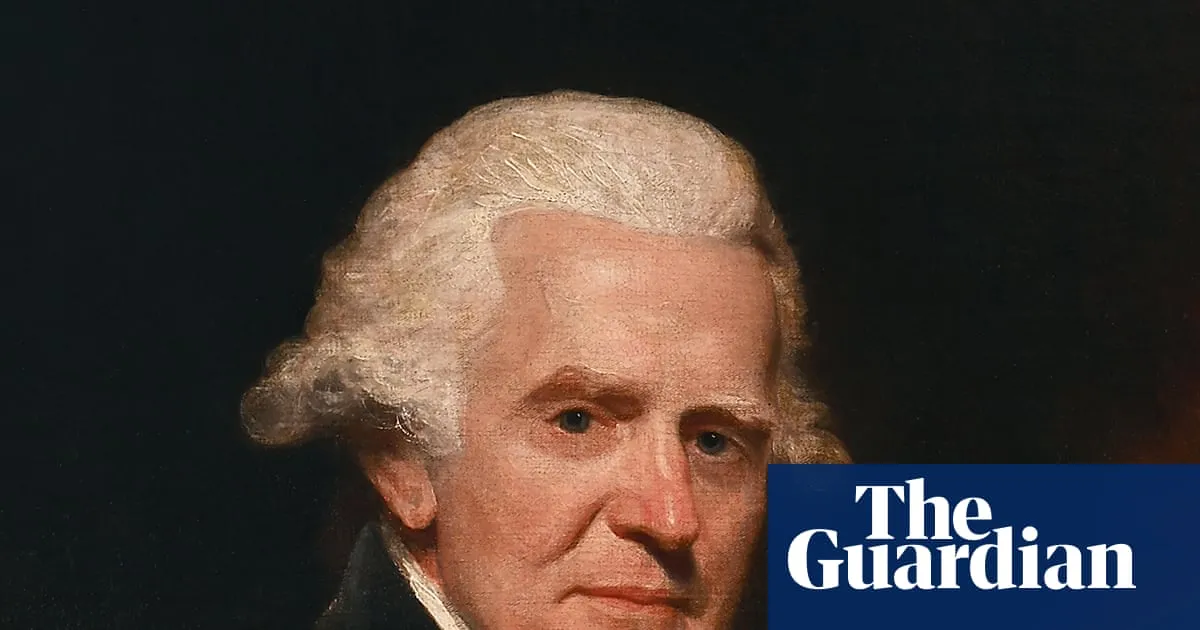
Thirty years ago, a painting by the British artist Sir William Beechey was sold as “portrait of a man”.The anonymous buyer, however, knew precisely who the unnamed man in the picture was: Pascal Paoli, the 18th-century Corsican independence leader and icon of the Enlightenment.Since that sale in April 1994, the Beechey portrait of the man credited with giving his Mediterranean island a modern written constitution – one that would later inspire American revolutionaries – has been held by a private collector on the Mediterranean island, unseen by the public.It is now up for auction once again, this time correctly titled, in Corsica on the 300th anniversary of Paoli’s birth.“There are a few portraits of Paoli in museums but this one is in my view the most important,” the auctioneer Vincent Bronzini de Caraffa told the Guardian.He said the painting was “far more than a work of art” and “touches on the identity of our island and the ideal of European freedom”, showing a figure who in his lifetime was admired by the philosopher Jean-Jacques Rousseau, the writer Samuel Johnson and was a hero to a young Napoleon Bonaparte.“I’m from an old Corsican family and I feel invested in a duty to respect the cultural and memorial significance of this work of art,” De Caraffa added. “It is being sold in Corsica so it can be seen by Corsicans before it perhaps leaves the island.”Paoli, who Corsicans nicknamed U Babbu di a Patria (Father of the fatherland), has been largely forgotten outside his homeland, which at the time of his birth was under Genoese rule. As the island’s elected leader between 1755 and 1769, he declared Corsica an independent republic, founded a university, introduced a system of representative democracy and wrote a constitution that drew heavily on Enlightenment ideas.George III by Sir William Beechey. The king sought Pascal Paoli’s support against the French. Photograph: AlamyWhen French troops invaded in 1768, Paoli oversaw the resistance movement whose defeat a year later led to him being forced into exile in England for the first time. In London, Paoli met King George III and was given a royal pension after agreeing that if he ever returned to power on Corsica he would defend English interests against the French.Paoli did return to preside over the short-lived Anglo-Corsican kingdom between 1794 and 1796 during which the island came under the protection of the British monarch during the wars that followed the French Revolution. Corsica was finally reoccupied by France and became one of its provinces.Paoli’s British sympathies and opposition to the guillotining of Louis XVI led to him being declared a traitor and again forced into exile. He died in 1807 and was buried in Old St Pancras churchyard in London before his remains were transferred to Corsica in 1889. He has a bust in Westminster Abbey.The portrait, measuring 1-metre 26cm high was completed in the years before Paoli’s death.skip past newsletter promotionafter newsletter promotion“It is the silent witness, the last message of an Enlightenment man who has become, through this portrait, one of the most noble faces of European liberty,” De Caraffa said.Eric Turquin, an art expert and French auctioneer, said: “Fifteen years ago this painting would have gone directly to London to be sold. London was the centre of the old masters’ market. Brexit was the last straw; for those in my field it was a major disaster.”“The red tape has multiplied fivefold. London is still a major old masters’ centre but it is really suffering.”De Caraffa said had things turned out differently: “Corsica could have been English.“Corsica has always had good relations with England and many people have a great deal of affection for the country.”The painting will be displayed at the Hôtel Ostella in Bastia on Thursday and Friday before the auction on 13 December.
SRCThe Guardian - World News
LANGEN
LEANCenter-Left
WORDS633
ENT2
MON · 2025-12-08 · 05:00 GMTBRIEF NSR-2025-1208-1499
NSR-2025-1208-1499News Report·EN·Human Interest
‘Portrait of a man’, who was 18th-century Corsican independence leader, goes on sale
A portrait of Pascal Paoli, the 18th-century Corsican independence leader, painted by Sir William Beechey, is being auctioned in Corsica on the 300th anniversary of Paoli's birth. The painting, previously sold as "portrait of a man" in 1994, has been held in private collection since then.
Kim Willsher in ParisThe Guardian - World NewsFiled 2025-12-08 · 05:00 GMTLean · Center-LeftRead · 3 min
The Guardian - World NewsFIG 01
Reading time
3min
Word count
633words
Sources cited
1cited
Entities identified
2entities
Quality score
100%
§ 01
Briefing Summary
AI-generatedNEWSAR · AI
A portrait of Pascal Paoli, the 18th-century Corsican independence leader, painted by Sir William Beechey, is being auctioned in Corsica on the 300th anniversary of Paoli's birth. The painting, previously sold as "portrait of a man" in 1994, has been held in private collection since then. Paoli, revered in Corsica as "Father of the fatherland," led the island's fight for independence from Genoese rule, establishing a republic with a modern constitution that influenced American revolutionaries. After French troops invaded, Paoli was exiled to England where he met King George III. The auctioneer emphasizes the painting's cultural and historical significance to Corsica, hoping it remains accessible to Corsicans.
Confidence 0.90Sources 1Claims 5Entities 2
§ 02
Article analysis
Model · rule-basedFraming
Human Interest
Political Strategy
Tone
Measured
AI-assessed
CalmNeutralAlarmist
Factuality
0.80 / 1.00
Factual
LowHigh
Sources cited
1
Limited
FewMany
§ 03
Key claims
5 extracted01
Paoli was forced into exile in England after French troops invaded Corsica in 1768.
factual
Confidence
1.00
02
Paoli was the elected leader of Corsica between 1755 and 1769 and declared it an independent republic.
factual
Confidence
1.00
03
The auctioneer believes this portrait of Paoli is the most important one.
quoteVincent Bronzini de Caraffa
Confidence
1.00
04
Paoli gave Corsica a modern written constitution that later inspired American revolutionaries.
factual
Confidence
1.00
05
A painting by Sir William Beechey of Pascal Paoli, an 18th-century Corsican independence leader, is up for auction.
factual
Confidence
1.00
§ 04
Full report
3 min read · 633 words§ 05
Entities
2 identifiedKey playerOppositionContextPositiveNeutralNegative
Locations1
§ 06
Keywords & salience
10 termspascal paoli
1.00
corsica
0.90
independence leader
0.80
portrait
0.70
18th-century
0.70
enlightenment
0.60
auction
0.60
constitution
0.50
british artist
0.40
cultural significance
0.40
§ 07
Topic connections
Interactive graph No topic relationship data available yet. This graph will appear once topic relationships have been computed.