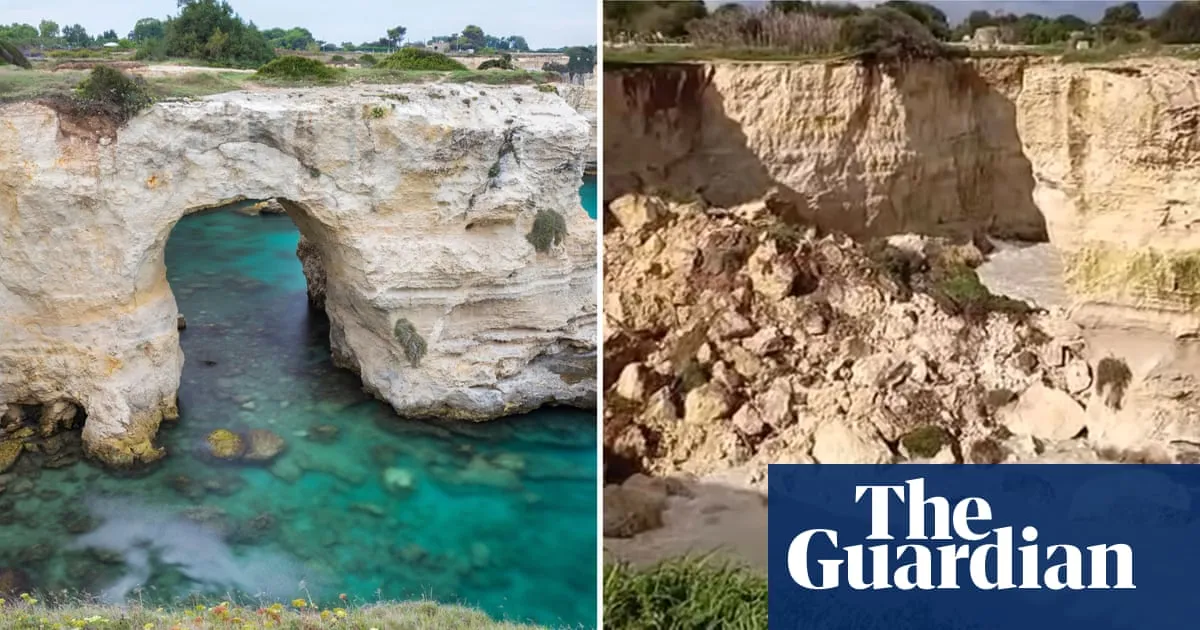
The famous arch of the sea stacks at Sant’Andrea in Melendugno, Puglia, Italy, popularly known as Lovers’ Arch, collapsed on Valentine’s Day after strong storm surges and heavy rain swept across southern Italy.The rocky arch, one of the best-known natural landmarks on the Adriatic coast, got its name as it served as a backdrop for wedding proposals, selfies and postcards, and was one of the most recognisable symbols of the Salento, one of Italy’s most heavily visited tourist areas.“It is a devastating blow to the heart,” said Melendugno’s mayor, Maurizio Cisternino. “One of the most famous tourist features of our coastline and of the whole of Italy has disappeared.”According to local authorities, strong winds, rough seas and intense rainfall in recent days progressively weakened the rock structure until its final collapse on Saturday. It is the most significant damage inflicted by coastal erosion on the landscape of the Salento.“Nature has been overturned: what existed 30 years ago no longer exists. We must find the resources for an organic intervention,” Cisternino added.“It’s like a funeral,” said Melendugno’s tourism councillor, Francesco Stella.Mediterranean cyclones, known as medicanes, include Cyclone Harry which struck in Janary, have been devastating ports, homes and roads, reshaping the structure of coastlines. Medicanes are warm-core systems that are becoming increasingly frequent in the Mediterranean, driven by rising sea temperatures linked to the climate emergency.“With the Mediterranean [experiencing] among its hottest years on record in 2025, warmer seas are supercharging the atmosphere and fuelling extreme events,” said Christian Mulder, a professor of ecology and climate emergency at the University of Catania in Sicily.The destructive force of these cyclones, with winds exceeding 60mph (97km/h) and seas whipped into waves of up to 15 metres, has left a long trail of devastation, destroying ports, damaging homes as well as tearing up roads and eating away long stretches of coastline in southern Italy.On 25 January, after torrential rain brought by Cyclone Harry, a devastating landslide tore away an entire slope in the town of Niscemi, Sicily, creating a 4km-long chasm. Roads collapsed, cars were swallowed and whole sections of the urban fabric plunged into the valley below.
SRCThe Guardian - World News
LANGEN
LEANCenter-Left
WORDS354
ENT5
MON · 2026-02-16 · 09:48 GMTBRIEF NSR-2026-0216-16637
NSR-2026-0216-16637News Report·EN·Environmental
Italy’s famous Lovers’ Arch collapses into the sea on Valentine’s Day
Italy's "Lovers' Arch," a well-known natural rock formation in Sant’Andrea, Melendugno, collapsed into the sea on Valentine's Day. The collapse of the arch, a popular tourist attraction and symbol of the Salento region, was caused by recent strong storm surges and heavy rainfall that weakened the structure.
Lorenzo Tondo in PalermoThe Guardian - World NewsFiled 2026-02-16 · 09:48 GMTLean · Center-LeftRead · 2 min
The Guardian - World NewsFIG 01
Reading time
2min
Word count
354words
Sources cited
2cited
Entities identified
5entities
Quality score
100%
§ 01
Briefing Summary
AI-generatedNEWSAR · AI
Italy's "Lovers' Arch," a well-known natural rock formation in Sant’Andrea, Melendugno, collapsed into the sea on Valentine's Day. The collapse of the arch, a popular tourist attraction and symbol of the Salento region, was caused by recent strong storm surges and heavy rainfall that weakened the structure. Local authorities report that the event is the most significant damage inflicted by coastal erosion on the landscape of the Salento. Mediterranean cyclones, which are becoming more frequent due to rising sea temperatures, have been devastating the region. The mayor of Melendugno described the collapse as a devastating blow, and a tourism councillor described it as a funeral.
Confidence 0.90Sources 2Claims 5Entities 5
§ 02
Article analysis
Model · rule-basedFraming
Environmental
Economic Impact
Tone
Mixed Tone
AI-assessed
CalmNeutralAlarmist
Factuality
0.80 / 1.00
Factual
LowHigh
Sources cited
2
Limited
FewMany
§ 03
Key claims
5 extracted01
The collapse is a devastating blow to the heart.
quoteMaurizio Cisternino, Melendugno’s mayor
Confidence
1.00
02
Strong winds, rough seas and intense rainfall weakened the rock structure.
factuallocal authorities
Confidence
1.00
03
The Lovers’ Arch at Sant’Andrea in Melendugno, Puglia, Italy, collapsed on Valentine’s Day.
factual
Confidence
1.00
04
Mediterranean cyclones, known as medicanes, are becoming increasingly frequent.
factual
Confidence
0.90
05
Warmer seas are supercharging the atmosphere and fuelling extreme events.
quoteChristian Mulder, a professor at the University of Catania in Sicily
Confidence
0.90
§ 04
Full report
2 min read · 354 words§ 05
Entities
5 identifiedKey playerOppositionContextPositiveNeutralNegative
§ 06
Keywords & salience
9 termscoastal erosion
0.80
climate change
0.80
storm surges
0.80
natural disasters
0.70
climate emergency
0.70
medicanes
0.60
italy
0.60
cyclone
0.50
salento
0.50
§ 07
Topic connections
Interactive graph Network visualization showing 51 related topics
View Full Graph Person Organization Location Event|Click node to navigate|Edge numbers = shared articles