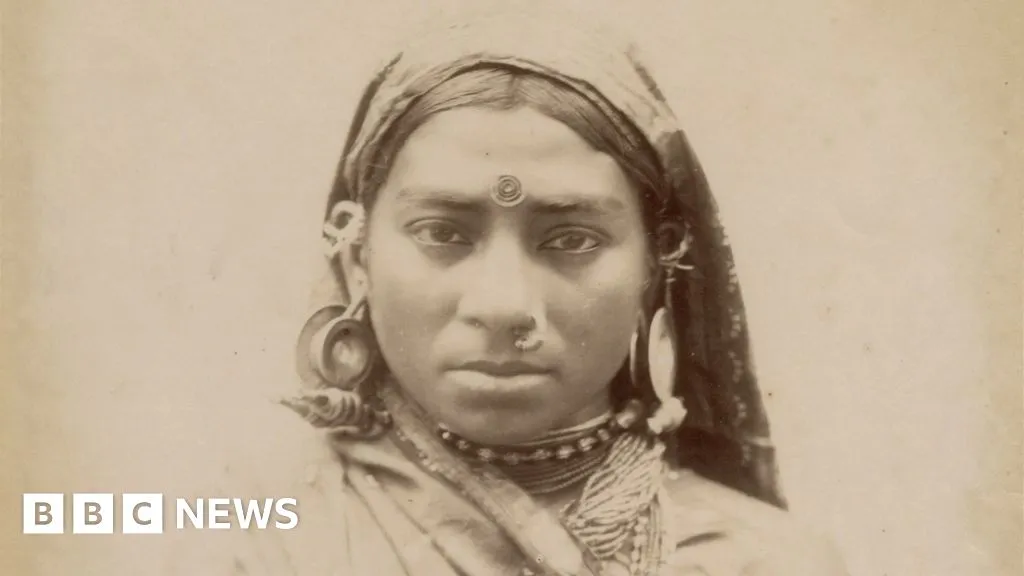
2 hours agoSudha G TilakDAGFemale dancers or nautch girls, early 20th Century. The photograph was taken by Edward Taurines, one of the first European photographers with a studio in Bombay (now Mumbai) which specialised in photographs showcasing the city for a Western audience. In the second half of the 19th Century, photography became one of the British Empire's most persuasive instruments for knowing - and classifying - India.A new exhibition - called Typecasting: Photographing the Peoples of India, 1855-1920, and organised by DAG, the Delhi-based art gallery - brings together nearly 200 rare photographs from a period when the camera was deployed to classify communities, fix identities and make India's complex social differences legible to the colonial government.Spanning 65 years, the exhibition maps an expansive human geography: from Lepcha and Bhutia communities in the north-east to Afridis in the north-west; from Todas in the Nilgiris to Parsi and Gujarati elites in western India. It also turns its gaze to those assigned to the lower rungs of the colonial social order - dancing girls, agricultural labourers, barbers and snake charmers.These images did not merely document India's diversity; they actively shaped it, translating fluid, lived realities into apparently stable and knowable "types".Curated by historian Sudeshna Guha, the exhibition centres on folios from The People of India, the influential eight-volume photographic survey published between 1868 and 1875. From this core, it expands outward to include albumen and silver-gelatin prints by photographers such as Samuel Bourne, Lala Deen Dayal, John Burke and the studio Shepherd & Robertson - practitioners whose images helped define the visual language of that time."Taken together, this material tells the history of ethnographic photography and its effect on the British administration and the Indian population, in a project which in size and depth has never before been seen in India," says Ashish Anand, CEO of DAG.Here's a selection of images from the exhibition:DAGWomen carrying cow dung cakes, Bombay, 1890, by Edward Taurines. Here, the women are presented in service to the household, engaged in domestic tasks typically performed within the home - but repositioned outdoors for the camera.DAGIndian woman, photographed by Felix Morin, 1890. Women feature prominently in the photographs at the show. This carefully composed colonial-era portrait captures both the ethnographic gaze of the period and the formal elegance of early photography.DAGThis 1862 photograph - 'Group of Afridis from the Khyber Pass' taken by Charles Shepherd - shows men from a Pathan tribe the British described as "fiercely independent" found along the Afghan border.DAGA street barber, by an unidentified photographer. Such images frequently captured street trades and everyday performances, turning ordinary labour into ethnographic subjects.DAGWilliam Johnson, a founding member of the Photographic Society of Bombay, published this image titled 'Brahmani Ladies' in the 1857 issue of The Indian Amateur's Photographic Album. The accompanying text named the two women, describing them as young and intelligent, and noted that they were in Bombay - with their father's encouragement and their husbands' support - to study English at a mission school.DAGA group of Parsis, possibly photographed by William Johnson, sit before a colonial bungalow - asserting their distinct identity through clothing and bearing, while occupying a colonial architectural world.DAGA group of young Bhutias, 1890. The volume includes photographs of people from Sikkim, Bhutan and Tibet - regions beyond the British rule. The Lepchas, Bhutias and Tibetans were photographed by Benjamin Simpson.DAGMusicians at ancient Buddhist rock-cut shrines in Maharashtra, photographed by Charles Scott, undated.DAGAn Indian family in Singapore, late 19th Century. Some images depict people from the Malay Peninsula, Singapore and Chittagong in Bangladesh.
SRCBBC News - World
LANGEN
LEANCenter
WORDS591
ENT4
SAT · 2026-02-21 · 01:21 GMTBRIEF NSR-2026-0221-18023
NSR-2026-0221-18023News Report·EN·Social Justice
How photography helped the British empire classify India
A new exhibition, "Typecasting: Photographing the Peoples of India, 1855-1920," organized by DAG, explores how photography was used by the British Empire to classify India's diverse population. The exhibition, featuring nearly 200 rare photographs, showcases how the camera was deployed to define communities and make India's social complexities understandable to the colonial government.
BBC News - WorldFiled 2026-02-21 · 01:21 GMTLean · CenterRead · 3 min
BBC News - WorldFIG 01
Reading time
3min
Word count
591words
Sources cited
1cited
Entities identified
4entities
Quality score
100%
§ 01
Briefing Summary
AI-generatedNEWSAR · AI
A new exhibition, "Typecasting: Photographing the Peoples of India, 1855-1920," organized by DAG, explores how photography was used by the British Empire to classify India's diverse population. The exhibition, featuring nearly 200 rare photographs, showcases how the camera was deployed to define communities and make India's social complexities understandable to the colonial government. It includes images from "The People of India" survey (1868-1875) and works by photographers like Samuel Bourne and Lala Deen Dayal. The exhibition maps human geography, including communities from the north-east to the north-west, and highlights those assigned to the lower rungs of the colonial social order. The images shaped perceptions of India's diversity, translating lived realities into seemingly stable "types" for administrative purposes.
Confidence 0.90Sources 1Claims 5Entities 4
§ 02
Article analysis
Model · rule-basedFraming
Social Justice
Political Strategy
Tone
Measured
AI-assessed
CalmNeutralAlarmist
Factuality
0.80 / 1.00
Factual
LowHigh
Sources cited
1
Limited
FewMany
§ 03
Key claims
5 extracted01
The People of India was an influential eight-volume photographic survey published between 1868 and 1875.
factual
Confidence
1.00
02
The exhibition brings together nearly 200 rare photographs from a period when the camera was deployed to classify communities.
factual
Confidence
1.00
03
Taken together, this material tells the history of ethnographic photography and its effect on the British administration.
quoteAshish Anand, CEO of DAG
Confidence
0.90
04
Photography became one of the British Empire's most persuasive instruments for knowing - and classifying - India.
factual
Confidence
0.90
05
These images did not merely document India's diversity; they actively shaped it.
factual
Confidence
0.80
§ 04
Full report
3 min read · 591 words§ 05
Entities
4 identifiedKey playerOppositionContextPositiveNeutralNegative
People1
Organizations1
§ 06
Keywords & salience
10 termsindia
1.00
photography
1.00
british empire
0.90
classification
0.80
ethnographic photography
0.70
colonialism
0.70
the people of india
0.60
typecasting
0.60
visual language
0.50
social differences
0.50
§ 07
Topic connections
Interactive graph Network visualization showing 51 related topics
View Full Graph Person Organization Location Event|Click node to navigate|Edge numbers = shared articles