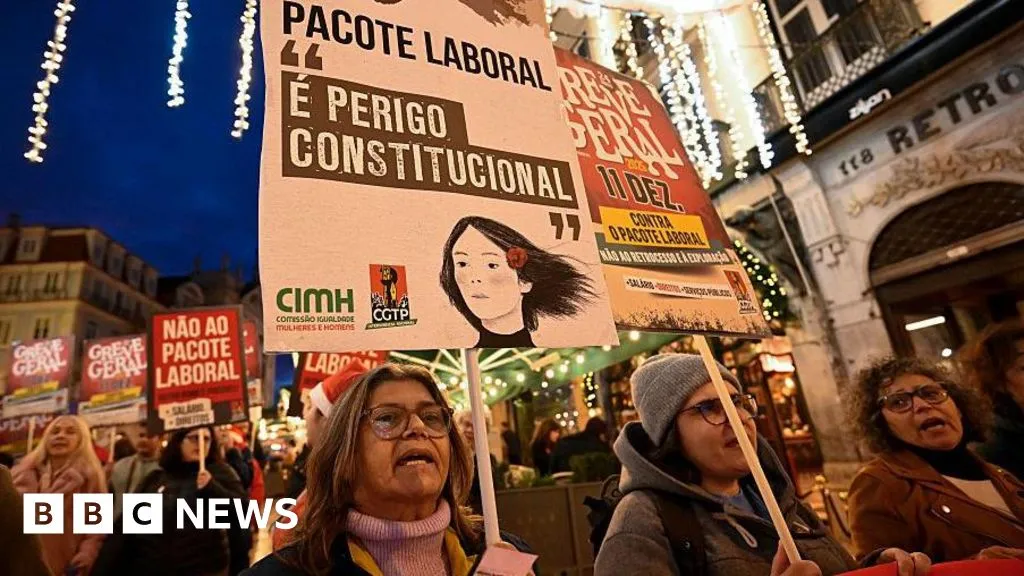
Portugal is facing severe disruption to transport, flights, hospitals, schools and other public services on Thursday, as the two main union federations stage a general strike over unprecedented labour reforms.The last time the CGTP and the generally less militant UGT joined forces was during the eurozone debt crisis in 2013, when a "troika" of international institutions demanded cuts in salaries and pensions as part of Portugal's bailout.Twelve years later, Portugal's economy has become the fastest growing in the eurozone in recent months, but Prime Minister Luís Montenegro says it is still necessary to tackle "rigidities" in the labour market "so companies can be more profitable and workers have better salaries" as a result."I will not give up on having a country with the ambition to be at the forefront, to be at the vanguard of Europe," he said on the eve of the strike.However, Montenegro appears to have been taken aback by the strength of feeling against his minority right-of-centre government's plans: one of his Social Democrat MPs is on the UGT executive and even he voted for a strike.The prime minister tweaked some proposals after calling the federation in for talks late last month, but it was clearly not enough.Among the most controversial of the more than 100 proposals are:letting employers roll over temporary contracts for years on endlifting a ban on sacking workers then immediately rehiring them indirectly via outsourcingremoving a requirement to reinstate employees who were unfairly dismissed.It is Portuguese in their 20s who are likely to be most affected by the changes - and opinion is rather mixed.Diogo Brito, who works as an air steward but has friends who do casual work in tourism, supports the right to strike but backs the package: "It has to be done. We have to catch up with richer countries and with these measures I think we can evolve more."But self-employed photographer Eduardo Ferreira says he knows many people who already cannot find secure jobs and is pleased to see the unions unite at a "critical moment" for Portugal: "Things have been tough ever since the troika, and workers haven't reacted until now."The CGTP has condemned the package as "an assault on the rights of all workers, particularly women and young people", while the UGT calls it "so out of step, in a context of economic growth, financial stability and a strong labour market, that… it reflects a clear bias in favour of employers".The UGT also complains that formal talks between unions, government and business were "unbalanced, restrictive and detrimental to workers".Montenegro's governing coalition lacks a majority in parliament, and is seeking support for the bill not only from the small, free-market Liberal Initiative (IL) but from hard-right Chega, which since May's general election has been the second-largest party. Its leader, André Ventura, has expressed reservations about the way some measures might affect family life, but looks open to negotiations.Before the election, Montenegro had ruled out deals with Chega, and the unions and the third-biggest party, the Socialists, say the prime minister's mask has slipped.They also warn that politicians on the right want to amend Portugal's 1976 constitution to loosen employment safeguards considered among Europe's strongest.The issue has also become caught up in the campaign for January's presidential election, with several candidates arguing that the labour reform bill flouts Portugal's 1976 constitution.Under Portugal's "semi-presidential" system, the head of state can decline to sign bills approved by parliament. Bills can instead be sent to the Constitutional Court for review or the president can exercise a veto that, while it can be overturned by a majority of elected MPs, delays the process, ensuring further discussion.With the government seeking to overhaul so much of the labour code, such scrutiny might stoke voter unease about its radicalism, particularly since the plans were not in the coalition's election manifesto.Unlike many strikes here, Thursday's day of action is not limited to the public sector. At Portugal's largest factory, VW-owned Autoeuropa, south of Lisbon, almost 1,000 employees voted unanimously last week to back it."I believe there is no worker in this country unaffected by the negative measures in this reform," said UGT secretary-general Mário Mourão, after the Autoeuropa gathering. "It must be responded to appropriately."
SRCBBC News - World
LANGEN
LEANCenter
WORDS698
ENT3
THU · 2025-12-11 · 00:24 GMTBRIEF NSR-2025-1211-2002
NSR-2025-1211-2002News Report·EN·Economic Impact
Portugal braced for mass disruption in first general strike for 12 years
Portugal is experiencing a general strike on Thursday, organized by the CGTP and UGT unions, due to proposed labor reforms by Prime Minister Luís Montenegro's government. This is the first joint general strike in 12 years.
BBC News - WorldFiled 2025-12-11 · 00:24 GMTLean · CenterRead · 3 min
BBC News - WorldFIG 01
Reading time
3min
Word count
698words
Sources cited
6cited
Entities identified
3entities
Quality score
100%
§ 01
Briefing Summary
AI-generatedNEWSAR · AI
Portugal is experiencing a general strike on Thursday, organized by the CGTP and UGT unions, due to proposed labor reforms by Prime Minister Luís Montenegro's government. This is the first joint general strike in 12 years. The unions oppose the reforms, which they view as detrimental to workers' rights, particularly for young people and women, despite recent economic growth. The proposed changes include easing restrictions on temporary contracts, rehiring practices, and unfair dismissals. While some, particularly those in casual work, believe the reforms are necessary for economic progress, others fear they will exacerbate job insecurity. The unions argue the reforms favor employers and are inappropriate given Portugal's current economic stability.
Confidence 0.90Sources 6Claims 5Entities 3
§ 02
Article analysis
Model · rule-basedFraming
Economic Impact
Political Strategy
Tone
Measured
AI-assessed
CalmNeutralAlarmist
Factuality
0.70 / 1.00
Factual
LowHigh
Sources cited
6
Well sourced
FewMany
§ 03
Key claims
5 extracted01
The CGTP has condemned the package as "an assault on the rights of all workers, particularly women and young people".
quoteCGTP
Confidence
1.00
02
Prime Minister Luís Montenegro says it is still necessary to tackle "rigidities" in the labour market.
quoteLuís Montenegro
Confidence
1.00
03
Portugal's economy has become the fastest growing in the eurozone in recent months.
factual
Confidence
1.00
04
The last time the CGTP and UGT joined forces was during the eurozone debt crisis in 2013.
factual
Confidence
1.00
05
Portugal is facing severe disruption to transport, flights, hospitals, schools and other public services on Thursday due to a general strike.
factual
Confidence
1.00
§ 04
Full report
3 min read · 698 words§ 05
Entities
3 identifiedKey playerOppositionContextPositiveNeutralNegative
Organizations1
Locations1
§ 06
Keywords & salience
9 termsgeneral strike
1.00
labor reforms
0.90
labor market
0.80
portugal
0.70
workers' rights
0.60
economic growth
0.60
unfair dismissal
0.50
union federations
0.50
temporary contracts
0.50
§ 07
Topic connections
Interactive graph Network visualization showing 51 related topics
View Full Graph Person Organization Location Event|Click node to navigate|Edge numbers = shared articles