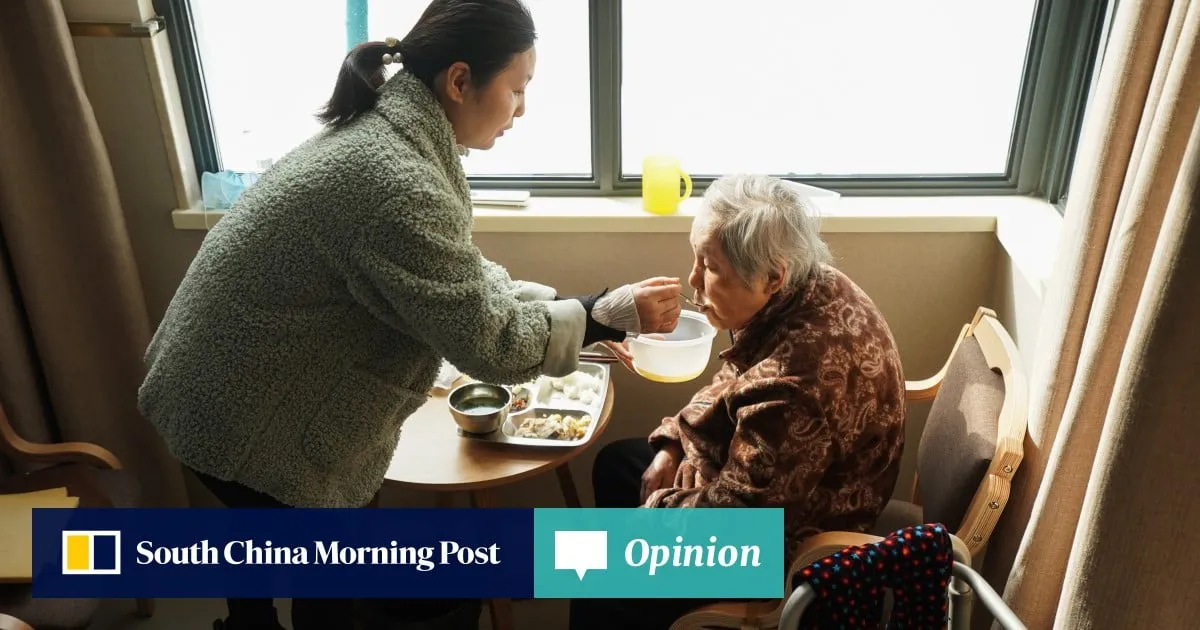
My grandma, now in her 90s, has long held together an extended family including four children and six grandchildren. As a Chinese saying goes, “Having an elder in the family is like having a treasure.” While my aunt, Father and two uncles all live near her in the same city in northern China, my generation has ventured out to different places. Yet no matter where we have settled, no trip home is complete without a visit to Grandma.When I first moved to Beijing, I had to travel about five hours by train – a journey that takes only two hours by high-speed rail nowadays. In the intervening decades, I have completed my studies, found a job and started a family of my own in the national capital.Meanwhile, Grandma has been facing one battle after another: lung cancer, a stroke, Alzheimer’s disease. Her days follow a strict medication routine, increasingly and carefully managed by her ageing offspring.My Father still recalls the emotional and financial strain that was put on the family when she was diagnosed with lung cancer, the leading cause of cancer-related deaths in China. One pill to be taken daily “used to cost about 500 yuan”, he said.Gefitinib, the key targeted drug sold under the brand name Iressa, was thus unaffordable for many, as the total cost of treatment could run to several hundred thousand yuan. My grandpa emptied his savings. My Father and his siblings didn’t have much but also stepped up and shared the expenses.A turning point came in 2018, when drugs like gefitinib were included in China’s medical insurance catalogue. Today, the catalogue covers more than 230 anticancer drugs, making critical therapy accessible to families like ours. Moreover, as the population ages – as of 2024, 310 million people or 22 per cent are 60 and older – an action plan is being implemented to build a comprehensive dementia prevention and care system by 2030.
SRCSouth China Morning Post
LANGEN
LEANCenter-Right
WORDS319
ENT3
SAT · 2026-03-07 · 01:30 GMTBRIEF NSR-2026-0307-22231
NSR-2026-0307-22231Opinion·EN·Human Interest
In China, some of us are keeping elderly care in the family – for now
In China, a family is managing the care of their 90-year-old grandmother, who lives in northern China and suffers from lung cancer, stroke, and Alzheimer's disease. The grandmother's adult children share the responsibility of her daily medication and care.
Ren YanSouth China Morning PostFiled 2026-03-07 · 01:30 GMTLean · Center-RightRead · 2 min
South China Morning PostFIG 01
Reading time
2min
Word count
319words
Sources cited
0cited
Entities identified
3entities
Quality score
100%
§ 01
Briefing Summary
AI-generatedNEWSAR · AI
In China, a family is managing the care of their 90-year-old grandmother, who lives in northern China and suffers from lung cancer, stroke, and Alzheimer's disease. The grandmother's adult children share the responsibility of her daily medication and care. Initially, the cost of her lung cancer medication was a significant financial burden, but in 2018, the inclusion of drugs like gefitinib in China’s medical insurance catalogue made treatment more accessible. As China's population ages, with 22% being 60 or older in 2024, the country is implementing plans to improve dementia prevention and care by 2030. This family's experience reflects broader challenges and changes in elderly care within China.
Confidence 0.90Claims 5Entities 3
§ 02
Article analysis
Model · rule-basedFraming
Human Interest
Economic Impact
Tone
Measured
AI-assessed
CalmNeutralAlarmist
Factuality
0.60 / 1.00
Mixed
LowHigh
Sources cited
0
No named sources
FewMany
§ 03
Key claims
5 extracted01
An action plan is being implemented to build a comprehensive dementia prevention and care system by 2030.
factual
Confidence
1.00
02
As of 2024, 310 million people or 22 per cent are 60 and older in China.
statistic
Confidence
1.00
03
The catalogue covers more than 230 anticancer drugs.
statistic
Confidence
1.00
04
In 2018, drugs like gefitinib were included in China’s medical insurance catalogue.
factual
Confidence
1.00
05
One pill to be taken daily used to cost about 500 yuan.
quoteMy father
Confidence
1.00
§ 04
Full report
2 min read · 319 words§ 05
Entities
3 identifiedKey playerOppositionContextPositiveNeutralNegative
People1
§ 06
Keywords & salience
9 termselderly care
1.00
family care
0.80
china
0.80
aging population
0.70
medical insurance
0.70
cancer treatment
0.60
dementia prevention
0.50
alzheimer's disease
0.50
financial strain
0.40
§ 07
Topic connections
Interactive graph Network visualization showing 51 related topics
View Full Graph Person Organization Location Event|Click node to navigate|Edge numbers = shared articles