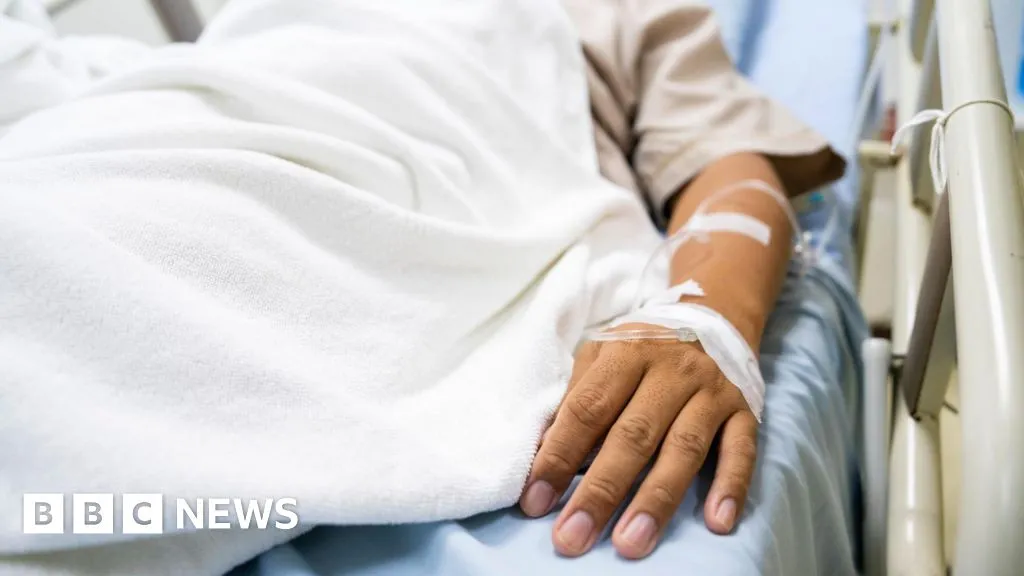
India's top court allows removal of life support of man in vegetative state2 hours agoCherylann MollanGetty ImagesIndia legalised passive euthanasia in 2018 (This is a representative image)In a landmark ruling, India's Supreme Court has allowed the removal of life support of a 31-year-old man who has been in a vegetative state for more than a decade.This is the first instance of court-approved passive euthanasia - the act of withdrawing or withholding life-sustaining treatment - in India. The man, Harish Rana, had not left a will specifying directives for his treatment before he had an accident.India legalised passive euthanasia in 2018 but active euthanasia - any act that intentionally helps a person kill themselves - remains illegal.Rana suffered serious head injuries after falling from a fourth-floor balcony in 2013. He has remained in a comatose state since then.Over the years, his parents petitioned courts several times to allow their son's life support system to be removed.They have said in interviews to local media that they had exhausted all their savings caring for Rana and were worried about what would happen to him after they died.On Wednesday, Rana's father, Ashok Rana, said in a statement that his family was grateful to the Supreme Court for its "humanitarian" judgement."This is a difficult decision for our family but we are doing what's best for Harish," he added.Rana's case had sparked a debate in India around the ethics of court-approved passive euthanasia, with some noting that it goes against the principle of self-determination, which is the foundation of a living will.A living will is a legal document which allows a person over 18 years to choose the medical care they would like to receive if they develop a terminal illness or condition with no hope of recovery. For example, they could specify that they don't want to be put on life-support machines or insist that they want to be given adequate pain-relieving medication.In this case, Rana was not able to give his consent or expressly state that he wanted to be taken off life support as he was in a coma since the accident.On Wednesday, the Supreme Court noted that Rana has not been responding to treatment."He experiences sleep-wake cycles but exhibits no meaningful interaction and has been dependent on others for all activities of self-care," the judges said, according to legal news website Bar and Bench.BBC/Rana FamilyRana's mother with her son, who has been in a vegetative state since 2013Rana was an engineering student at Punjab University in Chandigarh when he fell from the fourth-flour balcony of his paying guest accommodation.Since then, he has been breathing with the help of a tracheostomy tube and is fed through a gastrostomy tube. He cannot speak, see, hear or recognise anyone, his parents have said.Dying with dignity: Breaking the taboo around 'living wills' in IndiaIn 2024, they approached the Delhi High Court seeking passive euthanasia for their son, but their plea was rejected on the grounds that Rana hadn't been placed on life-support machines and was hence "able to sustain himself without any external aid", the court noted.They then went to the Supreme Court, which also declined their plea.In 2025, they approached the Supreme Court again, saying that their son's condition had deteriorated and that he was being kept alive "artificially" through life support machines.The Supreme Court agreed to consider their case after two medical boards assessed Rana's condition. Both boards said that Rana had a negligible chance of recovering and living a normal life, and that he required external support for feeding, bladder and bowel movements.The boards also noted that he had permanent brain damage and had suffered huge bed sores.According to the law governing living wills in India, two medical boards must certify that a patient meets the necessary criteria before their life support can be withdrawn.Wednesday's order paves the way for the medical boards to "exercise [their] clinical judgement regarding the withdrawal of treatment" for Rana.
SRCBBC News - World
LANGEN
LEANCenter
WORDS652
ENT5
WED · 2026-03-11 · 09:28 GMTBRIEF NSR-2026-0311-23453
NSR-2026-0311-23453News Report·EN·Legal & Judicial
India's top court allows removal of life support of man in vegetative state
India's Supreme Court has approved the removal of life support for Harish Rana, a 31-year-old man who has been in a vegetative state since 2013 after suffering severe head injuries. This marks the first instance of court-approved passive euthanasia in India, which was legalized in 2018.
BBC News - WorldFiled 2026-03-11 · 09:28 GMTLean · CenterRead · 3 min
BBC News - WorldFIG 01
Reading time
3min
Word count
652words
Sources cited
3cited
Entities identified
5entities
Quality score
100%
§ 01
Briefing Summary
AI-generatedNEWSAR · AI
India's Supreme Court has approved the removal of life support for Harish Rana, a 31-year-old man who has been in a vegetative state since 2013 after suffering severe head injuries. This marks the first instance of court-approved passive euthanasia in India, which was legalized in 2018. Rana's parents had petitioned the courts for years, citing depleted savings and concerns for his future care. The court noted Rana's lack of meaningful interaction and dependence on others for self-care. While passive euthanasia is legal in India, active euthanasia remains illegal. The case has sparked debate about the ethics of court-approved passive euthanasia, particularly in the absence of a living will.
Confidence 0.90Sources 3Claims 5Entities 5
§ 02
Article analysis
Model · rule-basedFraming
Legal & Judicial
Human Interest
Tone
Measured
AI-assessed
CalmNeutralAlarmist
Factuality
0.80 / 1.00
Factual
LowHigh
Sources cited
3
Well sourced
FewMany
§ 03
Key claims
5 extracted01
This is a difficult decision for our family but we are doing what's best for Harish.
quoteAshok Rana
Confidence
1.00
02
Rana suffered serious head injuries after falling from a fourth-floor balcony in 2013 and has remained in a comatose state since then.
factual
Confidence
1.00
03
India legalised passive euthanasia in 2018 but active euthanasia remains illegal.
factual
Confidence
1.00
04
This is the first instance of court-approved passive euthanasia in India.
factual
Confidence
1.00
05
India's Supreme Court has allowed the removal of life support of a 31-year-old man who has been in a vegetative state for more than a decade.
factual
Confidence
1.00
§ 04
Full report
3 min read · 652 words§ 05
Entities
5 identifiedKey playerOppositionContextPositiveNeutralNegative
Organizations2
Locations1
§ 06
Keywords & salience
8 termspassive euthanasia
1.00
life support
0.90
vegetative state
0.80
supreme court
0.70
india
0.70
living will
0.60
medical ethics
0.50
self-determination
0.40
§ 07
Topic connections
Interactive graph Network visualization showing 51 related topics
View Full Graph Person Organization Location Event|Click node to navigate|Edge numbers = shared articles