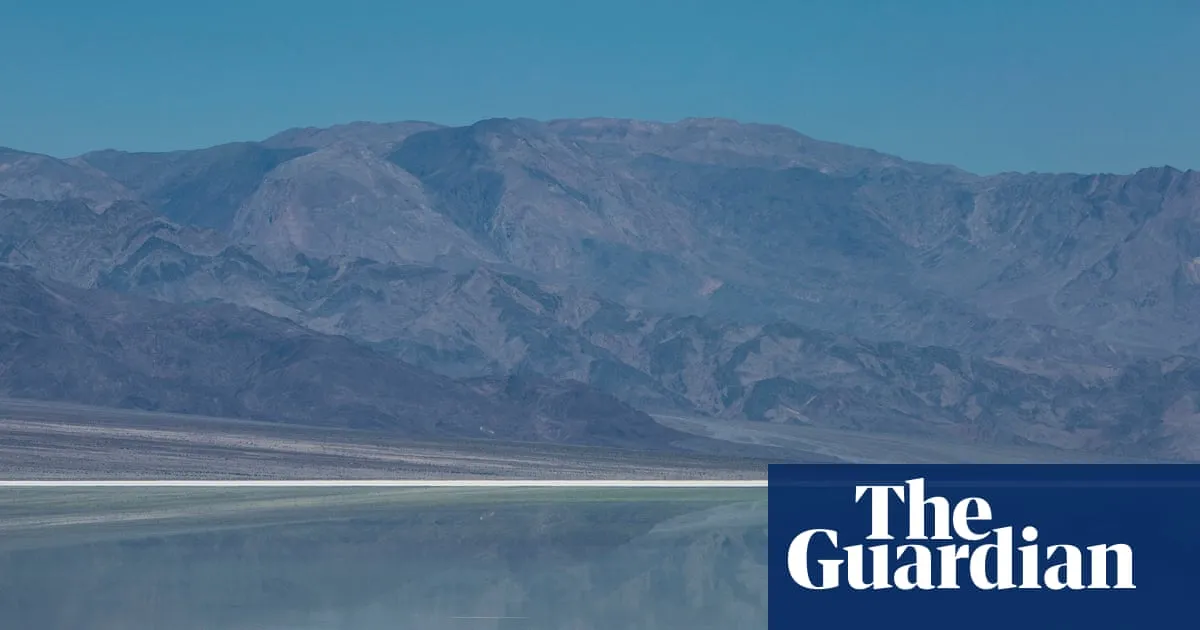
After record-breaking rains, an ancient lake in Death Valley National Park that had vanished has returned to view.The temporary lake, known informally as Lake Manly, has appeared once more at the bottom of Badwater Basin, which sits 282ft beneath sea level, in California. The basin is the lowest point in North America, according to the National Park Service.Repeated storms from September through November filled the flat with runoff, forming a thin layer of water. This year’s version is smaller and shallower than the one seen two years prior, when remnants of Hurricane Hilary drenched the area – and briefly even made it possible to kayak there.The park received in just two months more precipitation than it usually does in an entire year. From September to November, 2.41in of rain fell in Death Valley, according to the National Weather Service. November alone brought 1.76in, surpassing the 1923 record of 1.7in.Between 128,000 and 186,000 years ago, glaciers blanketed the Sierra Nevada. Meltwater from those ice sheets fed rivers that drained into a massive valley lake, the original Lake Manly, which once stretched nearly 100 miles (160km) long.Today, the basin is ordinarily bone-dry, its surface cracked by sun and wind. But the recent deluge transformed it once again, offering visitors a glimpse of how the desert might have looked millennia ago.Experts have also warned of the broader environmental shifts taking place in Death Valley. When temperatures in recent years climbed near 130F (54.4C), so-called heat tourists flocked to experience the extreme conditions first-hand. The rising heat has prompted concerns about the risks posed to native plants, birds and wildlife.In August 2023, more than 2in of rain fell in a single day in Death Valley, breaking previous records for rainfall. The flooding washed away trails, causing the park to close until mid-October. In July of that same year, the valley broke heat records by reaching temperatures of 128F (53.3C). The hottest temperature ever recorded on Earth is 134F (56.7C) in July 1913 in the same section of the park.In 2016, a series of storms with heavy rainfall brought a rare superbloom of millions of wildflowers to Death Valley. The National Park Service says it is still too early to predict whether current conditions could lead to another flourish of yellow flowers.
SRCThe Guardian - World News
LANGEN
LEANCenter-Left
WORDS377
ENT3
FRI · 2025-12-12 · 21:24 GMTBRIEF NSR-2025-1212-2371
NSR-2025-1212-2371News Report·EN·Environmental
Ancient lake reappears in Death Valley after record-breaking rains
Record-breaking rains in Death Valley National Park, California, have caused the temporary reappearance of an ancient lake, informally known as Lake Manly, in the Badwater Basin. The basin, the lowest point in North America, received more rainfall between September and November than it typically does in a year, surpassing previous records.
Marina DunbarThe Guardian - World NewsFiled 2025-12-12 · 21:24 GMTLean · Center-LeftRead · 2 min
The Guardian - World NewsFIG 01
Reading time
2min
Word count
377words
Sources cited
2cited
Entities identified
3entities
Quality score
100%
§ 01
Briefing Summary
AI-generatedNEWSAR · AI
Record-breaking rains in Death Valley National Park, California, have caused the temporary reappearance of an ancient lake, informally known as Lake Manly, in the Badwater Basin. The basin, the lowest point in North America, received more rainfall between September and November than it typically does in a year, surpassing previous records. While smaller than the lake formed by Hurricane Hilary in 2021, this event offers a glimpse of how the desert landscape looked millennia ago when the original Lake Manly stretched nearly 100 miles. The recent weather events, including extreme heat and flooding, highlight the environmental shifts occurring in Death Valley, raising concerns about the impact on native flora and fauna. It is currently unknown if the conditions will lead to a superbloom of wildflowers, as seen in 2016.
Confidence 0.90Sources 2Claims 5Entities 3
§ 02
Article analysis
Model · rule-basedFraming
Environmental
Human Interest
Tone
Measured
AI-assessed
CalmNeutralAlarmist
Factuality
0.90 / 1.00
Factual
LowHigh
Sources cited
2
Limited
FewMany
§ 03
Key claims
5 extracted01
The hottest temperature ever recorded on Earth is 134F (56.7C) in July 1913 in Death Valley.
factual
Confidence
1.00
02
November alone brought 1.76in, surpassing the 1923 record of 1.7in.
statisticNational Weather Service
Confidence
1.00
03
From September to November, 2.41in of rain fell in Death Valley.
statisticNational Weather Service
Confidence
1.00
04
The basin is the lowest point in North America, sitting 282ft beneath sea level.
factualNational Park Service
Confidence
1.00
05
An ancient lake in Death Valley national park has reappeared after record-breaking rains.
factual
Confidence
1.00
§ 04
Full report
2 min read · 377 words§ 05
Entities
3 identifiedKey playerOppositionContextPositiveNeutralNegative
Organizations1
§ 06
Keywords & salience
9 termsdeath valley
1.00
record-breaking rains
0.90
ancient lake
0.80
lake manly
0.70
extreme weather
0.60
precipitation
0.60
heat records
0.50
climate change
0.50
environmental shifts
0.40
§ 07
Topic connections
Interactive graph Network visualization showing 3 related topics
View Full Graph Person Organization Location Event|Click node to navigate|Edge numbers = shared articles