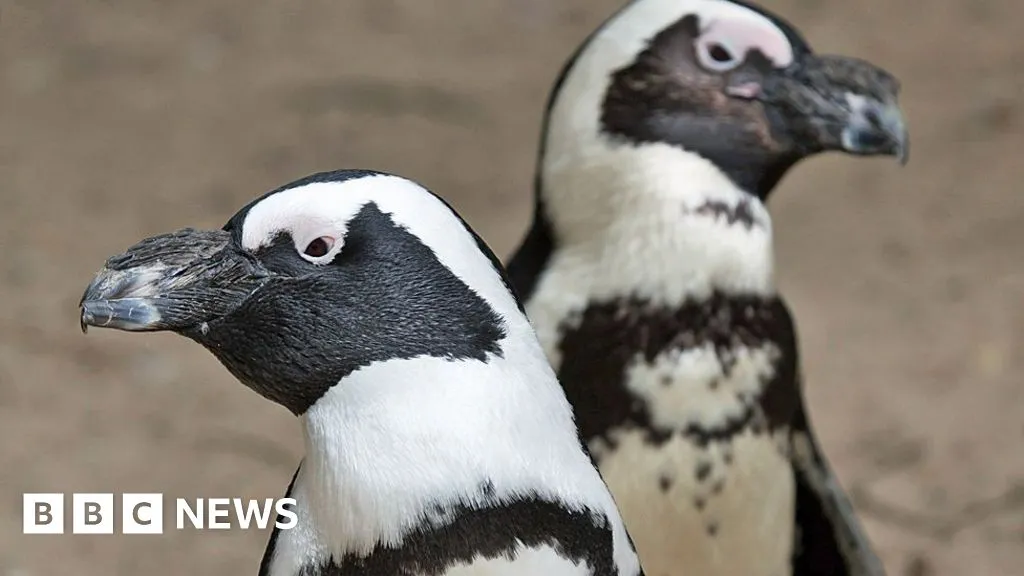
3 hours agoJohannes DellLüderitzGetty ImagesScientists have warned that the critically endangered African penguin could go extinct in the wild by 2035A near pristine desert and coastal wilderness in Namibia could soon host a huge hydrogen production facility, raising hopes for jobs but also fears for the unique plant and animal life of the region, such as rare succulents and endangered African penguins.It is part of the government's plan to become a green hydrogen superpower, exporting a clean-burning fuel that could help cut emissions elsewhere.Hyphen, a joint venture led by the Germany-based green energy group Enertrag, says Namibia has the "world class" solar and wind power potential needed for large-scale, competitive production.Hydrogen, a highly flammable gas that produces heat and water when it burns, can be used to refine petroleum and make chemicals, metals and fertilisers. It is usually produced with fossil fuels, however when renewable energy sources are used instead the hydrogen is labelled "green".Getty ImagesThe shifting sands of Tsau ǁKhaeb National Park have been off-limits for more than 100 years, allowing it to become a biodiversity hotspotBut the plan to build solar and wind farms in Namibia's Tsau ǁKhaeb National Park, which means "Soft Sands" in the Nama language, is not supported by conservationists.The 26,000 sq km (10,000 sq mile) park was established in 2004 out of what was known as the "Sperrgebiet" - German for "Restricted Area" - a vast swathe of land sealed off by the German colonial authorities to protect their mining interests when diamonds were discovered there at the beginning of the 20th Century.The diamond rush came and went - allowing a unique richness of flora and fauna to flourish undisturbed, which the Namibian Chamber of the Environment (NCE) says is now in danger.Succulents in particular thrive in this unforgiving landscape using ingenious strategies to survive, from water storage to light reflection.Its head, Chris Brown, puts it more bluntly, saying industrialised countries like Germany, which is actively supporting the green hydrogen projects, are applying double standards."The Germans would never allow their top parks to be turned into industrial sites," Brown says."But they seem to be quite happy to offshore not only the risk, but also the impacts on biodiversity to Namibia. And we find that totally unacceptable."This part of the coast belongs to the Namibian Islands' Marine Protected Area, a 400km (250 mile) stretch home to the critically endangered African penguins.The Namibian Foundation for the Conservation of Seabirds (Namcob) has also raised the alarm.It is based in the port of Lüderitz, a sleepy backwater on the South Atlantic where fishing has been the backbone of the local economy for decades - but which is likely to face huge expansion if the hydrogen project gets the green light."Where they plan to expand the port is a particularly bio-sensitive hotspot," Namcob's Neil Shaw says from his windswept office near a lagoon where flamingos feed."That can have quite severe ramifications on the marine ecosystem that the penguins and other coastal birds rely on."Hyphen says it is doing all it can to minimise disturbance of crucial ecosystems, avoiding the most sensitive sites and leaving the smallest possible footprint.According to Toni Beukes - head of environment, social and governance for Hyphen - impact assessments are under way and the park is the best possible place for their plans."The south is where you have a co-location of fantastic wind and solar resources. Namibia has to compete with other projects globally and that's where your competitive advantage lies," she told me.Getty ImagesGetty ImagesThis 55m natural rock formation, known as Bogenfels, is in the former forbidden zone, now Tsau ǁKhaeb National Park...The area is also renowned for its succulents, which have developed ingenious strategies to surviveAlthough the project is still in the feasibility stage, the proposed investment is already having an impact in Lüderitz, according to Phil Balhao, the mayor of the town until last year."We're seeing new investments, new opportunities, new services and amenities that never would have come down to Lüderitz," he says.And jobs are badly needed given Namibia's official youth unemployment rate of 44%.The scope of the project, in which the Namibian government has a 24% stake, is huge.Hyphen says it hopes to initially produce 3.75 gigawatts of renewable electricity, enough to power almost 400 million LED bulbs.The electricity would then power electrolysers, the technology that splits water into hydrogen and oxygen.And as hydrogen is hard to transport, pipelines would carry the gas to the coast to be turned into ammonia which can be more easily liquified and later converted back.By the end of 2028 Hyphen aims to produce one million tonnes of the substance.The total investment amounts to more than $10bn (£7.4bn) - by comparison, the annual output of Namibia's entire economy is just over $13bn.Johannes Dell/BBCYouth activists Luciel Adams and Junior Mutaleni, who are involved in various projects from ocean education to sports coaching, want more details about Hyphen's plansBut some youth activists say engagement meetings with investors have left them sceptical about the long-term benefits because of a lack of detail, though jobs and electricity would be welcomed."You have to ask what type of job, what are the criteria that are needed? We need to be specific so that we're able to prepare ourselves," says Junior Mutaleni.Hyphen estimates it will create 15,000 jobs during the construction phase, and 3,000 permanent jobs during operation. The company is running a nationwide survey to find out what skills are available locally.Hyphen's Beukes says that while the firm is committed to employing as many Namibians as possible, the prioritising of local jobs and contracts will not happen overnight."We have to be pragmatic. It is one of the biggest projects in the world," she says.Local activist Luciel Adams also warns that the project should be respectful of a rocky peninsula near Lüderitz that was once the site of the Shark Island concentration camp.Johannes Dell/BBCThe Shark Island genocide memorial commemorates the deaths of thousands of Nama and Herero slave labourers held in a concentration camp hereThis was where thousands of Nama and Herero people were killed by Germany's colonial army during the 1904-1908 genocide."People used to be fed to the sharks as slaves there, so there's a lot of raw, hurtful history. People's identity lies in that place," she told me.Full community engagement is essential, agrees Graham Hopwood of Namibia's Institute for Public Policy Research."For the people of Lüderitz, this could vastly change the town, so they need to be involved."Some smaller green hydrogen projects have already got off the ground in Namibia.The HyIron plant, in the west of the country, turns ore into pure iron for steel making, something normally done with fossil fuels.The final investment decision on whether Hyphen's multi-billion-dollar project gets the go-ahead is due by the end of 2026.Some Lüderitz residents, like ex-mayor Balhao, disagree with the environmentalists, saying the town badly needs investment."It would really unlock Lüderitz and the south of Namibia massively. But after decades of isolation he says the town's resilience will see it through."We're ready to adapt and move on to whatever is next."Getty Images/BBCBBC Africa podcasts
SRCBBC News - World
LANGEN
LEANCenter
WORDS1 172
ENT9
THU · 2026-03-12 · 00:04 GMTBRIEF NSR-2026-0312-23713
NSR-2026-0312-23713News Report·EN·Environmental
Why Namibia's green energy dream could be a red flag for penguins
Namibia aims to become a green hydrogen superpower by building renewable energy facilities in the Tsau ǁKhaeb National Park. This plan, spearheaded by a joint venture including the German-based Enertrag, seeks to produce and export green hydrogen using the area's abundant solar and wind resources.
BBC News - WorldFiled 2026-03-12 · 00:04 GMTLean · CenterRead · 5 min
BBC News - WorldFIG 01
Reading time
5min
Word count
1 172words
Sources cited
4cited
Entities identified
9entities
Quality score
100%
§ 01
Briefing Summary
AI-generatedNEWSAR · AI
Namibia aims to become a green hydrogen superpower by building renewable energy facilities in the Tsau ǁKhaeb National Park. This plan, spearheaded by a joint venture including the German-based Enertrag, seeks to produce and export green hydrogen using the area's abundant solar and wind resources. However, conservationists are raising concerns about the potential impact on the park's unique biodiversity, including rare succulents and the endangered African penguin, which is predicted to possibly be extinct by 2035. Critics argue that industrializing this protected area, previously restricted for diamond mining, is unacceptable and represents a double standard, as similar development would not be permitted in Germany's top parks. The Namibian Islands' Marine Protected Area, a 400km stretch of coast, is also at risk.
Confidence 0.90Sources 4Claims 5Entities 9
§ 02
Article analysis
Model · rule-basedFraming
Environmental
Economic Impact
Tone
Mixed Tone
AI-assessed
CalmNeutralAlarmist
Factuality
0.70 / 1.00
Factual
LowHigh
Sources cited
4
Well sourced
FewMany
§ 03
Key claims
5 extracted01
The Namibian Islands' Marine Protected Area is a 400km stretch home to the critically endangered African penguins.
factualnull
Confidence
1.00
02
Tsau ǁKhaeb National Park was established in 2004.
factualnull
Confidence
1.00
03
Namibia plans to become a green hydrogen superpower.
factualnull
Confidence
1.00
04
Industrialised countries are applying double standards by supporting green hydrogen projects in Namibia.
quoteChris Brown, Namibian Chamber of the Environment
Confidence
0.90
05
The critically endangered African penguin could go extinct in the wild by 2035.
predictionScientists
Confidence
0.80
§ 04
Full report
5 min read · 1 172 words§ 05
Entities
9 identifiedKey playerOppositionContextPositiveNeutralNegative
Organizations3
§ 06
Keywords & salience
9 termsgreen hydrogen
1.00
namibia
0.90
african penguin
0.80
biodiversity
0.70
conservation
0.60
renewable energy
0.60
endangered species
0.50
tsau ǁkhaeb national park
0.50
environmental impact
0.40
§ 07
Topic connections
Interactive graph Network visualization showing 14 related topics
View Full Graph Person Organization Location Event|Click node to navigate|Edge numbers = shared articles