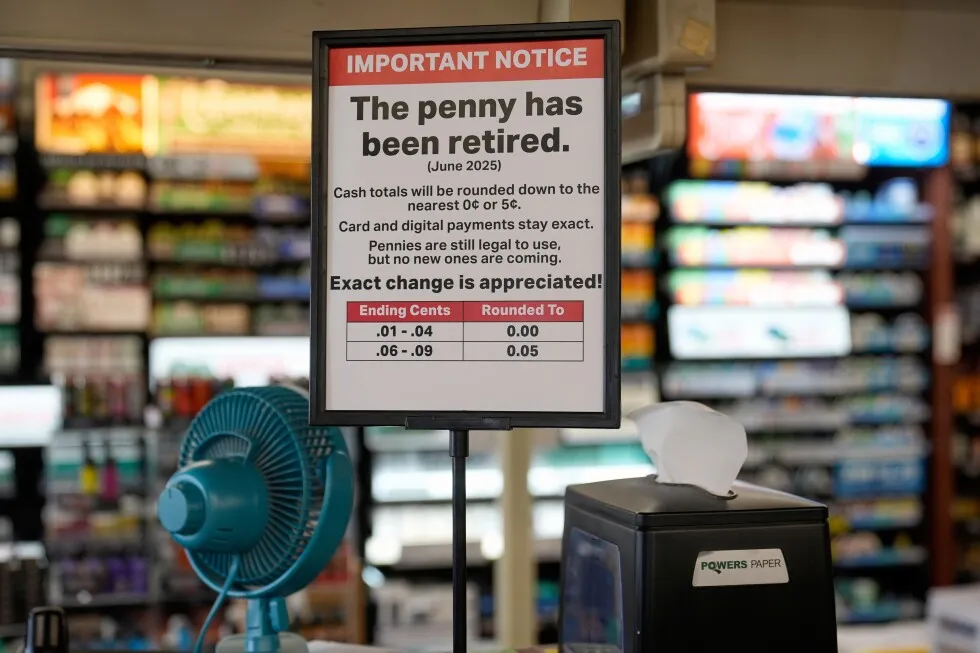
A sign in a Kwik Trip store shows the store will no longer be using pennies to give change, on Oct. 23, 2025, in Yorkville, Wis. (AP Photo/Morry Gash, File) Updated [hour]:[minute] [AMPM] [timezone], [monthFull] [day], [year] Months after the last of the United States’ 1-cent coins were pressed, some states are beginning to offer their own 2 cents on the penny problem by setting rounding guidance for cash purchases.President Donald Trump announced early last year an end to penny production, saying it was wasteful. It cost 3.7 cents to make each 1-cent coin in 2024, according to the U.S. Mint. The move led to a shortage of pennies in cash registers last summer, forcing consumers and businesses to confront a penniless future in which making exact change would be difficult.The Treasury Department has said it will continue circulating the roughly 114 billion pennies that exist for “as long as possible.” Pennies must still be accepted as payment.One solution to the penny problem is rounding to the nearest nickel, using a practice called symmetrical rounding. If the final price, after taxes, ends in one, two, six or seven cents, payment in cash rounds down. For example, $1.91 or $1.92 becomes $1.90. If the price ends in three, four, eight or nine, cash payment rounds up. For $1.98 or $1.99, the consumer pays $2. A bill introduced last year in Congress and passed out of the House financial services committee would apply symmetrical rounding across the country. U.S. Rep. Lisa McClain, R-Mich., said in an email the federal law is important to prevent a “confusing patchwork of state policies.”The bill hasn’t been voted on in the House and would still need to move through the U.S. Senate before reaching Trump’s desk. Some states are looking to what’s nextIn the meantime, bills to deal with penniless cash transactions have passed both chambers and await the governor’s signature in Arizona, Florida, Oregon, Tennessee, Virginia and Washington. Some states are proposing to allow businesses to round cash purchases, while others consider requiring it.In Indiana, a bill signed into law this month by Republican Gov. Mike Braun tells businesses they must round cash purchases for all transactions that do not end in a zero or five. Lawmakers revised that provision in a second bill that makes rounding optional, which would take effect Sunday if Braun signs it into law. In both bills, Indiana businesses can choose to always round cash purchases up to the nearest nickel, always round down or round up or down depending on the amount. In Republican-led Tennessee, legislation makes symmetrical rounding exempt from legal claims under a state consumer protection law but does not require rounding. “It is to provide safe harbor for private businesses,” said Republican Rep. Charlie Baum, the bill sponsor in Tennessee, during floor debate.Rounding bills have been introduced in about two dozen states since late last year, according to an Associated Press analysis using the bill-tracking service Plural. Outside of lawmaking bodies, some state agencies have published guidelines to advise that rounding should happen after tax, and that businesses must make sure the full taxed amount still goes to the state. Will consumers pay more with rounding?Cash isn’t used as ubiquitously since the rise in electronic payment methods. Still, about 8 in 10 U.S. adults said they recently used cash in a 2024 survey conducted by the Federal Reserve. Cash was more often used by older adults and those in lower-income households.The Treasury wrote online that prices would be “rounded down just as often as they will be rounded up, so there should be no overall effect on consumer prices.”But researchers at the Federal Reserve Bank of Richmond used a 2023 survey to show prices that didn’t end in zero or five were especially likely to end in eight or nine. Payment amounts could be different when multiple items are purchased or depending on the tax rate, but overall, prices more often being rounded up would lead to millions of dollars gained by businesses and lost by consumers collectively, amounting to a few pennies lost per person.Do people think it’s fair?As businesses have introduced rounding, some Americans have taken to social media to say they feel scammed, even if it is a penny or two at a time.Nikki Capozzo-Hennessy, 50, said she tends to pay in cash because it makes her more conscious of her spending. The Trumbull, Connecticut, resident posted her grocery store receipt online when she noticed the rounding adjustment on a purchase of $8.73, with tax. The store chose to round down and she gained three cents. Capozzo-Hennessy said it might feel taxing if she had to hand over extra pennies every time, but she also thinks it’s practical to stick with one rule. She runs a food truck business and said they’d likely use symmetrical rounding to be consistent.“At the end of the day it’s three cents, but I can imagine with all the purchases that you make, it can add up,” Capozzo-Hennessy said.Washington state Rep. April Berg, who introduced a rounding bill there, said she understands people who feel frustrated losing a penny but that the elimination of the hard currency leaves little option.“We did make sure that everyone is allowed to pay exactly what they owe,” Berg said of her legislation. What about the nickel? The Treasury says ceasing penny production will save $56 million annually, but rounding could increase demand for nickels. The 5-cent coins also are costly to make, reaching nearly 14 cents each in 2024, according to the Mint.The proposed federal legislation currently includes a potential cost-saving solution, allowing the Treasury to adjust the coin’s composition to use cheaper zinc and nickel instead of copper and nickel. Fingerhut is a government and politics reporter based in Des Moines, Iowa.
SRCAssociated Press (AP)
LANGEN
LEANCenter
WORDS961
ENT12
THU · 2026-03-12 · 09:23 GMTBRIEF NSR-2026-0312-23797
NSR-2026-0312-23797News Report·EN·Economic Impact
State lawmakers rush to set rounding rules for when there are no pennies
With the U.S. ending penny production due to high costs, states are addressing the challenge of cash transactions without pennies.
By
HANNAH FINGERHUTAssociated Press (AP)Filed 2026-03-12 · 09:23 GMTLean · CenterRead · 4 min
Associated Press (AP)FIG 01
Reading time
4min
Word count
961words
Sources cited
4cited
Entities identified
12entities
Quality score
100%
§ 01
Briefing Summary
AI-generatedNEWSAR · AI
With the U.S. ending penny production due to high costs, states are addressing the challenge of cash transactions without pennies. A federal bill proposing symmetrical rounding to the nearest nickel, where prices ending in 1, 2, 6, or 7 cents round down and 3, 4, 8, or 9 cents round up, has stalled in Congress. Consequently, states like Arizona, Florida, Oregon, Tennessee, Virginia, and Washington are considering or implementing their own rounding policies for cash purchases, with some mandating and others allowing businesses to round to the nearest nickel. Indiana initially required rounding for transactions not ending in zero or five, but revised the law to make rounding optional. These state-level actions aim to provide clarity and consistency in the absence of pennies.
Confidence 0.90Sources 4Claims 5Entities 12
§ 02
Article analysis
Model · rule-basedFraming
Economic Impact
Political Strategy
Tone
Measured
AI-assessed
CalmNeutralAlarmist
Factuality
0.80 / 1.00
Factual
LowHigh
Sources cited
4
Well sourced
FewMany
§ 03
Key claims
5 extracted01
In Indiana, a bill signed into law this month by Republican Gov. Mike Braun tells businesses they must round cash purchases.
factual
Confidence
1.00
02
A bill introduced last year in Congress and passed out of the House financial services committee would apply symmetrical rounding across the country.
factual
Confidence
1.00
03
The Treasury Department has said it will continue circulating the roughly 114 billion pennies that exist for “as long as possible.”
quoteTreasury Department
Confidence
1.00
04
It cost 3.7 cents to make each 1-cent coin in 2024, according to the U.S. Mint.
statisticU.S. Mint
Confidence
1.00
05
Some states are beginning to offer their own guidance on the penny problem by setting rounding guidance for cash purchases.
factual
Confidence
1.00
§ 04
Full report
4 min read · 961 words§ 05
Entities
12 identifiedKey playerOppositionContextPositiveNeutralNegative
Organizations4
§ 06
Keywords & salience
8 termsrounding rules
0.90
penny shortage
0.90
cash purchases
0.80
symmetrical rounding
0.70
state lawmakers
0.60
u.s. mint
0.50
exact change
0.50
federal law
0.40
§ 07
Topic connections
Interactive graph Network visualization showing 51 related topics
View Full Graph Person Organization Location Event|Click node to navigate|Edge numbers = shared articles