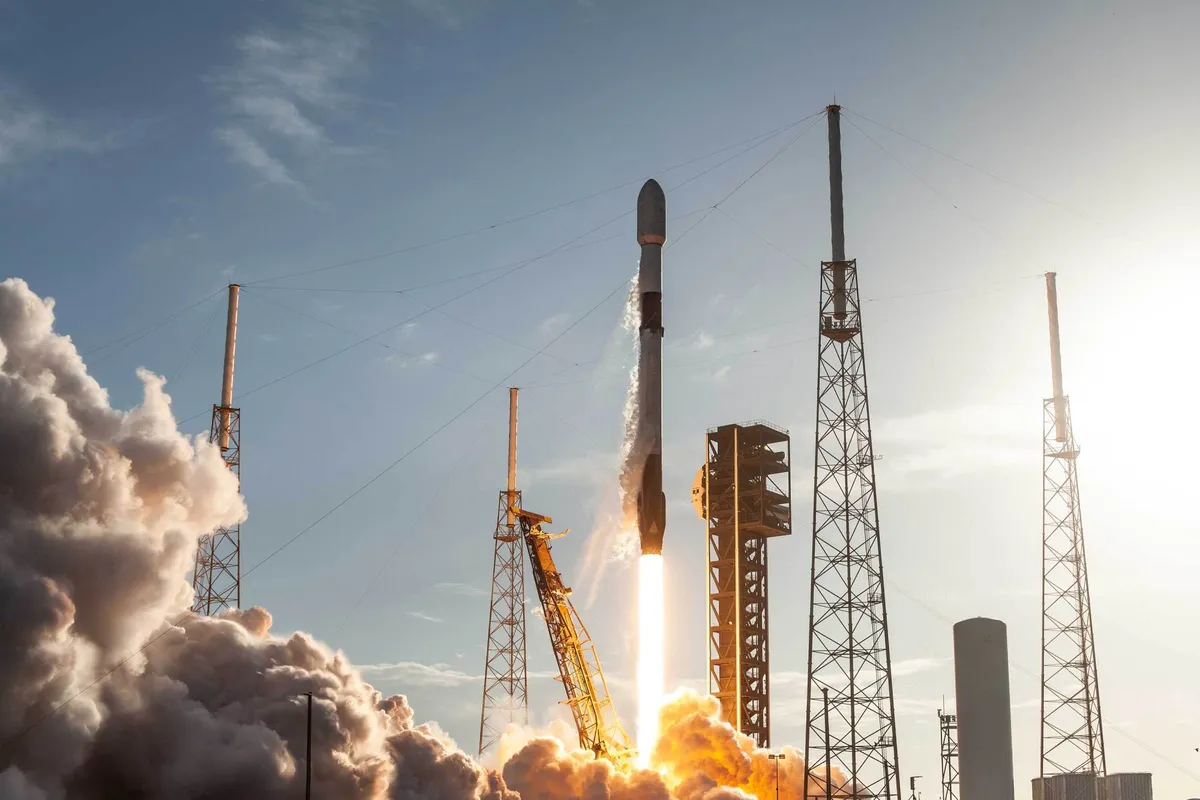
The Trump administration is backing off a rule aimed at stopping commercial space companies from leaving rocket bodies in Earth’s orbit, a practice that experts say could threaten public safety and telecommunications. The Federal Aviation Administration first proposed the measure in 2023, under the Biden administration, in hopes of curbing the growing junkyard of debris circling the planet. It would have required companies like Elon Musk’s SpaceX to safely remove such spacecraft within 25 years of launch, saying they “pose a significant risk to people on the ground due to their mass and the uncertainty of where they will land.” Officials cited examples such as a SpaceX Falcon 9 rocket reentering Earth’s atmosphere over the Pacific Northwest in March 2021, which created streaks of lights across the night sky and dropped a tank on a farm in Washington state. SpaceX and other companies, however, criticized the proposal, citing concerns that included its cost, and in January, the FAA nixed the rule, saying the agency needs more time to research it. “FAA intends to review the space launch industry cost inputs and expectations with respect to debris mitigation activities,” the FAA said, adding it would also look at the agency’s authority to enact such regulations. In response to questions for this story, an agency spokesperson reiterated that rationale. The White House did not respond to requests for comment about the withdrawal. The action is a concession to the commercial space industry and follows moves by President Donald Trump’s administration last year to roll back regulations meant to protect the environment and the public during rocket launches. “The Trump administration is committed to cementing America’s dominance in space without compromising public safety or national security,” a White House spokesperson said last summer. Critics, however, said the government was missing an opportunity to control debris — and endangering the public in the process. Rockets can be hundreds of feet tall and typically are made up of multiple parts, known as stages. After any lower stages fall away, the upper stage continues on into space to deploy payloads such as satellites or to perform other missions. “Instead of requiring companies to responsibly dispose of these upper stages, the U.S. has decided to roll the dice on a person or a plane getting hit by falling debris,” said Ewan Wright, a Ph.D. candidate at the University of British Columbia and junior fellow at the Outer Space Institute, a nonprofit that supported the rule. Wright’s research with colleagues found a 20% to 29% chance that debris from a reentering rocket would kill at least one bystander sometime in the next decade. No deaths have occurred from falling space debris yet. But minor injuries have been documented, including a boy in China whose toe was broken and a woman who was hit on the shoulder in Tulsa, Oklahoma. In 2024, a piece of metal from the International Space Station crashed through the roof of a home in Naples, Florida. The explosions of two SpaceX Starship megarockets last year that rained debris over the Caribbean brought new attention to the danger to airplanes as spacecraft reenter the atmosphere — sometimes in an uncontrolled way. After ProPublica wrote about the Starship mishaps, the FAA issued a new warning to airlines, saying that rocket launches could “significantly reduce safety” and that pilots should prepare for the possibility that “catastrophic failures” could create dangerous debris. Space junk also adds to the threat, experts said, for both the space program and daily life on Earth. If the growing debris field above the planet is left unchecked, the FAA said in 2023, it could clutter orbits used for human spaceflight and increase the chance of collisions causing damage to satellites that support communications, weather forecasting and global positioning systems. The FAA said at the time that the rule was an attempt to bring the evolving commercial space industry in line with national practices that are followed by NASA and with international guidelines. Wright said that about half of all launches leave the rocket’s upper stage in orbit. There, it can pose a risk to crewed space stations and interfere with astronomers’ research before crashing to earth. In the last three years, U.S. rocket companies, including SpaceX and United Launch Alliance, have abandoned 41 upper stage rockets in orbit, Wright said. Thirty-three are still there now. “Abandoning truck-sized upper stages in orbit is an irresponsible act,” he said. In response, SpaceX pointed to a statement posted on its website, saying it has been working to reduce — and ultimately eliminate — space debris left behind by Falcon, which regularly deploys new Starlink satellites. “In 2024, 13 out of 134 upper Falcon 9 stages remained on-orbit after successful payload deploys,” the company said. “In 2025, we reduced this number to three out of a total of 165 launches.” United Launch Alliance, a joint venture of Lockheed Martin and Boeing, said through a spokesperson that it disposes of its upper stage rockets safely “by placing them in a graveyard orbit or conducting a controlled reentry where most of the stage disintegrates over the remote, deep ocean.” The FAA’s proposal would have required launch companies to submit a plan for how they would remove debris prior to launch and would apply to any pieces of debris larger than five millimeters. Acceptable options for disposing of used rockets that couldn’t burn up in the atmosphere would include pushing them out to a higher “disposal” orbit or navigating them to splashdown in a “broad ocean area,” the FAA wrote.
SRCProPublica
LANGEN
LEANCenter-Left
WORDS920
ENT8
THU · 2026-03-12 · 09:00 GMTBRIEF NSR-2026-0312-23799
NSR-2026-0312-23799News Report·EN·Public Health
Amid Crowded Skies, FAA Kills Rule Aimed at Regulating Space Junk
The FAA has withdrawn a proposed rule that would have required commercial space companies to safely remove rocket bodies from Earth's orbit within 25 years of launch. The rule, initially proposed in 2023, aimed to mitigate the growing problem of space junk and the potential safety risks associated with falling debris.
Heather VogellProPublicaFiled 2026-03-12 · 09:00 GMTLean · Center-LeftRead · 4 min
ProPublicaFIG 01
Reading time
4min
Word count
920words
Sources cited
3cited
Entities identified
8entities
Quality score
100%
§ 01
Briefing Summary
AI-generatedNEWSAR · AI
The FAA has withdrawn a proposed rule that would have required commercial space companies to safely remove rocket bodies from Earth's orbit within 25 years of launch. The rule, initially proposed in 2023, aimed to mitigate the growing problem of space junk and the potential safety risks associated with falling debris. Companies like SpaceX criticized the proposal, citing concerns about cost and other factors. The FAA stated it needs more time to research the issue, review cost inputs from the space launch industry, and assess its authority to enact such regulations. Critics argue that the decision endangers the public and misses an opportunity to control debris, while the Trump administration emphasizes its commitment to American dominance in space without compromising safety.
Confidence 0.90Sources 3Claims 5Entities 8
§ 02
Article analysis
Model · rule-basedFraming
Public Health
Economic Impact
Tone
Mixed Tone
AI-assessed
CalmNeutralAlarmist
Factuality
0.70 / 1.00
Factual
LowHigh
Sources cited
3
Well sourced
FewMany
§ 03
Key claims
5 extracted01
It would have required companies like SpaceX to safely remove such spacecraft within 25 years of launch.
factual
Confidence
1.00
02
The Trump administration is committed to cementing America’s dominance in space without compromising public safety or national security.
quoteWhite House spokesperson
Confidence
1.00
03
The FAA nixed the rule, saying the agency needs more time to research it.
quoteFAA
Confidence
1.00
04
The Trump administration is backing off a rule aimed at stopping commercial space companies from leaving rocket bodies in Earth’s orbit.
factual
Confidence
1.00
05
Wright’s research found a 20% to 29% chance that debris from a reentering rocket would kill at least one bystander sometime in the next decade.
statisticEwan Wright
Confidence
0.90
§ 04
Full report
4 min read · 920 words§ 05
Entities
8 identifiedKey playerOppositionContextPositiveNeutralNegative
Organizations3
§ 06
Keywords & salience
9 termsspace junk
1.00
faa
0.90
rocket debris
0.80
commercial space industry
0.70
space regulations
0.70
public safety
0.60
trump administration
0.50
rocket bodies
0.50
debris mitigation
0.50
§ 07
Topic connections
Interactive graph Network visualization showing 34 related topics
View Full Graph Person Organization Location Event|Click node to navigate|Edge numbers = shared articles