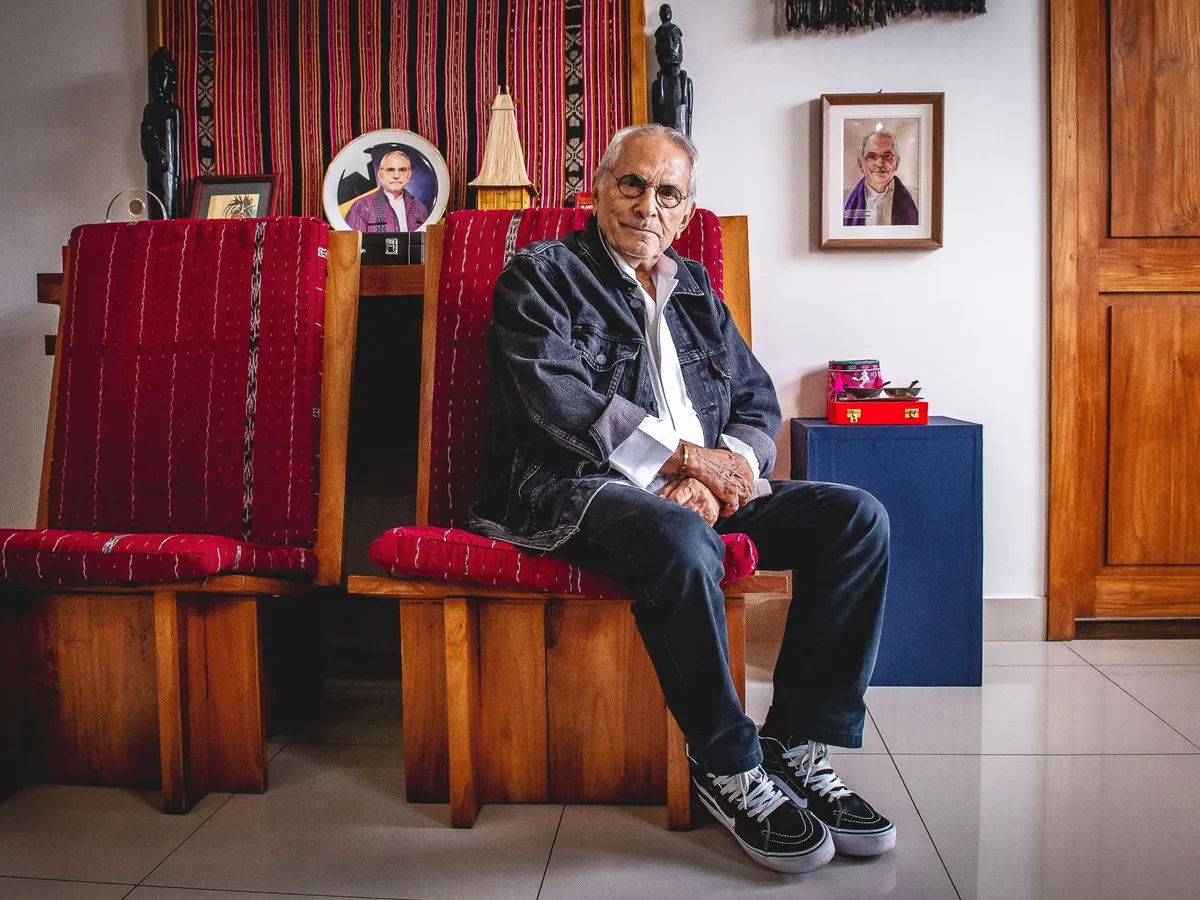
Q&A: East Timor’s President Ramos-Horta on diplomacy, Gaza, and the West'I am thoroughly disillusioned with the so-called international community': East Timor's President Jose Ramos-Horta.East Timor's President Jose Ramos-Horta at the Presidential Palace in Dili, East Timor [Ali MC/Al Jazeera]Published On 12 Dec 2025Dili, East Timor – On the 50th anniversary of Indonesia’s invasion of East Timor, longtime independence advocate and now the country’s President Jose Ramos-Horta reflected on the last half-century of politics and diplomacy in his country.Ramos-Horta was serving as the foreign minister of the newly declared Democratic Republic of East Timor in the days leading up to Indonesia’s invasion in December 1975.Recommended Stories list of 4 itemslist 1 of 4‘Dream realised’: East Timor becomes ASEAN’s 11th memberlist 2 of 4Asia’s youngest nation East Timor, declared ASEAN’s 11th memberlist 3 of 4Indonesia makes former president Soeharto posthumous national herolist 4 of 4Who was Soeharto, the late leader named Indonesia’s ‘national hero’?end of listFormed by the independence party Fretilin after colonial Portugal’s withdrawal from the country, the new government in East Timor’s capital Dili was under pressure from Indonesia and its threat of invasion.As the danger intensified, Ramos-Horta flew to the United Nations in New York to plead for international recognition and protection for East Timor’s fragile independence. Despite unanimous support at the UN for Timorese self-determination, Indonesian troops launched their invasion on December 7, 1975.Ramos-Horta’s colleagues, including Prime Minister Nicolau Lobato and other Fretilin leaders, either went into hiding or were killed in the ensuing attack. Unable to return home, Ramos-Horta became East Timor’s voice in exile for the next 24 years.During his exile, Ramos-Horta lobbied governments, human rights organisations, and the UN to condemn Indonesia’s occupation, which resulted in the deaths of an estimated 200,000 Timorese through conflict, famine, and repression.Silenced by a military-imposed media blackout for much of the 1980s, it was only in the 1990s that reports of Indonesian atrocities – including the 1991 Santa Cruz massacre – began to filter out and East Timor’s struggle for independence gained international attention.Ramos-Horta’s tireless advocacy earned him a Nobel Peace Prize, along with Bishop Carlos Belo, in 1996.A UN-sponsored referendum delivered an overwhelming vote for independence in 1999, leading to a fully independent East Timor in 2002. However, the country continues to face economic challenges and remains one of Southeast Asia’s poorest nations.In the years overseeing his country’s transition from conflict to reconciliation, Ramos-Horta has held the roles of foreign minister, prime minister and now president.Al Jazeera’s Ali MC sat down with Ramos-Horta on a recent trip to East Timor, where the president spoke about his country’s long road to peace and hopes for it to prosper from membership of the Association of Southeast Asian Nations (ASEAN), increased trade with China, and development of the offshore Greater Sunrise gas field.Al Jazeera: Reflecting on your role as an ambassador for East Timor after Indonesia’s 1975 invasion, what were some of the key challenges that you faced while advocating for your country on the international stage?Ramos-Horta: First, we were in the midst of the Cold War with that catastrophic US engagement in the wars against North Vietnam, Cambodia and Laos.Then, you can say – the US defeat, if not military defeat, it was a total political defeat at the hands of the Vietnamese. So, it was in the midst of all of this that Indonesia invaded Timor-Leste [the official Portuguese-language name for East Timor], on December 7, 1975. The day before, US President Gerald Ford and Secretary of State Kissinger were in Jakarta, and they officially gave the green light to President Soeharto to invade – immorally – with the use of American weapons.So, it was within this context that it was very challenging for us to mobilise sympathy, support and the media. The invasion merited only one small, short column in The New York Times.In Australia, there was more coverage. But the coverage didn’t last long, because Indonesia did a very good job, with Australian complicity, in blocking any news out of East Timor. At that time, not a single journalist came – the first foreign journalist to come here was in 1987.The absence of [proof of] death is the worst enemy of any struggle. There were terrible massacres on the day of the invasion, hundreds of people shot and dumped into the sea, including an Australian, Roger East [a journalist killed by Indonesian forces on the day of the invasion].Many, many countless people shot on the spot. Many were alive and dragged to the port of Dili, shot and fell into the sea. Many more killed randomly around town. And zero media coverage, not a single camera.East Timorese President Jose Ramos-Horta addresses the 78th Session of the UN General Assembly in New York City, US, in 2023 [File: Brendan McDermid/Reuters]AJ: How did that lack of media coverage make it difficult for you, as an ambassador overseas, to describe to the international community exactly what was happening in East Timor?Ramos-Horta: Terribly difficult.To mobilise people who are potentially sympathetic, you can do so effectively if you have a backup for what you say, what you allege, what you report. This must be backed up with visuals.But people were sympathetic and listened to me. I was persuasive enough for them to believe what might be going on.AJ: Given your own personal experience in the struggle for independence in East Timor, does that influence the way that you advocate? Does that bring a more personal response to your diplomacy?Ramos-Horta: My personal instinct as a person is not shaped by anyone, by any school, any religion. It is me, always, against injustice and abuse.Then came our experience and the fight for independence. When we fought for independence and for freedom, I went around the world begging for support, begging for sympathy. Then, we became independent.Well, how can I not show sympathy in a real way towards the Palestinians? Why would I not show sympathy in a real way towards the people of Myanmar? Just showing sympathy, because we cannot do much more.What can we do? We are not even a mid-sized country. But speaking out – a voice – is very important.AJ: What are your reflections on what has occurred in Gaza?Ramos-Horta: It is one of the most abominable humanitarian catastrophes in modern times, in the 21st century, next to the killing fields in Cambodia during Pol Pot’s regime.The amount of bombs dropped on Gaza is more than the combined amount of the bombs dropped on London and Dresden during World War II, and more than the bombs dropped on Cambodia by the Americans during the Vietnam War.The suffering inflicted on civilians, women and children is just unbelievable.How we, human beings in this 21st century, can descend so low and how Israel, a country that I always admired, first out of sympathy for what Jewish people went through, through their lives, through their history – always persecuted, always having to flee, and then culminating in the horrendous Holocaust. When you survive a Holocaust experience, like the Jews, I would think that you are a person that is the most sympathetic to anyone yearning for freedom, for peace, for dignity. Because you understand.They [Israelis] are doing the opposite.And you have to understand, also, the people who are on the other side. You know the Palestinians, who had 70 years of occupation and brutality, they are not going to show any sympathy to the Jews or Israelis. So, this whole situation has generated hatred and polarisation as never before.Palestinian President Mahmoud Abbas, right, meets East Timor’s President Jose Ramos Horta in the occupied West Bank city of Ramallah in 2011 [File: Mohamad Torokman/Reuters]AJ: What can the international community learn from the experience of East Timor and people such as yourself?Ramos-Horta: I am thoroughly disillusioned with the so-called international community, particularly the West, that enjoy entertaining themselves lecturing Third World countries on democracy, human rights, transparency, anticorruption, etc, etc.They could never find the case to help poorer countries getting out of extreme poverty. But they found billions of dollars for the last three years to pump into the war in Ukraine.I don’t condemn that. It is white people supporting white people being attacked. But then they are silent on Israel as it bulldozes the whole of Palestine; carpet bombing, killing tens of thousands of civilians.And yet, with incredible, nauseating hypocrisy, when they are asked to comment on this, they say Israel has the right to defend itself!Defend itself against children, against women, against students, against academics, against universities, that they bulldoze completely. Defend themselves against doctors and nurses in hospitals that they bulldoze.And in an incredible contortion, you have the secretary-general of NATO say Iran presents a threat to the whole world. I know the whole world, literally, and I don’t know of anyone in the whole world that I know that considers Iran a threat to them.I feel nauseated with such dishonesty, such inhumanity. So, I’m thoroughly disappointed. And I was always an admirer of the West.AJ: Reflecting on many decades in politics in East Timor, is there anything that stands out to you as a personal success or something that you feel most proud about?Ramos-Horta: I feel proud that we have been able to keep the country at peace. We have zero political violence. We have zero ethnic-based or religious-based tensions or violence. We don’t have even organised crime. We have never had a bank robbery or armed robbery in someone’s home. We don’t have that. And we are ranked among having the freest media in the world and the freest democracy in the world. I’m proud of my contribution in that.AJ: East Timor is set to join the Association of Southeast Asian Nations (ASEAN). What will be the benefits of being a part of that?Ramos-Horta: We’ll be part of a community of 700 million people, a community whose combined GDP is at least $4 trillion.And that means the possibility of Timor-Leste benefitting from our neighbours is greater. There will be more free movement of capital. There’ll be more people attracted to visit Timor-Leste and more embassies opening.These are the benefits of being associated with an organisation like ASEAN. There are concrete, material benefits besides the importance of the strategic alliance, the strategic partnership, with our neighbours.AJ: China is really emerging in the Southeast Asia and Pacific regions. Are there any tensions over East Timor’s relationship with China?Ramos-Horta: We don’t view China as an enemy of anyone, unlike some in America.The US is not able to digest the fact that China today is a global superpower, that China today is a major global financial and economic power. That it is no longer the US that rules this unipolar world, that it has a competitor.But the Chinese are very modest, and they say they are not competing to be number one with the US.Any rational, intelligent person who is informed about China – even if a leader emerged in China that would view Australia and the US with hostility – would, in his right mind, think that you can overpower the US economically and militarily.AJ: What is the projected benefit economically for East Timor from the Greater Sunrise Gas Field?Ramos-Horta: The existing studies point to it taking seven years for the whole project to be completed and deliver gas and revenue to Timor-Leste.But long before that, the day we sign the agreement, within the following few months, two years, a lot of investments already start to happen. Because we have to build all the infrastructure on the south coast that will run into the tens of millions of dollars, hundreds of millions of dollars.The pipeline will take its time to reach Timor, but the pipeline will be served by all the infrastructure built on the south coast, plus housing. Hundreds, maybe thousands of houses for workers, for people and so on. Then improvement in the agriculture sector. Farmers in the community benefitting because they will sell produce to the company, to the workers and so on.
SRCAl Jazeera
LANGEN
LEANCenter
WORDS1 991
ENT3
FRI · 2025-12-12 · 23:40 GMTBRIEF NSR-2025-1213-2392
NSR-2025-1213-2392News Report·EN·Diplomatic
Q&A: East Timor’s President Ramos-Horta on diplomacy, Gaza, and the West
In an interview marking the 50th anniversary of Indonesia's invasion of East Timor, President Jose Ramos-Horta reflected on his country's history and international diplomacy. As East Timor's foreign minister in 1975, Ramos-Horta sought international recognition at the UN before the invasion.
Ali MCAl JazeeraFiled 2025-12-12 · 23:40 GMTLean · CenterRead · 8 min
Al JazeeraFIG 01
Reading time
8min
Word count
1 991words
Sources cited
1cited
Entities identified
3entities
Quality score
100%
§ 01
Briefing Summary
AI-generatedNEWSAR · AI
In an interview marking the 50th anniversary of Indonesia's invasion of East Timor, President Jose Ramos-Horta reflected on his country's history and international diplomacy. As East Timor's foreign minister in 1975, Ramos-Horta sought international recognition at the UN before the invasion. Unable to return home, he spent 24 years in exile, advocating for East Timor's independence and condemning Indonesia's occupation, which led to an estimated 200,000 Timorese deaths. Ramos-Horta's efforts, along with reports of Indonesian atrocities, eventually garnered international attention and a Nobel Peace Prize in 1996. A UN-sponsored referendum ultimately led to East Timor's independence.
Confidence 0.90Sources 1Claims 5Entities 3
§ 02
Article analysis
Model · rule-basedFraming
Diplomatic
Human Rights
Tone
Measured
AI-assessed
CalmNeutralAlarmist
Factuality
0.80 / 1.00
Factual
LowHigh
Sources cited
1
Limited
FewMany
§ 03
Key claims
5 extracted01
A UN-sponsored referendum in 1999 resulted in an overwhelming vote for independence, leading to a fully independent East Timor in 2002.
factualArticle
Confidence
1.00
02
Ramos-Horta and Bishop Carlos Belo won the Nobel Peace Prize in 1996 for their work advocating for East Timor's independence.
factualArticle
Confidence
1.00
03
Indonesia invaded East Timor on December 7, 1975, despite unanimous UN support for Timorese self-determination.
factualArticle
Confidence
1.00
04
East Timor remains one of Southeast Asia’s poorest nations and faces economic challenges.
factualArticle
Confidence
0.90
05
An estimated 200,000 Timorese died through conflict, famine, and repression during Indonesia’s occupation.
statisticArticle
Confidence
0.90
§ 04
Full report
8 min read · 1 991 words§ 05
Entities
3 identifiedKey playerOppositionContextPositiveNeutralNegative
Organizations1
§ 06
Keywords & salience
10 termsjose ramos-horta
1.00
east timor
1.00
independence
0.90
indonesian invasion
0.80
diplomacy
0.70
united nations
0.60
asean
0.50
international community
0.50
human rights
0.40
foreign policy
0.40
§ 07
Topic connections
Interactive graph No topic relationship data available yet. This graph will appear once topic relationships have been computed.