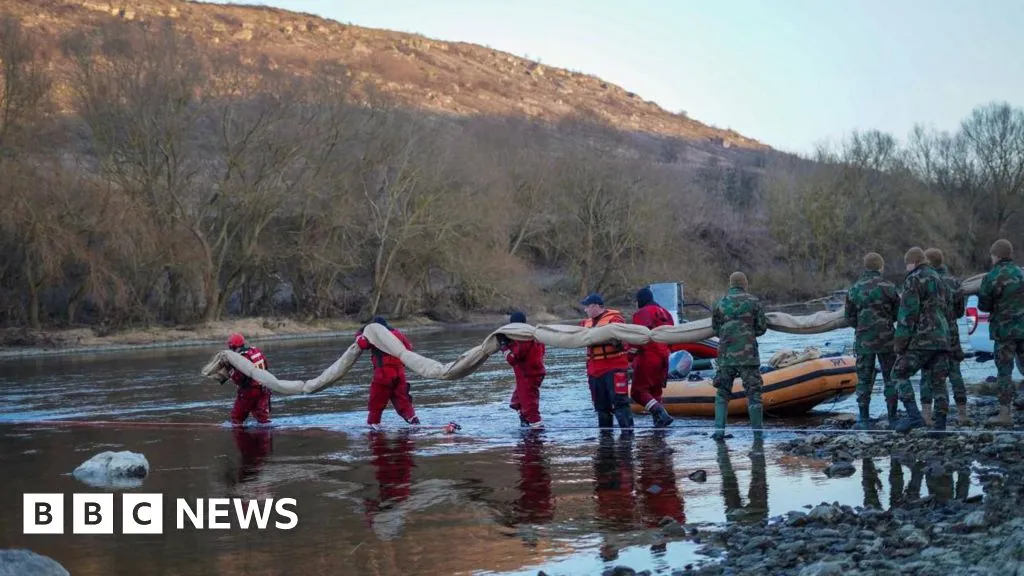
3 hours agoPaul KirbyEurope digital editorCNMC MoldovaOil pollution has left supplies in the city of Balti unsafe to drink, officials sayAn oil spill which has been blamed on a Russian attack in Ukraine has polluted a major river in Moldova, prompting authorities to cut water supplies to the northern city of Balti.Ukrainian authorities said oil began leaking after a Russian strike on the Dniester Hydroelectric Plant on 7 March, with the first slicks appearing three days later on the Dniester River - a vital source for most of Moldova and the Odesa region in southwestern Ukraine.Moldova imposed a 15-day state of alert in the Dniester River basin on Monday as a precaution.Russia's ambassador was summoned by the foreign ministry in protest and shown a bottle of cloudy water from the polluted river.He refused to comment to reporters as he left the meeting, according to Moldovan media.Moldovan Environment Minister Gheorghe Hajder said supplies would only be restored once oil levels had been brought down to the recommended limit of 0.1mg per litre of water.He added that Monday night's readings were too high for northern areas including Balti, the third-largest city in Moldova, and further results on Tuesday would indicate whether or not the water could be pumped back into the pipes.Three other northern towns have been hit by the water crisis.The pollution has also affected water supplies in Ukraine, with contamination in the Chernivtsi, Vinnytsya and Odesa regions, according to Ukrainian Deputy Minister Iryna Ovcharenko.Moldovan Foreign MinistryOleg Ozerov, Russia's ambassador to Moldova, was shown a bottle of water taken from the Dniester riverHajder said earlier that Ukrainian officials had assured him the source of the oil pollution had been contained. Schools in the Balti area have moved to online learning, while authorities focus on delivering tankers of drinkable water to the local population.Maia Sandu, Moldova's pro-European president, has been a strong supporter of Ukraine since Russia's full-scale invasion in February 2022, praising Kyiv for protecting her own country from attack.She has said Russia "bears full responsibility" for the oil pollution.Russia has long accused Sandu of being "Russiaphobic". She won a second term as president of Moldova in 2024 despite what the EU called "unprecedented interference [in the election] by Russia".Moldova has a population of 2.4 million, but Russia still has a military base in the Russian-speaking, breakaway region of Transnistria, which lies along much of Moldova's eastern border with Ukraine. Local TV reports say oil has been spotted in Transnistria although officials there do not expect to impose restrictions on drinking water.Meanwhile, Moldovan police have said an "active" Russian drone, armed with an "explosive device", has landed 500m (1640ft) inside the Ukraine-Moldova border in the village of Tudora.
SRCBBC News - World
LANGEN
LEANCenter
WORDS447
ENT12
TUE · 2026-03-17 · 16:10 GMTBRIEF NSR-2026-0317-25419
NSR-2026-0317-25419News Report·EN·Environmental
Water supply cut in Moldova after oil spill blamed on Russian strike in Ukraine
An oil spill, attributed to a Russian strike on a Ukrainian hydroelectric plant on March 7th, has contaminated the Dniester River, a vital water source for Moldova and southwestern Ukraine. The pollution prompted Moldova to declare a state of alert and cut water supplies to Balti and three other northern towns.
BBC News - WorldFiled 2026-03-17 · 16:10 GMTLean · CenterRead · 2 min
BBC News - WorldFIG 01
Reading time
2min
Word count
447words
Sources cited
6cited
Entities identified
12entities
Quality score
100%
§ 01
Briefing Summary
AI-generatedNEWSAR · AI
An oil spill, attributed to a Russian strike on a Ukrainian hydroelectric plant on March 7th, has contaminated the Dniester River, a vital water source for Moldova and southwestern Ukraine. The pollution prompted Moldova to declare a state of alert and cut water supplies to Balti and three other northern towns. Ukrainian regions including Chernivtsi, Vinnytsya, and Odesa are also affected. Moldova summoned the Russian ambassador in protest, demanding action to reduce oil levels in the water. Schools in Balti have shifted to online learning as authorities provide drinking water via tankers. Moldova's president holds Russia responsible for the pollution, while Russia accuses her of Russophobia.
Confidence 0.90Sources 6Claims 5Entities 12
§ 02
Article analysis
Model · rule-basedFraming
Environmental
Conflict
Tone
Measured
AI-assessed
CalmNeutralAlarmist
Factuality
0.80 / 1.00
Factual
LowHigh
Sources cited
6
Well sourced
FewMany
§ 03
Key claims
5 extracted01
Russia 'bears full responsibility' for the oil pollution.
quoteMaia Sandu, Moldova's pro-European president
Confidence
1.00
02
Supplies would only be restored once oil levels had been brought down to the recommended limit of 0.1mg per litre of water.
quoteMoldovan Environment Minister Gheorghe Hajder
Confidence
1.00
03
Moldova imposed a 15-day state of alert in the Dniester river basin on Monday.
factualnull
Confidence
1.00
04
Oil pollution has left supplies in the city of Balti unsafe to drink.
factualofficials
Confidence
1.00
05
Oil began leaking after a Russian strike on the Dniester hydroelectric plant on 7 March.
factualUkrainian authorities
Confidence
0.90
§ 04
Full report
2 min read · 447 words§ 05
Entities
12 identifiedKey playerOppositionContextPositiveNeutralNegative
§ 06
Keywords & salience
10 termswater pollution
0.90
oil spill
0.80
moldova
0.80
russia
0.70
ukraine
0.70
water supply cut
0.70
dniester river
0.60
russian strike
0.60
balti
0.50
state of alert
0.40
§ 07
Topic connections
Interactive graph Network visualization showing 22 related topics
View Full Graph Person Organization Location Event|Click node to navigate|Edge numbers = shared articles