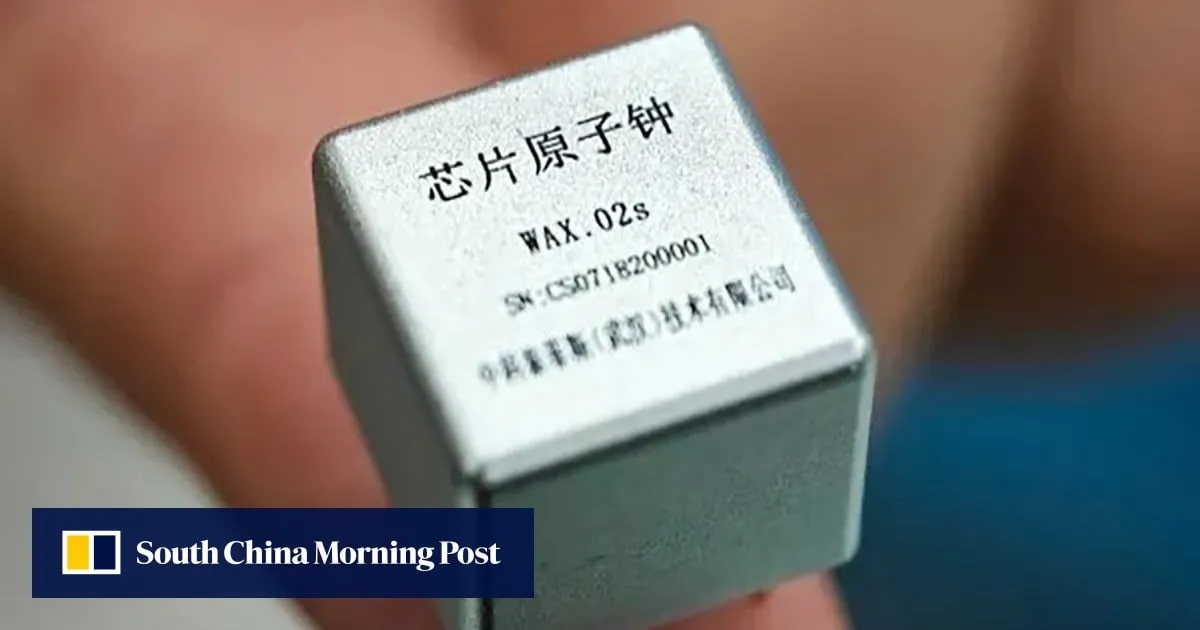
Timing is everything in modern warfare, where even a nanosecond’s delay can make the difference between hitting or missing a target in a coordinated drone or missile attack.China may now have taken a major step forward in this field with the mass production of the world’s smallest atomic clock – something the researchers behind it say could transform drone warfare, underwater navigation and battlefield communication.Developed by a research team led by Professor Chen Jiehua from Wuhan University’s Satellite Navigation and Positioning Technology Research Centre, the clock only loses a second every 30,000 years, according to the official newspaper Changjiang Daily.The device measures just 2.3 cubic cm (0.14 cubic inch), less than one-seventh the size of the leading US models and about the size of a fingernail.“Even if traditional atomic clocks are miniaturised, the minimum volume limit is still several hundred cubic centimetres and the minimum power consumption is at least several watts,” Chen told the newspaper.According to Chen, the US has produced a 17 cubic cm product, but his team’s clock has a comparable performance even though it is much smaller.
SRCSouth China Morning Post
LANGEN
LEANCenter-Right
WORDS181
ENT6
THU · 2026-03-19 · 04:00 GMTBRIEF NSR-2026-0319-25911
NSR-2026-0319-25911News Report·EN·National Security
Why tiny atomic clocks may hold the key to China mass-producing cheap swarm drones
A Chinese research team at Wuhan University, led by Professor Chen Jiehua, has developed a miniature atomic clock with potential implications for military technology. The clock, measuring only 2.3 cubic cm, is significantly smaller than existing US models while maintaining comparable performance, losing only one second every 30,000 years.
Chao KongSouth China Morning PostFiled 2026-03-19 · 04:00 GMTLean · Center-RightRead · 1 min
South China Morning PostFIG 01
Reading time
1min
Word count
181words
Sources cited
1cited
Entities identified
6entities
Quality score
100%
§ 01
Briefing Summary
AI-generatedNEWSAR · AI
A Chinese research team at Wuhan University, led by Professor Chen Jiehua, has developed a miniature atomic clock with potential implications for military technology. The clock, measuring only 2.3 cubic cm, is significantly smaller than existing US models while maintaining comparable performance, losing only one second every 30,000 years. Researchers claim this breakthrough could revolutionize drone warfare, underwater navigation, and battlefield communication by enabling more precise timing and coordination. The mass production of this compact and accurate clock could allow for cheaper and more effective drone swarms and other advanced military applications for China.
Confidence 0.90Sources 1Claims 5Entities 6
§ 02
Article analysis
Model · rule-basedFraming
National Security
Technology
Tone
Mixed Tone
AI-assessed
CalmNeutralAlarmist
Factuality
0.70 / 1.00
Factual
LowHigh
Sources cited
1
Limited
FewMany
§ 03
Key claims
5 extracted01
The device measures just 2.3 cubic cm (0.14 cubic inch).
factual
Confidence
1.00
02
The clock only loses a second every 30,000 years.
statisticChangjiang Daily
Confidence
0.90
03
US has produced a 17 cubic cm product.
factualChen Jiehua
Confidence
0.80
04
China may now have taken a major step forward in this field with the mass production of the world’s smallest atomic clock.
factual
Confidence
0.70
05
The clock could transform drone warfare, underwater navigation and battlefield communication.
prediction
Confidence
0.60
§ 04
Full report
1 min read · 181 words§ 05
Entities
6 identifiedKey playerOppositionContextPositiveNeutralNegative
Organizations3
§ 06
Keywords & salience
8 termsatomic clock
1.00
swarm drones
0.80
drone warfare
0.70
miniaturization
0.60
mass production
0.50
navigation
0.50
timing
0.50
wuhan university
0.40
§ 07
Topic connections
Interactive graph Network visualization showing 51 related topics
View Full Graph Person Organization Location Event|Click node to navigate|Edge numbers = shared articles