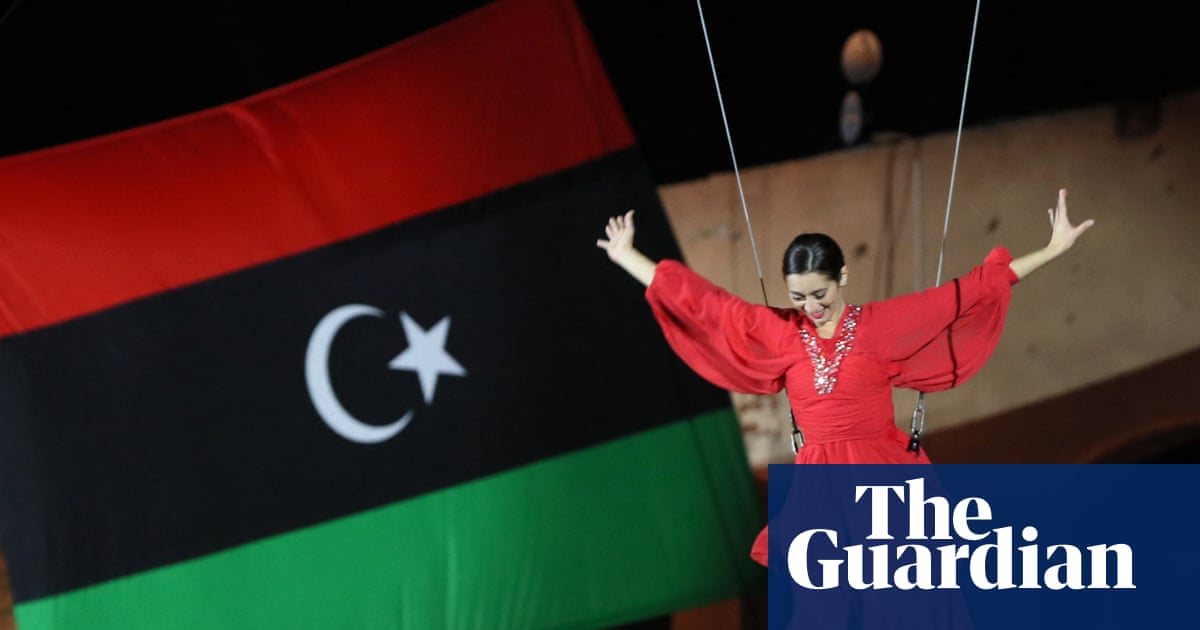
It was a night at the museum like no other. As the staccato sound of firecrackers and explosions rang out across Martyr’s Square in the heart of Tripoli, for once it was not Libya’s militias battling it out for a larger stake in the country’s oil economy, but a huge firework display celebrating the reopening of one of the finest museums in the Mediterranean.The National Museum of Libya – housing Africa’s greatest collection of classical antiquities in Tripoli’s historic Red Castle complex – had been closed for nearly 14 years due to the civil war that followed the former dictator Muammar Gaddafi’s downfall. Its ceremonial reopening came at the climax of a lavish show compressing Libya’s rich history and attended by diplomats and Arab celebrities, with a full-size Italian orchestra, acrobats, dancers, arches of fire and lights projected on to the fort. It did not lack for circus drama or cost, peaking with a billowing Ottoman sailing ship arriving high above the port on wires to be greeted by an angelic-appearing Libyan woman.A fireworks display during the reopening ceremony. Photograph: Libyan government platform/ReutersAbdul Hamid Dbeibah, the prime minister of Libya’s UN-recognised government of national unity – Libya has two rival governments, one in the east and one in the west – was then taken to the doors of the museum, where he wielded a big stick, as if at the opening of the British parliament, to hammer on them and demand entry. The giant wooden doors drew open slowly and crowds poured in.Inside, Libya’s history revealed itself – a record of a vast country shaped by successive occupations from Greek to Roman, Ottoman and Italian. On its four floors could be found cave paintings worthy of Lascaux; 5,000-year-old mummies from the ancient settlements of Uan Muhuggiag in Libya’s deep south; tablets in the Punic alphabet; and countless treasures from the still largely unvisited Roman coastal cities of Leptis Magna and Sabratha, including spell-binding mosaics, friezes and statues of great public figures and gods. Gone, however, was Gaddafi’s turquoise VW beetle, once given pride of place in the collection and one of the museum’s few losses to the uprising.Speaking the next day in offices once occupied by Italian archeologists on the top floor of the Red Castle, Dr Mustafa Turjman, the former head of the department of antiquities, recalled evacuating all the museum’s works to secret hideaways to keep them from robbers and smugglers. He admitted there was hesitation about the reopening, after artefacts from the tiniest coin to giant statues were brought back from hiding.Visitors at the National Museum in Tripoli. Photograph: Libyan government platform/ReutersTurjman said the museum showed people what Libya had once been – a region of great cultural and economic self-confidence, well connected to the world beyond the sea. “We are part of the Mediterranean,” he said.This was not just a moment for classicists, or lovers of Libya’s rich history, Turjman said, but a moment for a country riven between its eastern and western regions to come together. “This is a museum about the whole of Libya … the archaeological masterpieces of the whole country. It is a force for unification,” he said. “So when people from Tripoli [in the west] come here they see statues from [the eastern region of] Cyrenaica, and when Cyrenaicans come they see their heritage, so it helps reunify the two regions … We are relatives. Their cousins are here and out cousins are here.”Turjman hopes the museum will help educate Libyans after the distorted teaching of the Gaddafi era, and the first few weeks of the museum’s opening is dedicated to bringing in schoolchildren. “The most important thing is teaching the mind. Teaching how to respect time and history, and how to respect others, and to be involved in the world,” he said. “We have to build the minds. My generation studied the philosophy of the Greeks as part of our heritage, but this stopped. Libya is often an arid remote region, but we kept this heritage: it shows our willpower.”Statues in the National Museum. Photograph: Libyan government platform/ReutersPersuading the world to see Libya “through optimist’s eyes”, as the government slogan puts it, could be a tough ask. True, embassies are reopening, as are long-closed luxury hotels. The British oil multinational BP has reopened its office and new oil investments are planned. Luxury waterfront marinas have been built. A drive-in food complex has sprung up. But there is much to overcome.A Libyan passport provides free passage to virtually nowhere and the country remains close to the bottom of world league tables for press freedom and corruption. On the museum’s opening night a notorious people smuggler, Ahmed al-Dabbashi, was reported shot dead in a gunfight with Libyan security forces in Sabratha. Australia only last week advised its citizens to stay away; in Tripoli’s al-Madina souq some of the shops say they are open only two hours a day due to the lack of visitors.Dbeibah is disarmingly frank in interview about his country’s failings, including the arrest of three of his ministers in a corruption investigation, even if he insisted spending was transparent down to the last dinar. He admitted the country’s inability to shake off its dependency on the oil economy meant that 2.5 millions Libyans were on the government payroll – roughly a third of the population. Distorting but popular subsidies also mean petrol is cheaper than water, costing less than £1 to fill a tank. The price makes it a target for smuggling that the various auditing agencies seem incapable of preventing.The official reopening came at the climax of a lavish ceremony. Photograph: Mahmud Turkia/AFP/Getty ImagesPressed on why the east and west of the country had set up conflicting parallel institutions since the 2014 uprising, he blamed politicians and not the people.Dbeibah has not been elected to office. Becoming prime minister in 2021 as part of a UN-supervised process, he was due to stay in power only until elections across the country could be held. But a parliament or president with a meaningful mandate remains a distant prospect so long as the political elite in east and west prefer the personal riches disunity brings.The UN Libya mission is organising “a structured dialogue” in an effort to reconcile the country ahead of elections possibly next year, but Dbeibah says he opposes holding a vote until there has been a referendum on a new constitution. The merry-go-round of west and east setting preconditions for elections never stops. One Libyan official said: “Libyans have no clue about politics. Gaddafi prevented that.”Dbeibah knocking on the museum door. Photograph: Libyan government platform/ReutersOne of the very first visitors to the museum was the Egyptian comedian and TV host Bassem Youssef, who has millions of social media followers and has appeared on Piers Morgan’s TV show to speak about the Gaza war.He said it had taken time to convince his wife it would be safe to visit Libya, and reflected on “the rectangular screen in our pockets that shapes our consciousness and minds”. He said Libya was in the news only when it was embroiled in conflict or other problems, and when things calmed down the media were no longer interested. It was as if for an Arab country to be in the news, something had to be wrong, he said.“The image of any country or society has nothing to do with the reality on the ground, but rather with the lens through which one sees reality,” he said. “Unfortunately, we must admit that this lens, which transmits the image of most of our Arab countries, is broken, cracked and distorted.”
SRCThe Guardian - World News
LANGEN
LEANCenter-Left
WORDS1 264
ENT4
TUE · 2025-12-16 · 05:00 GMTBRIEF NSR-2025-1216-2852
NSR-2025-1216-2852News Report·EN·Human Interest
Libya looks to its past to build a new future as national museum reopens
After nearly 14 years of closure due to civil war, the National Museum of Libya in Tripoli reopened with a lavish ceremony. The museum, located in the historic Red Castle complex, houses Africa's largest collection of classical antiquities, showcasing Libya's rich history shaped by Greek, Roman, Ottoman, and Italian occupations.
Patrick Wintour in TripoliThe Guardian - World NewsFiled 2025-12-16 · 05:00 GMTLean · Center-LeftRead · 6 min
The Guardian - World NewsFIG 01
Reading time
6min
Word count
1 264words
Sources cited
1cited
Entities identified
4entities
Quality score
100%
§ 01
Briefing Summary
AI-generatedNEWSAR · AI
After nearly 14 years of closure due to civil war, the National Museum of Libya in Tripoli reopened with a lavish ceremony. The museum, located in the historic Red Castle complex, houses Africa's largest collection of classical antiquities, showcasing Libya's rich history shaped by Greek, Roman, Ottoman, and Italian occupations. The reopening was attended by diplomats and celebrities, featuring a large-scale performance and fireworks display. The museum's collection includes cave paintings, ancient mummies, Punic tablets, and treasures from Roman coastal cities. During the closure, the museum's artifacts were evacuated to secret locations to protect them from theft. The reopening signifies Libya's effort to rebuild and look to its past for a new future.
Confidence 0.90Sources 1Claims 5Entities 4
§ 02
Article analysis
Model · rule-basedFraming
Human Interest
Political Strategy
Tone
Measured
AI-assessed
CalmNeutralAlarmist
Factuality
0.80 / 1.00
Factual
LowHigh
Sources cited
1
Limited
FewMany
§ 03
Key claims
5 extracted01
Dr. Mustafa Turjman recalled evacuating all the museum’s works to secret hideaways.
quoteDr. Mustafa Turjman
Confidence
1.00
02
Abdul Hamid Dbeibah, the prime minister of Libya’s UN-recognised government of national unity, attended the reopening.
factual
Confidence
1.00
03
The National Museum of Libya reopened after being closed for nearly 14 years due to civil war.
factual
Confidence
1.00
04
The museum houses Africa’s greatest collection of classical antiquities in Tripoli’s historic Red Castle complex.
factual
Confidence
0.90
05
The museum showed people what Libya had once been – a region of great cultural and economic self-confidence.
quoteDr. Mustafa Turjman
Confidence
0.80
§ 04
Full report
6 min read · 1 264 words§ 05
Entities
4 identifiedKey playerOppositionContextPositiveNeutralNegative
§ 06
Keywords & salience
9 termsnational museum of libya
1.00
libya
0.90
cultural heritage
0.80
museum reopening
0.80
classical antiquities
0.70
historical artifacts
0.60
civil war
0.60
red castle
0.50
muammar gaddafi
0.40
§ 07
Topic connections
Interactive graph Network visualization showing 29 related topics
View Full Graph Person Organization Location Event|Click node to navigate|Edge numbers = shared articles