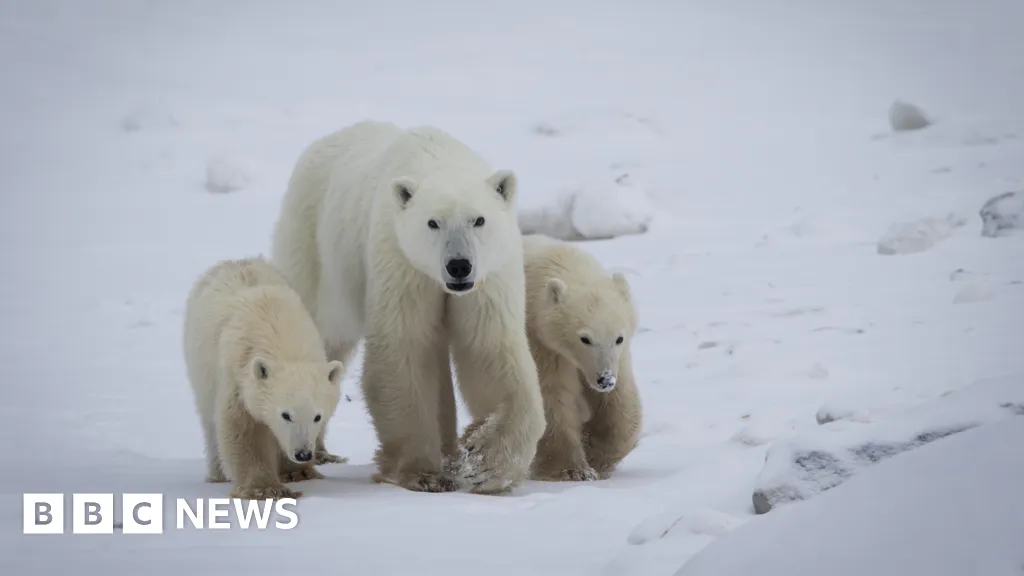
Researchers tracking wild polar bears in northern Canada witnessed something exceedingly rare this fall: a mother bear adopting a cub that was not biologically her own. The five-year-old mother bear and her 10- to 11-month-old cubs were observed and captured on camera during the annual polar bear migration along the Western Hudson Bay near Churchill, Manitoba, a town known for its polar bear population."It's unusual," Alyssa McCall, a scientist at Polar Bears International, said in a video. "We don't really know why it happens...but we know it doesn't happen often at all."It's only the 13th known case of adoption out of the 4,600 bears studied for nearly five decades in the area. The mother bear was first captured as she emerged from her maternity den this spring. At the time, she had one cub, which scientists tagged for study.In the fall, she was seen again, but this time with two cubs - the original cub that had been tagged and another without a tag. Researchers aren't sure what happened to the new cub's biological mother, but they are trying to identify her with genetic samples. "The bears need all the help they can get these days with climate change," Evan Richardson, a polar bear scientist with Environment and Climate Change Canada, said in a video statement. "If females have the opportunity to pick up another cub and care for it and successfully wean it, it's a good thing for bears in Churchill."Polar bears in the wild only have a 50% chance of surviving into adulthood, but having a mother caring for them improves their odds. The cubs appear to be healthy, researchers said, and they will likely stay with their mother until they are about two-and-a-half years old. Next, the family is expected to head out to sea ice, where the cubs will learn from their mother how to hunt seals and survive on their own. "It's just nice to know that the bears are looking out for each other," Richardson said.
SRCBBC News - World
LANGEN
LEANCenter
WORDS332
ENT3
WED · 2025-12-17 · 15:55 GMTBRIEF NSR-2025-1217-3119
NSR-2025-1217-3119News Report·EN·Environmental
Polar bear mother adopts cub in rarely documented case
Researchers in northern Canada observed a rare polar bear adoption near Churchill, Manitoba, documenting only the 13th known case in nearly five decades of studying the area's 4,600 bears. A five-year-old mother bear, initially seen with one cub this spring, was observed this fall with two cubs, one of which was not her biological offspring.
BBC News - WorldFiled 2025-12-17 · 15:55 GMTLean · CenterRead · 2 min
BBC News - WorldFIG 01
Reading time
2min
Word count
332words
Sources cited
2cited
Entities identified
3entities
Quality score
100%
§ 01
Briefing Summary
AI-generatedNEWSAR · AI
Researchers in northern Canada observed a rare polar bear adoption near Churchill, Manitoba, documenting only the 13th known case in nearly five decades of studying the area's 4,600 bears. A five-year-old mother bear, initially seen with one cub this spring, was observed this fall with two cubs, one of which was not her biological offspring. Scientists are unsure of the adopted cub's origins but are attempting to identify its biological mother through genetic samples. This adoption is considered beneficial for the species, as polar bear cubs face a high mortality rate, and maternal care significantly improves their chances of survival. The cubs are expected to remain with their adoptive mother for about two-and-a-half years, learning essential hunting skills before venturing out on their own.
Confidence 0.90Sources 2Claims 5Entities 3
§ 02
Article analysis
Model · rule-basedFraming
Environmental
Human Interest
Tone
Measured
AI-assessed
CalmNeutralAlarmist
Factuality
0.80 / 1.00
Factual
LowHigh
Sources cited
2
Limited
FewMany
§ 03
Key claims
5 extracted01
The bears need all the help they can get these days with climate change.
quoteEvan Richardson, Environment and Climate Change Canada
Confidence
1.00
02
Polar bears in the wild only have a 50% chance of surviving into adulthood.
statisticnull
Confidence
1.00
03
It's only the 13th known case of adoption out of the 4,600 bears studied for nearly five decades in the area.
statisticAlyssa McCall, Polar Bears International
Confidence
1.00
04
A mother bear adopted a cub that was not biologically her own.
factualResearchers
Confidence
1.00
05
The cubs appear to be healthy.
factualResearchers
Confidence
0.90
§ 04
Full report
2 min read · 332 words§ 05
Entities
3 identifiedKey playerOppositionContextPositiveNeutralNegative
§ 06
Keywords & salience
9 termspolar bear adoption
1.00
mother bear
0.80
polar bear cubs
0.70
wild polar bears
0.60
climate change
0.60
hudson bay
0.50
churchill, manitoba
0.50
genetic samples
0.40
sea ice
0.40
§ 07
Topic connections
Interactive graph Network visualization showing 6 related topics
View Full Graph Person Organization Location Event|Click node to navigate|Edge numbers = shared articles