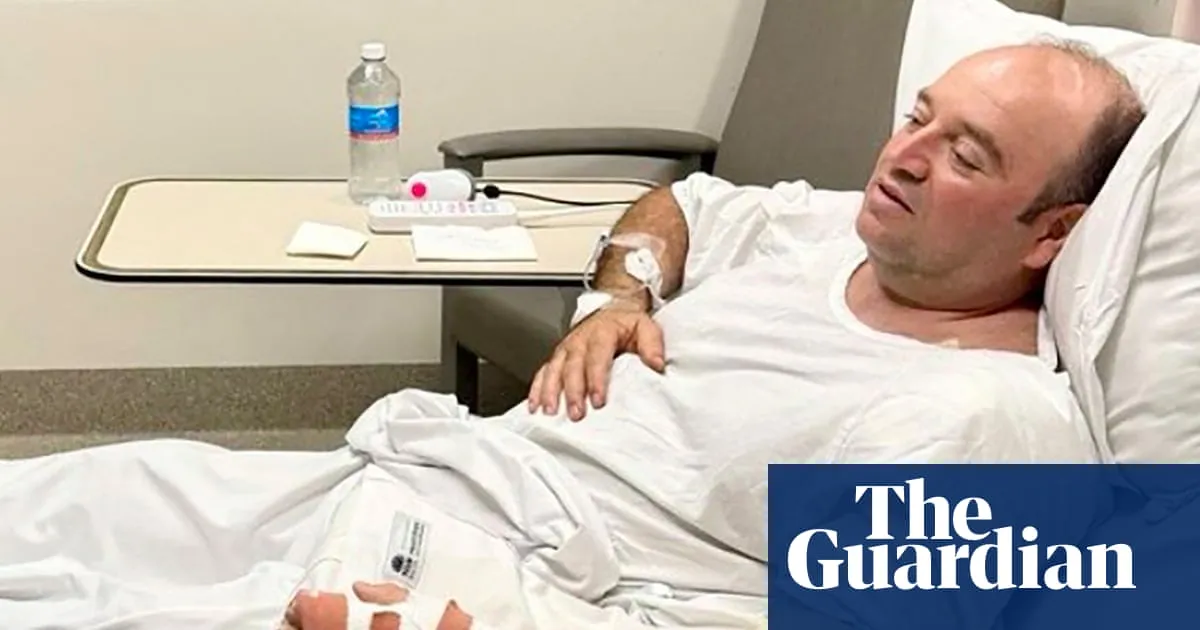
As a knife-wielding terrorist wearing a fake suicide belt caused panic on London Bridge in 2019, Darryn Frost remembers entering a state of intense focus.Having grabbed a decorative narwhal tusk from the wall of Fishmongers’ Hall, the formerly shy civil servant zoned in on the danger and ran towards it, helping pin the attacker to the ground.It is unclear why Frost went from bystander to “have-a-go hero”, much like Ahmed al-Ahmed, who wrestled a gun off one of the attackers on Sydney’s Bondi Beach on Sunday.Ahmed al-Ahmed, who risked his life wrestling alleged Bondi shooter, speaks in hospital – videoFor Frost, 44, the answer is neither simple nor instinctive. He has spoken to Steven Gallant, who was on day release from prison when he used a chair to help bring down the attacker, Usman Khan, who had killed two people. “He said he reacted on instinct, whereas I was thinking about every action and consequence of it,” Frost said.When the London Bridge attack unfolded inside the hall on 29 November 2019, Frost said chaos and confusion took hold. “There was screaming, noise, no one knew what was going on and I imagine it would have been the same on Bondi Beach.”Darryn Frost: ‘I can still remember the flecks of dust in the air.’ Photograph: Graeme Robertson/The GuardianRunning towards danger, he insisted, was not a natural impulse. “I don’t think it comes naturally to anyone. I saw Saskia [Jones, who was killed by the attacker] fall to the stairs, and she was very clearly severely injured. So the next thought in my mind was: ‘I need to prevent that from happening to anyone else’.”He said what followed felt unreal: “It’s crazy, but this was all happening in split seconds. It really is like the Superman or Spider-Man movies, or the Matrix, where time literally slows down for you.”He said his senses narrowed to a single point: the attacker. “I had tunnel vision,” he recalled. “My hearing switched off to everything around me except for the perpetrator in front of me. It’s a really strange thing. Sirens, alarms were going off, I couldn’t even hear that. All I could hear was what he was saying and anything that he did, my hearing just became super fine-tuned.“My vision went tunnel vision just on to him so anything in the periphery I couldn’t see at all, and what I could see was super-high detail like an 8K TV. I can still remember the flecks of dust in the air.”A neuroscientist, Dr Daniel Glaser, said humans, like all mammals, exhibit a natural “fight or flight” response to threat or surprise, but it does not dictate the course of action they choose.“It prepares your muscles, and to some extent your brain, for action, but the action that you take depends on a bunch of other things,” he said.“How you perceive what’s happening changes what you’ll do, and your perceptions are driven by prejudice and expectations. Your sense of what’s happening depends on what you expect to be happening and how you read different situations.“You shouldn’t necessarily think about it as a choice. There’s very good evidence to say that lots of things in the brain which determine your behaviour happen before you’re aware of them.”He said the kind of bravery that caused people to run towards danger while others were running away was guided not by “instinct”, but by life experiences and any training they may have had.Earlier this week, Dan Barr, a former soldier, was hailed as a hero for jumping into the car of Paul Doyle, who drove into crowds of pedestrians at the Liverpool FC parade.Dan Barr. Photograph: Peter Byrne/PAProf Craig Jackson, a chartered member of the British Psychological Society, who has a specialist interest in gun violence and mass killings, said there was no “profile” of the kind of person who would “have a go”.“It’s just as likely to be an angry mum in defence mode as it could be a fit, healthy rugby-playing male,” said the professor of workplace health psychology at Birmingham City University. “That’s reassuring because that means that attackers, either lone wolves or terrorists, they’re never quite sure who’s going to be the hero who could challenge them.”During the London Bridge attack in 2017 Roy Larner, 56, a football fan, was stabbed in his hands, chest and head as he tried to fight off three knife-wielding terrorists with his fists.“Fuck you, I’m Millwall,” he shouted after Khuram Butt, Rachid Redouane and Youssef Zaghba burst into the Black and Blue steakhouse.Roy Larner pictured around 2017. Photograph: Facebook“They’d come in and kicked the door open, and that’s when the three of them started stabbing me. I started fighting back with them, but it gave that 20 or 30 people a chance to get out in front of me. It nearly cost me my life,” he recalled.“I was fighting for my life. Punching and punching and punching. [I was stabbed] eight times and slashed in the head as well. They were slicing me, stabbing me. I broke my ribs when I went back into the table. But luckily – my arm’s a bit weak still – but nothing major. It’s only the trauma side of it that really hurt me.”Larner, who was hailed the “Lion of London Bridge”, said he made a split-second decision to intervene.“You should run. [But] you can be an idiot and take three on,” he said. “There was an older bloke with us, about 78, and I think that was the reason why I stood there. But obviously it gave other people a chance to get out as well.”Larner, who lives in Peckham, south London, was not formally recognised for his bravery and did not receive compensation for his injuries. He said it was because he had convictions, including for racially aggravated common assault.Despite this, he said he would not hesitate to intervene again. “I’ve never had any boxing training or anything like that. [But] I’ve done something good. Whether that makes up for the bad things I’ve done, who knows?”
SRCThe Guardian - World News
LANGEN
LEANCenter-Left
WORDS1 004
ENT3
FRI · 2025-12-19 · 17:12 GMTBRIEF NSR-2025-1219-3515
NSR-2025-1219-3515News Report·EN·Human Interest
When attacks unfold, what makes a person run towards danger?
The article explores the motivations behind individuals who run towards danger during attacks, using the examples of Darryn Frost in the 2019 London Bridge attack and Ahmed al-Ahmed in the recent Bondi Beach shooting. Frost, a civil servant, used a narwhal tusk to help subdue the London Bridge attacker after witnessing a victim's severe injury.
Emine SinmazThe Guardian - World NewsFiled 2025-12-19 · 17:12 GMTLean · Center-LeftRead · 5 min
The Guardian - World NewsFIG 01
Reading time
5min
Word count
1 004words
Sources cited
1cited
Entities identified
3entities
Quality score
100%
§ 01
Briefing Summary
AI-generatedNEWSAR · AI
The article explores the motivations behind individuals who run towards danger during attacks, using the examples of Darryn Frost in the 2019 London Bridge attack and Ahmed al-Ahmed in the recent Bondi Beach shooting. Frost, a civil servant, used a narwhal tusk to help subdue the London Bridge attacker after witnessing a victim's severe injury. He describes a state of intense focus and narrowed senses during the event, contrasting his conscious actions with the instinctive reactions of others. The article highlights the perplexing nature of this "have-a-go hero" phenomenon, noting that running towards danger is not a natural impulse. A neuroscientist suggests a "fight or flight" response may be at play.
Confidence 0.90Sources 1Claims 5Entities 3
§ 02
Article analysis
Model · rule-basedFraming
Human Interest
Tone
Measured
AI-assessed
CalmNeutralAlarmist
Factuality
0.70 / 1.00
Factual
LowHigh
Sources cited
1
Limited
FewMany
§ 03
Key claims
5 extracted01
The London Bridge attack unfolded inside Fishmongers’ Hall on 29 November 2019.
factualArticle
Confidence
1.00
02
Humans exhibit a natural “fight or flight” response to threat or surprise.
quoteDr Daniel Glaser
Confidence
1.00
03
Frost said he was thinking about every action and consequence of it during the attack.
quoteDarryn Frost
Confidence
1.00
04
Ahmed al-Ahmed wrestled a gun off one of the attackers on Sydney’s Bondi Beach.
factualArticle
Confidence
1.00
05
Darryn Frost helped pin the London Bridge attacker to the ground using a narwhal tusk.
factualArticle
Confidence
1.00
§ 04
Full report
5 min read · 1 004 words§ 05
Entities
3 identifiedKey playerOppositionContextPositiveNeutralNegative
§ 06
Keywords & salience
8 termsrunning towards danger
0.90
london bridge attack
0.80
fight or flight
0.70
bystander intervention
0.60
tunnel vision
0.60
instinct
0.50
intense focus
0.50
heroism
0.40
§ 07
Topic connections
Interactive graph Network visualization showing 2 related topics
View Full Graph Person Organization Location Event|Click node to navigate|Edge numbers = shared articles