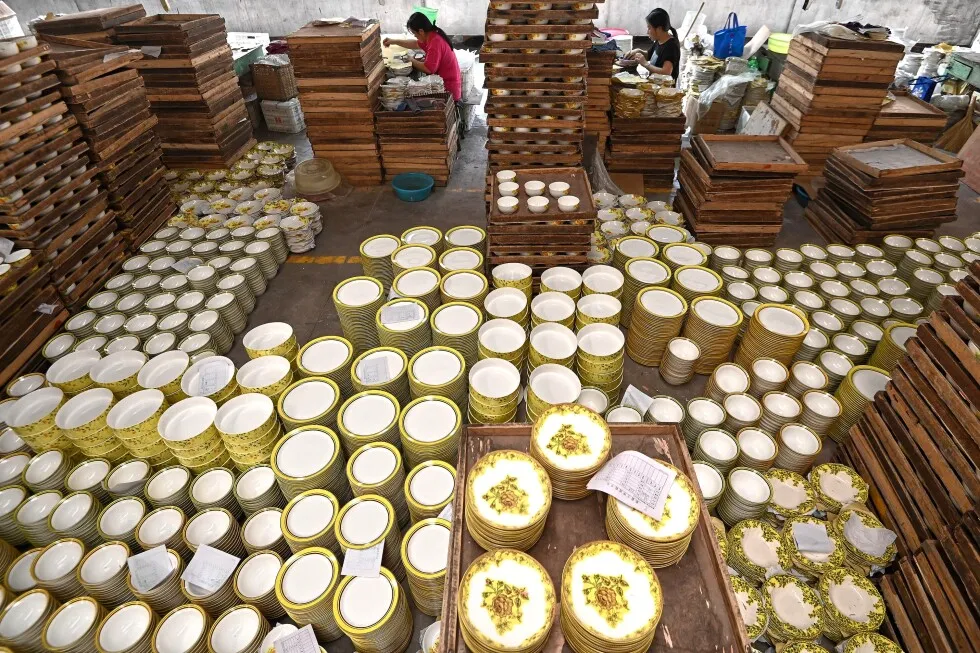
Workers labor at a ceramic ware factory, in Handan in north China’s Hebei province on Nov. 4, 2025. (Chinatopix Via AP, File) Updated [hour]:[minute] [AMPM] [timezone], [monthFull] [day], [year] HONG KONG (AP) — China’s factory activity expanded in March, ending two months of contraction, the government said Tuesday, but analysts say prolonged impacts of the Iran war could weigh on growth.The official manufacturing purchasing managers index rose to 50.4 from 49 in February, the National Bureau of Statistics reported, beating economists’ expectations and notching the strongest reading in a year. PMI is measured on a scale of 0 to 100 and a reading above 50 indicates expansion.While the latest official data covered a period after the Iran war began on Feb. 28, analysts say the impacts of surging energy costs have not yet been fully seen. “So far supply disruptions have not occurred in a material way,” said Jacqueline Rong, Chief China Economist, BNP Paribas, a French bank.A years-long property sector slump in China has also weighed on economic growth and weakened domestic consumption and investment demand in China, the world’s second-largest economy after the U.S. To help drive its economy, China has been reliant on growing exports, especially to regions such as Southeast Asia and Europe, which propelled its trade surplus last year to a record $1.2 trillion despite higher U.S. tariffs. China’s export engine could hit headwinds as the Iran war drive up energy costs and disrupts supply chains, with most maritime traffic blocked from passing the Strait of Hormuz, through which roughly a fifth of the world’s oil normally passes. The extent of the impact will depend on how long the energy flows from the Middle East are cut off, said BNP Paribas’ Rong. “If it is months, rather than weeks, then the supply disruptions, not just from oil, but also from the shortage of many chemical products — such as rare gases — would manifest itself in disrupting industrial production and services,” she said. China’s exports could also suffer if overall global growth takes a serious hit from the energy crisis, Rong said. Analysts say, for example, higher global inflation could weaken consumption demand for Chinese goods. For now, China’s economy “appears to have weathered” the energy shock from the Iran war well, wrote Zichun Huang, China economist at Capital Economics, in a recent research note, although she also cautioned it is “likely that the fallout from the Iran war will grow over the coming months.”With China’s exports to the U.S., its largest trading partner, in decline over the past months, economists are closely watching for positive signs in trade relations between Washington and Beijing as U.S. President Donald Trump is expected to meet with Chinese leader Xi Jinping in May.Some analysts say lower U.S. tariffs following a recent Supreme Court ruling against Trump’s wide-reaching global tariffs could give China a small boost to exports and factory activity.
SRCAssociated Press (AP)
LANGEN
LEANCenter
WORDS482
ENT12
TUE · 2026-03-31 · 06:53 GMTBRIEF NSR-2026-0331-44583
NSR-2026-0331-44583News Report·EN·Economic Impact
China factory activity rebounds in March as Iran war looms over growth
China's factory activity rebounded in March, according to the National Bureau of Statistics, with the manufacturing purchasing managers index rising to 50.4, signaling expansion after two months of contraction. While this data covers the period after the Iran war began in late February, analysts suggest the full impact of surging energy costs and potential supply chain disruptions are yet to be seen.
By
CHAN HO-HIMAssociated Press (AP)Filed 2026-03-31 · 06:53 GMTLean · CenterRead · 2 min
Associated Press (AP)FIG 01
Reading time
2min
Word count
482words
Sources cited
5cited
Entities identified
12entities
Quality score
100%
§ 01
Briefing Summary
AI-generatedNEWSAR · AI
China's factory activity rebounded in March, according to the National Bureau of Statistics, with the manufacturing purchasing managers index rising to 50.4, signaling expansion after two months of contraction. While this data covers the period after the Iran war began in late February, analysts suggest the full impact of surging energy costs and potential supply chain disruptions are yet to be seen. A prolonged war and blocked Strait of Hormuz could disrupt global energy flows and supplies of key chemical products, impacting China's industrial production and exports. China's economy, already facing challenges from a property sector slump, relies heavily on exports, and a global economic slowdown due to the energy crisis could further weaken demand for Chinese goods. The extent of the impact hinges on the duration of energy flow disruptions from the Middle East.
Confidence 0.90Sources 5Claims 5Entities 12
§ 02
Article analysis
Model · rule-basedFraming
Economic Impact
Tone
Measured
AI-assessed
CalmNeutralAlarmist
Factuality
0.85 / 1.00
Factual
LowHigh
Sources cited
5
Well sourced
FewMany
§ 03
Key claims
5 extracted01
China’s property sector slump has weighed on economic growth and weakened domestic consumption and investment demand.
factualJacqueline Rong, Chief China Economist at BNP Paribas
Confidence
1.00
02
The official manufacturing purchasing managers index rose to 50.4 from 49 in February.
statisticNational Bureau of Statistics
Confidence
1.00
03
China’s factory activity expanded in March, ending two months of contraction.
factualNational Bureau of Statistics
Confidence
1.00
04
If it is months, rather than weeks, then the supply disruptions would manifest itself in disrupting industrial production and services.
quoteJacqueline Rong, Chief China Economist at BNP Paribas
Confidence
0.90
05
China’s exports could suffer if overall global growth takes a serious hit from the energy crisis.
predictionJacqueline Rong, Chief China Economist at BNP Paribas
Confidence
0.80
§ 04
Full report
2 min read · 482 words§ 05
Entities
12 identifiedKey playerOppositionContextPositiveNeutralNegative
Organizations3
Locations6
§ 06
Keywords & salience
9 termschina factory activity
0.90
iran war
0.80
economic growth
0.70
manufacturing pmi
0.70
supply chain disruptions
0.60
energy costs
0.60
exports
0.50
global inflation
0.40
trade surplus
0.40
§ 07
Topic connections
Interactive graph Network visualization showing 51 related topics
View Full Graph Person Organization Location Event|Click node to navigate|Edge numbers = shared articles