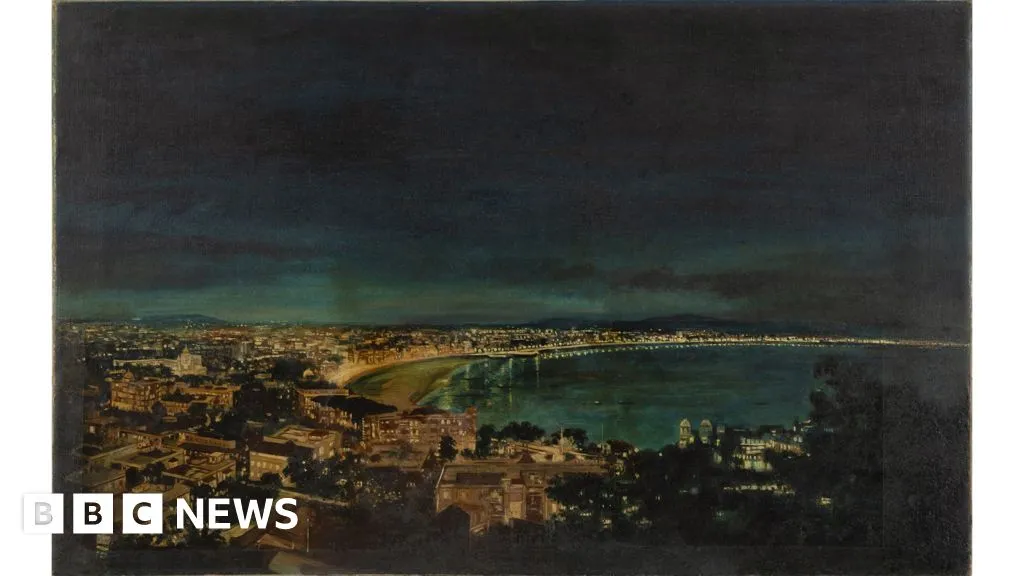
How Bombay went from a fort city to a bustling metropolis2 hours agoNikhil InamdarMumbaiDAGA painting of a night view of Marine Drive, called the 'Queen's Necklace', captures Bombay's modern glowFrom seven islands to a city of 20 million, Bombay (now Mumbai) has been shaped over centuries by political, economic and social forces.From Koli fisherfolk to colonial planners, and from Bollywood stars to textile barons, many have shaped the western Indian city's landscape and identity.The city is ever-evolving, the past giving way to the future, birthing new guises and blurring the old. From fishing nets to ports and mills to malls, Bombay has constantly reinvented itself and remained a city in flux.A new exhibition 'Bombay Framed' charts the city's shape-shifting passage through the centuries using a stunning array of paintings, photographs and multimedia prints.More than 100 images spanning three centuries have an extraordinary range that document the city in its full diversity from the elite worlds of Zoroastrian merchants and cinema stars to working-class lives of ordinary citizens."Together they invite us to see the city itself as a kind of artwork: layered, complex and made up of many different experiences," Gyan Prakash, curator of the exhibition, told the BBC.DAGThe map shows land reclamation and growing infrastructure in early 20th Century Bombay DAGA ceremonial military scene from early British rule in BombayAccording to Prakash there are a few key moments when Bombay really changed - in the 1830s and 40s, when reclamations and bunds joined the seven separate islets into a single island city. Two decades later, in the 1860s, the fort walls came down, paving the way for imperial buildings to come up which gave the city its distinct colonial identity. In the 1920s and 30s the Marine Drive corniche, with its Art Deco buildings was constructed, birthing a uniquely modern architectural style that departed from the earlier Victorian Gothic character. Since the 2000s the city's planners have been preoccupied with building more utilitarian infrastructure, with new sea bridges and coastal roads, radically transforming how the city looks today. DAGAn early photograph of Horniman Circle, a key colonial-era commercial hubDAGThis print by MV Dhurandhar captures Bombay's trams before they were phased out in the 1960sThrough its history, Bombay has remained a city of stark contradictions and wild extremes - luxury towers jostling for space with shanty towns, the restless chaos of the city standing in contrast to the calmness of the ocean surrounding it and heritage structures co-existing with the city's modern pursuits. This is a city of ancient caves but also of modern mills and atomic research facilities, which makes it impossible for two people to view it in the same way. DAGThe Karla Caves are among many ancient rock-cut caves around MumbaiDAGThe Bhabha Atomic Research Centre in Trombay was part of India's post-independence scientific build-upBut a city's soul is animated not just by its buildings and structures but also by the people who inhabit it. And the exhibition tries to tell its story through the everyday life of its many denizens. "Even the early British picturesque views of the sea and boats include human figures, reminding us that the environment was always shaped by human activity," says Prakash. From Parsi philanthropists and Maharashtrian nobility to mill workers and marginalised migrant settlers, the photographs showcase the city's many faces that stake a claim to the making of Bombay. The commissioned portraits of Parsi elite "reflect the patronage networks and social aspirations of the community" which formed the mercantile fabric of the city in the early 20th century.In stark contrast, works by artists like Chittaprosad, who was known for his sharp social and political critique, depict working-class life. DAGParsi merchants and elites supported local artists in colonial institutionsDAGArtist Chittaprosad's sketch of a fish seller shows life on Bombay's marginsWhile Bombay brought cinema to India, cinema lived on its streets and not just on celluloid. The exhibition has a vivid line up of vintage film posters from the 1950s and 60s that were once pasted across the city's walls, as well as photographs by JH Thakkar, founder of India Photo Studio in Dadar. "His moody, meticulously composed silver gelatin portraits shaped how audiences saw stars like Raj Kapoor, Nargis, Dev Anand, Meena Kumari and Dilip Kumar," the curatorial note says. DAGThe exhibition features a vivid collection of film posters from the 1950s and 60sDAGBollywood star Dev Anand in a black-and-white portrait by JH ThakkarThe city's name was officially changed from Bombay to Mumbai in the mid-1990s. Authorities said that was to shed its colonial legacy, making the older name politically charged for some.Prakash says their exhibition is titled "Bombay Framed" rather than "Mumbai Framed" simply because most of the images come from a time when the city was officially known as Bombay. "For Marathi speakers, it was always Mumbai. I'm agnostic about the name, as are many people, which reflects the city's long history of dual names and multiple perspectives. It really only becomes contentious when the issue is politicised."
SRCBBC News - World
LANGEN
LEANCenter
WORDS828
ENT8
SAT · 2026-04-04 · 00:09 GMTBRIEF NSR-2026-0404-51523
NSR-2026-0404-51523News Report·EN·Human Interest
How Bombay went from a fort city to a bustling metropolis
An exhibition called "Bombay Framed" chronicles the transformation of Bombay (now Mumbai) from seven islands into a metropolis of 20 million people. The exhibition uses paintings, photographs, and multimedia prints to showcase the city's evolution over three centuries.
BBC News - WorldFiled 2026-04-04 · 00:09 GMTLean · CenterRead · 4 min
BBC News - WorldFIG 01
Reading time
4min
Word count
828words
Sources cited
1cited
Entities identified
8entities
Quality score
100%
§ 01
Briefing Summary
AI-generatedNEWSAR · AI
An exhibition called "Bombay Framed" chronicles the transformation of Bombay (now Mumbai) from seven islands into a metropolis of 20 million people. The exhibition uses paintings, photographs, and multimedia prints to showcase the city's evolution over three centuries. Key periods of change include land reclamation in the 1830s and 40s that unified the islands, the demolition of fort walls in the 1860s which allowed for the construction of colonial buildings, and the development of Marine Drive in the 1920s and 30s. Since 2000, the focus has been on utilitarian infrastructure like sea bridges and coastal roads. The exhibition aims to portray Bombay as a layered artwork shaped by diverse experiences, from fisherfolk to colonial planners, and Bollywood stars to textile barons.
Confidence 0.90Sources 1Claims 5Entities 8
§ 02
Article analysis
Model · rule-basedFraming
Human Interest
Economic Impact
Tone
Measured
AI-assessed
CalmNeutralAlarmist
Factuality
0.70 / 1.00
Factual
LowHigh
Sources cited
1
Limited
FewMany
§ 03
Key claims
5 extracted01
Marine Drive corniche, with its Art Deco buildings was constructed in the 1920s and 30s.
factualGyan Prakash
Confidence
1.00
02
In the 1860s, the fort walls came down, paving the way for imperial buildings.
factualGyan Prakash
Confidence
1.00
03
In the 1830s and 40s, reclamations joined the seven separate islets into a single island city.
factualGyan Prakash
Confidence
1.00
04
Since the 2000s the city's planners have been preoccupied with building more utilitarian infrastructure.
factualNikhil Inamdar
Confidence
0.90
05
Bombay has been shaped over centuries by political, economic and social forces.
factualNikhil Inamdar
Confidence
0.90
§ 04
Full report
4 min read · 828 words§ 05
Entities
8 identifiedKey playerOppositionContextPositiveNeutralNegative
Organizations1
§ 06
Keywords & salience
8 termsbombay/mumbai
1.00
city evolution
0.80
urban development
0.70
colonial history
0.60
architecture
0.60
social change
0.50
land reclamation
0.50
cultural identity
0.40
§ 07
Topic connections
Interactive graph No topic relationship data available yet. This graph will appear once topic relationships have been computed.