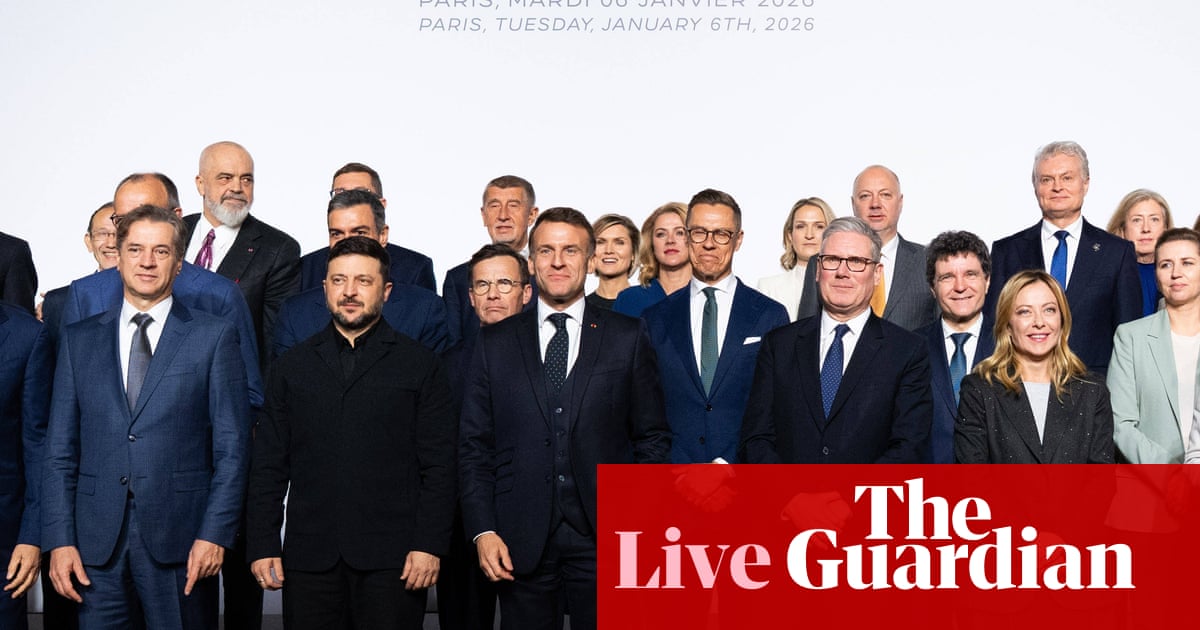
From 35m agoMultinational force would ensure 'regeneration of Ukrainian armed forces' - draft statementWe have some more of the draft statement – drawn up by Ukraine’s western allies – now. In the event that that end to this war is achieved – it would provide crucial security guarantees to Kyiv to help deter future Russian aggression.“There will be a continuous, reliable ceasefire monitoring system. This will be led by the US with international participation,” the draft statement said.The multinational force to be deployed after a ceasefire would provide “reassurance measures in the air, at sea and on land” for Ukraine and ensure the “regeneration of the armed forces of Ukraine”, it added. “These elements will be European-led”.There would be US participation in the force “including US capabilities such as intelligence and logistics”, and “a US commitment to support the force in case of attack” by Russia, it said.There would also be “binding commitments to support Ukraine in the case of a future armed attack by Russia in order to restore peace”.These commitments “may include the use of military capabilities, intelligence and logistical support, diplomatic initiatives, adoption of additional sanctions,” it said.Key eventsnowA ceasefire is still needed first35m agoMultinational force would ensure 'regeneration of Ukrainian armed forces' - draft statement1h agoReports US committing to supporting multinational defence of Ukraine in event of another Russia attack2h agoZelenskyy discussed more defences for Ukraine with Macron2h agoWhat Denmark has said2h agoMiller ramped up Trump's Greenland threat3h agoEurope would commit to binding guarantees to protect Ukraine, draft statement shows3h agoZelenskyy arrives for EU-US talks on peace4h agoEurope says Arctic security should be achieved 'collectively with Nato allies including US'4h agoEuropean allies 'are stepping up' in the Arctic4h agoEuropean leaders issue joint statement defending Denmark and Greenland4h agoWhat guarantees have been discussed so far4h agoPoland says Denmark can rely on European solidarity regarding Greenland4h agoDenmark says a US attack on Greenland would be end of security order4h agoMorning opening: Ukraine on the agenda at a perilous momentShow key events onlyPlease turn on JavaScript to use this featureA ceasefire is still needed firstWhile these details of what support the US and Europe could offer Ukraine post-war are interesting – a European-led defence force supported by Washington, US-led monitoring of a ceasefire- the key thing is that we’re still far from an end to the war, given Russia has shown no sign it’s ready to stop fighting.So this “reassurance force” of measures is just what happens after a ceasefire, “rather than being a means to getting to one”, points out Matthew Savill, from the London-based Royal United Services Institute defence and security think tank.“European countries an the US would ideally be increasing support for Ukraine and pressure on Russia to get to deal, otherwise this post-ceasefire work will only exist on paper,” he tells the Guardian.Multinational force would ensure 'regeneration of Ukrainian armed forces' - draft statementWe have some more of the draft statement – drawn up by Ukraine’s western allies – now. In the event that that end to this war is achieved – it would provide crucial security guarantees to Kyiv to help deter future Russian aggression.“There will be a continuous, reliable ceasefire monitoring system. This will be led by the US with international participation,” the draft statement said.The multinational force to be deployed after a ceasefire would provide “reassurance measures in the air, at sea and on land” for Ukraine and ensure the “regeneration of the armed forces of Ukraine”, it added. “These elements will be European-led”.There would be US participation in the force “including US capabilities such as intelligence and logistics”, and “a US commitment to support the force in case of attack” by Russia, it said.There would also be “binding commitments to support Ukraine in the case of a future armed attack by Russia in order to restore peace”.These commitments “may include the use of military capabilities, intelligence and logistical support, diplomatic initiatives, adoption of additional sanctions,” it said.According to AFP reporting of this draft statement, the US would lead a “ceasefire monitoring and verification mechanism” that would involve the Europeans, in the eventuality of a ceasefire.In addition, the US would also commit to “support” a European-led multinational force – deployed in Ukraine after an eventual ceasefire – “in case of” a new attack by Russia.Details about this arrangement are thin at the moment but we will continue to bring you the latest as we get it.Reports US committing to supporting multinational defence of Ukraine in event of another Russia attackSome other key lines emerging from this draft summit statement, reported by news wire AFP.It reportedly says the US is committing to supporting a multinational Ukraine defence force if Russia were to attack again.Also, that the US would lead efforts in monitoring a ceasefire.Zelenskyy discussed more defences for Ukraine with MacronMacron with Zelensky during a working meeting as part of the Coalition of the Willing summit Photograph: Eric Tschaen/Sipa/ShutterstockZelenskyy also wrote on X about 15 minutes ago that he’d had a meeting with Macron where they had discussed further supplies of defence weapons.“Diplomacy and real assistance must go hand in hand. Russia does not stop its strikes against our country, and right now we need to bolster air defence to protect our people, our communities, and critical infrastructure.“Every delivery of air defence missiles saves lives and boosts the chances for diplomacy. That is why every meeting must yield concrete results – new decisions regarding air defence, new assistance packages, and new capabilities to protect the skies.“During our meeting with President Macron, this was exactly what we discussed – Ukraine’s real capabilities to counter Russian terror, our defence, and the support that can strengthen our positions in diplomacy.”He also shared a video of their meeting in the palace.Zelenskyy earlier shared video of him stepping off a Ukraine-flagged plane upon arrival in France.He wrote on Telegram that there would be “important negotiations” with allied leaders of the “Coalition of the Willing” today, with the Nato secretary-general and the US delegation. He called them “negotiations that should give more protection and strength to Ukraine.“We count on the support of partners and steps that can guarantee real security for our people.”What Denmark has saidDenmark’s Prime Minister Mette Frederiksen was quick to push back on Monday against Trump’s renewed call to takeover Greenland, a semi-autonomous territory of the Danish kingdom. She said an attack by the US on a Nato ally would mean the end of the military alliance and “post-second world war security”. It would, she warned, mark the end of “everything”.Denmark, Greenland push back on Trump remarks, say Greenland not for conquest - videoIn her statement today released jointly with six other European countries (UK, France, Germany, Italy, Poland and Spain) she stressed: “Greenland belongs to its people. It is for Denmark and Greenland, and them only, to decide on matters concerning Denmark and Greenland.”With Trump having refused to rule out the use of force to take Greenland, the Danish foreign policy committee has called an extraordinary meeting of the Danish parliament on Tuesday night to discuss its relationship with the US.It will be attended by the foreign minister, Lars Løkke Rasmussen, and the defence minister, Troels Lund Poulsen.Miller ramped up Trump's Greenland threatBack to the Greenland issue and while we’ve had that statement from European leaders this morning, vigorously defending Denmark, I’ll also flag what Stephen Miller, the US president’s deputy chief of staff for policy said a few hours ago.He told CNN that military intervention would not be needed in order for the US to gain control over Greenland because of its small population – which he incorrectly stated as 30,000 when it is roughly 57,000.He also suggested that Denmark does not have a right to the Arctic territory, which is a former Danish colony and remains part of the Danish kingdom. Copenhagen continues to control Greenland’s foreign and security policy.Asked whether military action against Greenland was off the table, he said:“The real question is what right does Denmark have to assert control over Greenland? What is the basis of their territorial claim? What is their basis of having Greenland as a colony of Denmark?”He added: “The US is the power of Nato. For the US to secure the Arctic region to protect and defend Nato and Nato interests, obviously Greenland should be part of the US. And so that’s a conversation that we’re going to have as a country. That’s a process we’re going to have as a community of nations.”There was, he said, “no need to even think or talk about” a military operation in Greenland, adding: “Nobody is going to fight the US militarily over the future of Greenland. That doesn’t make any sense.”Macron (right) welcoming Zelenskyy at the Elysee Palace Photograph: Jeanne Accorsini/SIPA/ShutterstockJust wanted to remind readers of the key outcomes parties are working on at the Paris summit today.We’ve just had a smidge of detail on commitments allies would provide to Ukraine were Russia to attack again.But allies are also working on securing consensus on: Ways to monitor a ceasefire. Any deployments of a multinational force to protect Ukraine. Continued support and investment for Ukraine’s military (given they will be the first line of defence against any more Russian aggression). Long-term plans for defence co-operation with Europe and Nato. Of course an actual ceasefire would also require Russia to agree to any of the above that would be eventually hashed out in a common Ukraine-Europe-US position. Moscow has shown no sign so far that is ready and willing to end fighting.Europe would commit to binding guarantees to protect Ukraine, draft statement showsEuropean allies would commit to “politically and legally binding” guarantees to protect Ukraine “in the case of a future armed attack by Russia in order to restore peace”, a draft Coalition of Willing statement reads, according to Reuters.“These commitments may include the use of military capabilities, intelligence and logistical support, diplomatic initiatives, adoption of additional sanctions,” said the draft.The statement is being put forward at the summit today at the Elysee Palace and still needs sign-off.The statement says such a “system of politically and legally binding guarantees” will be “activated once a ceasefire enters into force”.You would assume that such pledges would be legally binding but explicitly spelling it out is no doubt a relief to Ukraine. The detail of what those guarantees actually consist of is still unclear beyond the vague categories above.Analysts had noted that it was hoped if European leaders could firm up their commitments to Ukraine at today’s meeting, that would encourage the US to consolidate their pledges to Ukraine on security support.Zelenskyy arrives for EU-US talks on peaceZelenskyy is embraced by French President Macron as he arrives for a meeting of the ‘Coalition of the Willing’ on Ukraine in Paris Photograph: Michel Euler/APUkraine’s president, Volodymyr Zelenskyy, has also just arrived at the Élysée Palace for talks with European leaders and US officials. He was warmly greeted by Macron.Earlier we saw some lines from a draft statement from the “coalition of the willing”, I’ll go through them soon.So we’ve just had that statement from the leaders of France, Germany, Italy, Poland, Spain, Britain, and Denmark on the issue of Greenland, following Trump’s explicit coveting of the Danish territory in the Arctic.It’s a fairly robust message saying Greenland belongs to its people, and only Denmark and Greenland can make decisions on its future.Europe says Arctic security should be achieved 'collectively with Nato allies including US'They note that Arctic security “remains a key priority for Europe” and for Nato. Security in the Arctic must be achieved collectively, in conjunction with Nato allies including the United States.”
SRCThe Guardian - World News
LANGEN
LEANCenter-Left
WORDS1 930
ENT9
TUE · 2026-01-06 · 14:40 GMTBRIEF NSR-2026-0106-5988
NSR-2026-0106-5988News Report·EN·National Security
US reportedly ready to support European-led post-ceasefire defence force for Ukraine – Europe live
A draft statement indicates the US is prepared to support a European-led multinational force for Ukraine following a ceasefire with Russia. The force would provide security guarantees, including air, sea, and land support, and focus on regenerating the Ukrainian armed forces.
Yohannes Lowe (now) and Frances Mao (earlier)The Guardian - World NewsFiled 2026-01-06 · 14:40 GMTLean · Center-LeftRead · 8 min
The Guardian - World NewsFIG 01
Reading time
8min
Word count
1 930words
Sources cited
1cited
Entities identified
9entities
Quality score
100%
§ 01
Briefing Summary
AI-generatedNEWSAR · AI
A draft statement indicates the US is prepared to support a European-led multinational force for Ukraine following a ceasefire with Russia. The force would provide security guarantees, including air, sea, and land support, and focus on regenerating the Ukrainian armed forces. The US would contribute intelligence, logistics, and a commitment to support the force if Russia attacks. Furthermore, the US and Europe would provide binding commitments to support Ukraine in the event of a future Russian attack, potentially including military capabilities, sanctions, and diplomatic initiatives. The agreement is contingent on achieving a ceasefire first. The proposal was drafted by Ukraine's western allies.
Confidence 0.90Sources 1Claims 5Entities 9
§ 02
Article analysis
Model · rule-basedFraming
National Security
Diplomatic
Tone
Measured
AI-assessed
CalmNeutralAlarmist
Factuality
0.70 / 1.00
Factual
LowHigh
Sources cited
1
Limited
FewMany
§ 03
Key claims
5 extracted01
These commitments “may include the use of military capabilities, intelligence and logistical support, diplomatic initiatives, adoption of additional sanctions,”
quotedraft statement
Confidence
0.90
02
US participation in the force includes intelligence and logistics support.
factualdraft statement
Confidence
0.90
03
The multinational force would provide "reassurance measures in the air, at sea and on land" for Ukraine.
quotedraft statement
Confidence
0.90
04
A multinational force would ensure 'regeneration of Ukrainian armed forces'.
quotedraft statement by Ukraine's western allies
Confidence
0.90
05
US is reportedly ready to support a European-led post-ceasefire defence force for Ukraine.
factualEurope live (report)
Confidence
0.80
§ 04
Full report
8 min read · 1 930 words§ 05
Entities
9 identified§ 06
Keywords & salience
10 termsukraine
1.00
ceasefire
0.90
defence force
0.80
security guarantees
0.70
russian aggression
0.70
us support
0.60
multinational force
0.60
armed forces regeneration
0.50
european-led
0.50
military capabilities
0.40
§ 07
Topic connections
Interactive graph Network visualization showing 51 related topics
View Full Graph Person Organization Location Event|Click node to navigate|Edge numbers = shared articles