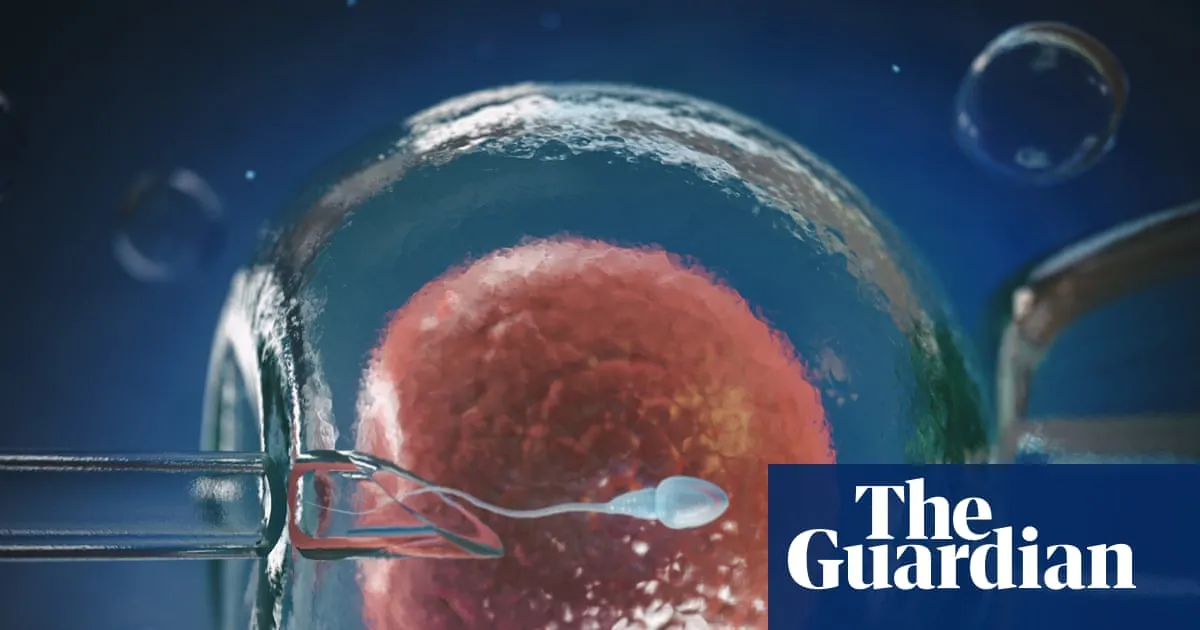
It is a rollercoaster of emotional extremes that will be familiar to many who have gone through IVF treatment: hope and joy turns to despair and back again. This is especially true for women over 35, the age when IVF success rates decline steeply and for whom the only real way to improve the odds is to keep trying.While there has been huge progress in IVF in the past decades, including the advent of genetic testing, egg freezing and techniques to overcome male infertility, the primary cause of age-related female infertility – egg quality – has not been directly addressed.Now, groundbreaking research presented at the Fertility 2026 in Edinburgh this week, suggests progress is on the horizon. Scientists from a leading lab in Germany say they have been able to reverse a common age-related defect in eggs in an advance that they predict could be transformative.“Currently there are no methods for improving the ageing egg. It is a very large unmet need,” said Dr Agata Zielinska, co-CEO of Ovo Labs, and one of the scientists behind the advance. “This would be a first-in-class solution for improving egg quality.”Eggs are uniquely vulnerable to ageing as women are born with all their eggs. Sperm, by contrast, is continuously generated from stem cells in the testes throughout adult life.In IVF treatment, women under 35 had an average birth rate for each embryo transferred of 35% compared with just 5% for women aged 43-44, according to the most recent figures from UK clinics. And it is the age of the egg, not the woman, that matters most. When older women use younger donor eggs or their own frozen eggs the success rate is almost entirely defined by the age of the egg.“Female eggs sit there for a really long time,” said Dr Güneş Taylor, who researches female fertility at the Edinburgh" class="entity-link entity-organization" data-entity-id="7367" data-entity-type="organization">University of Edinburgh. “It’s been quite hard to get a grip on what is going wrong with them. They’re meant to be dormant.”A key part of this puzzle appears to have been cracked by scientists working in the lab of Prof Melina Schuh, a director at the Max Planck Institute for Multidisciplinary Sciences in Göttingen and co-founder of Ovo Labs.They found that as eggs age they have less of a crucial protein, called Shugoshin 1, which acts as a glue to keep the egg’s chromosomes neatly stuck together in X-shaped pairs. Without enough of this adhesive, the chromosomes start to fray apart. This means the chromosome pairs won’t split evenly when the egg is fertilised, leading to a higher rate of embryos with the wrong number of chromosomes.Often, these embryos will begin developing normally, but are not ultimately viable. For IVF patients, this can create an initial sense of hope that is destined to turn to disappointment.“What’s weird about humans is that in the absence of the normal number of chromosomes you can still get quite a long way,” said Taylor. “That’s how you end up with this horrible IVF rollercoaster when you seem to get pregnant and then the cycle fails.”The latest work provides tantalising evidence that an important age-related defect in eggs could be reversible. In results presented in Edinburgh, they showed that eggs that were supplemented with Shugoshin 1 were almost half as likely to show the chromosome defect. This suggests that there could be a window of opportunity in IVF treatment between harvesting the eggs and fertilising them in which eggs could be given a rejuvenating microinjection.“Our aim is to really reduce the time to successful conception,” said Zielinska. “Many more women would be able to conceive within a single IVF attempt.”The research is still at an experimental stage and will need years of further testing. And, in a field known for over-hyping expensive IVF add-ons, patients are right to reserve judgment. Ovo Labs still needs to prove that its proposed technique is safe and that the apparent improvements in egg quality translate to a real difference in IVF rates. The team did not wish to put a time-frame on how long this might take when asked whether this could be a couple of years, five years or a decade.“We don’t want to overpromise,” said Schuh.There is hope, though, that the advance could be a step to overcoming one of the major causes of female infertility – and the reason why the IVF journey is so often so painful.“While we await further details and confirmatory clinical trials, including addressing safety issues, these results have great potential for improving IVF success rates,” said Prof Richard Anderson, head of obstetrics and gynaecology at the Edinburgh" class="entity-link entity-organization" data-entity-id="7367" data-entity-type="organization">University of Edinburgh, who was not involved in the work.“We all have friends who have been struggling with IVF,” said Schuh. “It’s a long journey and such an emotional burden. I really hope we can make this entire experience more successful.”
SRCThe Guardian - World News
LANGEN
LEANCenter-Left
WORDS803
ENT5
FRI · 2026-01-09 · 14:23 GMTBRIEF NSR-2026-0109-6619
NSR-2026-0109-6619News Report·EN·Human Interest
Could egg defect breakthrough help stop the ‘horrible IVF rollercoaster’?
Researchers at Ovo Labs in Germany, working with the Max Planck Institute, have made a potential breakthrough in addressing age-related egg defects, a major factor in female infertility, particularly for women over 35 undergoing IVF. The scientists discovered that aging eggs have reduced levels of the protein Shugoshin 1, which is crucial for maintaining chromosome structure.
Hannah Devlin Science correspondentThe Guardian - World NewsFiled 2026-01-09 · 14:23 GMTLean · Center-LeftRead · 4 min
The Guardian - World NewsFIG 01
Reading time
4min
Word count
803words
Sources cited
3cited
Entities identified
5entities
Quality score
100%
§ 01
Briefing Summary
AI-generatedNEWSAR · AI
Researchers at Ovo Labs in Germany, working with the Max Planck Institute, have made a potential breakthrough in addressing age-related egg defects, a major factor in female infertility, particularly for women over 35 undergoing IVF. The scientists discovered that aging eggs have reduced levels of the protein Shugoshin 1, which is crucial for maintaining chromosome structure. This deficiency leads to chromosome separation issues during fertilization, increasing the risk of embryo abnormalities. The research, presented at Fertility 2026 in Edinburgh, suggests that reversing this protein deficiency could significantly improve egg quality and IVF success rates for older women. This development could offer a much-needed solution to improve outcomes, as current IVF methods do not directly address egg quality decline.
Confidence 0.90Sources 3Claims 5Entities 5
§ 02
Article analysis
Model · rule-basedFraming
Human Interest
Technology
Tone
Mixed Tone
AI-assessed
CalmNeutralAlarmist
Factuality
0.70 / 1.00
Factual
LowHigh
Sources cited
3
Well sourced
FewMany
§ 03
Key claims
5 extracted01
Women under 35 had an average birth rate for each embryo transferred of 35% compared with just 5% for women aged 43-44.
statisticUK clinics
Confidence
1.00
02
As eggs age they have less of a crucial protein, called Shugoshin 1.
factualScientists working in the lab of Prof Melina Schuh
Confidence
0.90
03
Currently there are no methods for improving the ageing egg.
quoteDr Agata Zielinska, co-CEO of Ovo Labs
Confidence
0.90
04
Scientists say they have been able to reverse a common age-related defect in eggs.
factualScientists from a leading lab in Germany
Confidence
0.80
05
This advance could be transformative.
predictionScientists from a leading lab in Germany
Confidence
0.60
§ 04
Full report
4 min read · 803 words§ 05
Entities
5 identifiedKey playerOppositionContextPositiveNeutralNegative
Organizations1
§ 06
Keywords & salience
9 termsivf
1.00
egg quality
0.90
female infertility
0.80
age-related
0.70
shugoshin 1
0.60
chromosome
0.60
fertility
0.50
embryo
0.50
ovo labs
0.40
§ 07
Topic connections
Interactive graph No topic relationship data available yet. This graph will appear once topic relationships have been computed.