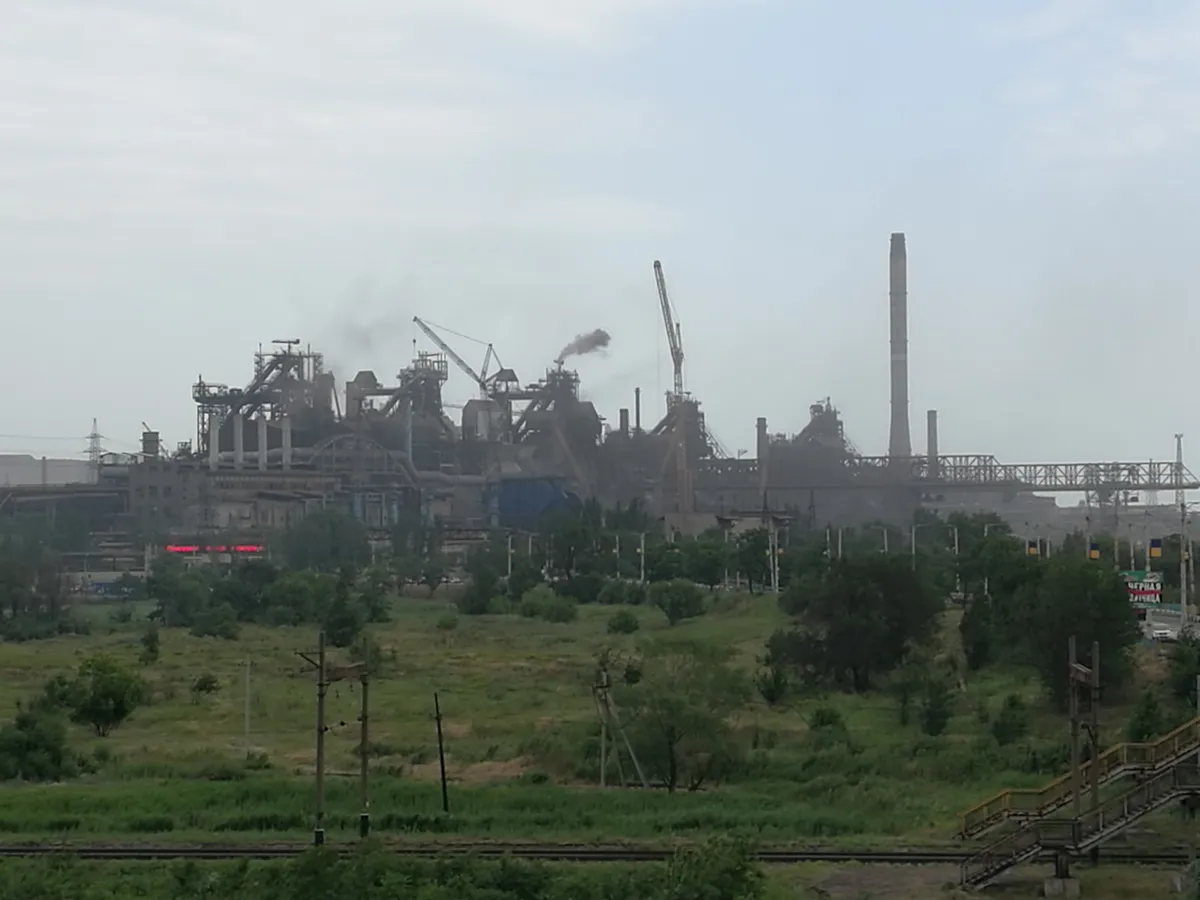
The colossal steel plants along Ukraine’s side of the sea are unrestorable ruins since the invasion, and Russia’s gains equate to ‘almost zero’, analysts say.Ukraine's Azovstal metallurgical plant on the Sea of Azov in 2019. It was destroyed by Russian shelling in 2022 [File: Mansur Mirovalev/Al Jazeera]Published On 14 Apr 2026Kyiv, Ukraine – The first things Mariya Bubnova recalls about the Sea of Azov are the small sailboats she and her friends rented to cruise its warm and barely salty waters.“It was our tradition – to get together once a year,” the dark-haired businesswoman, displaced person and mother of two tells Al Jazeera.These days, Azov is no longer the place of wistful memories for Ukrainians like her. Russia seized it all after its invasion of Ukraine in 2022, and hundreds of thousands of people fled.Bubnova grew up in Mariupol, a southeastern city of almost half a million people and the largest port on Azov. The world’s shallowest sea is the size of Switzerland and was divided between Ukraine and Russia after the 1991 Soviet collapse.Back then, spas and resorts coexisted there with two mammoth steel plants that churned out 40 percent of Ukraine’s steel and polluted the sea breeze.Bypassing fishing flotillas and jam-packed beaches, dozens of freighters shipped millions of tonnes of steel slabs along with wheat, vegetable oils and coal to the Black Sea and farther to the Mediterranean.Almost 1,500km (932 miles) of Azov’s Ukrainian shoreline was a top budget destination for families with small children who could safely frolic in the knee-deep water with almost no waves.Grown-ups flocked to spas offering curative dirt and thermal waters to treat arthritis, skin conditions and allergies.“Since the [Russian] tsars, people came to Azov because it’s curative,” Bubnova says.‘Didn’t take a thing’In 2011, Bubnova and her husband, Serhiy, started selling fruit and vegetables in Mariupol and then diversified into mass production of salads and pickles.And then Russia began chipping away at their business.In 2014, Moscow annexed the Crimean Peninsula, whose northeastern part frames Azov, and helped separatists carve out two totalitarian, economically stillborn “statelets” north of Mariupol.The Bubnovs couldn’t sell their products there any more because of “border checkpoints” and “customs offices”, they say.They received a grant from the United States Agency for International Development (USAID) to produce frozen soups, but the launch of that business was thwarted by Russia’s full-scale invasion in February 2022.Mariupol was hit harder than any Ukrainian city as Russian planes and artillery pounded the city 24/7, killing tens of thousands of civilians and destroying its steel plants and other factories and businesses.Bubnova’s family fled the city in mid-March that year.“We didn’t take a thing, nothing, just walked out,” she says.Shelling destroyed their equipment worth hundreds of thousands of dollars, and their apartment was appropriated by Russia-appointed “authorities”.Bubnova and her two children fled to the Netherlands. They were among hundreds of thousands of Ukrainians who left eastern Ukraine.The Sea of Azov, seen from the Ukrainian side, is the world’s shallowest inland sea [Mansur Mirovalev/Al Jazeera]A decimated GDPUkraine lost all of Azov after the 2022 invasion. Within weeks, Russian forces occupied the entire seashore to create a “land bridge” to safeguard their control of Crimea.Moscow declared Azov its “domestic sea”, and in 2023, Russian President Vladimir Putin signed a decree banning Ukraine from using Azov.The loss of Azov crippled Ukraine’s economy.The sea “has always been of strategic economic importance for Ukraine, primarily as a hub for logistics and exports”, Maryna Horbashevska, head of the management and finance department at Mariupol State University, which has been relocated to Kyiv, tells Al Jazeera.She also fled Mariupol in mid-March 2022.Ukraine lost about 10 to 12 percent of its gross domestic product (GDP), but the figure could be “significantly higher” with the destruction of the Mariupol metallurgical plants, she says.Together with the mineral resources of other Russia-occupied areas north and east of Azov, Ukraine’s losses amounted to $12.4 trillion, according to a survey by SecDev, a Canadian geopolitical risk firm, that was commissioned by The Washington Post in 2022.The losses included almost two-thirds of Ukraine’s coal mines; two-fifths of its metals; a third of its rare earth minerals, including lithium; one-fifth of its natural gas; and 11 percent of its oil deposits, the survey found.To secure its control over Azov, Moscow began building a ring of roads and railroads around the sea.For Moscow, the “acquisition” of Azov became a propaganda tool and a step in boosting state control over the economy.“Russia uses the slogan about Azov as an ‘internal sea’ for propaganda purposes and factors the expenses on the infrastructure [around it] to boost internal demand for industrial production commissioned by the state,” Kyiv-based analyst Aleksey Kushch tells Al Jazeera.A beach on the Ukrainian side of the Sea of Azov as it was in 2019 [File: Mansur Mirovalev/Al Jazeera]A Pyrrhic victory standing on mass gravesBut Ukraine’s losses don’t necessarily translate into Russia’s gains.The steel plants of Mariupol are unrestorable ruins, and their manufacturing processes, which required iron ore from central Ukraine, will hardly be whole again.Russia’s gains in terms of industrial assets equal “almost zero”, Kushch says, because now, Moscow can use only the industrial area of the city of Melitopol, 200km (124 miles) west of Mariupol.Moscow trumpets the “restoration” of Mariupol, but Ukrainian officials say the hastily built buildings stand on the mass graves of slain civilians.Even though the air around Mariupol is cleaner, the seawater is in a deplorable state because of the destroyed sewage system and the pollution from shelling.The brain drain is also crucial as refugees from the area settle in other parts of Ukraine or in the West.After one and a half years in the Netherlands with her children, Bubnova reunited with her husband and settled in Slavutych, a former company town for the closed Chornobyl nuclear power station north of Kyiv.Like other displaced people, they have to adapt to life in a new place with little money and few assets, if any.“I don’t know anything. You have to make every effort to find yourself, start working,” she says.After painstaking planning, she and her husband started a new company to produce canned soups in pouches, and her 19-year-old daughter, Alyna, developed a new recipe for borscht, Ukraine’s trademark beetroot soup.A painter works outside the Ukrainian port of Mariupol on the Sea of Azov in 2018 [File: Mansur Mirovalev/Al Jazeera]A link to the Caspian?There is one possible development that may dramatically boost Azov’s geopolitical status and ruin Ukraine’s chances of reclaiming it.In 2007, the Kremlin unveiled plans to build a canal between Azov and the oil-rich Caspian Sea along a lowland that linked them millions of years ago.The canal would give Caspian nations such as Kazakhstan, Turkmenistan and Azerbaijan access to the Black Sea and to the Mediterranean.If implemented, the project would rival the Suez Canal and bolster Russia’s role in the region, where China and Turkiye are vying for influence.“It will work against China, against Türkiye, partially even against Iran,” Kyiv-based analyst Igar Tyshkevych tells Al Jazeera.“If Russia comes out of the war [and] tries to sell this project to the United States as an infrastructure project that will limit China’s expansion, then it is very bad for us,” he says, “because in this case, Ukraine will simply become a nuisance that stands in [the project’s] way with its demands to have its territories returned.”(Al Jazeera)
SRCAl Jazeera
LANGEN
LEANCenter
WORDS1 218
ENT10
TUE · 2026-04-14 · 06:27 GMTBRIEF NSR-2026-0414-66930
NSR-2026-0414-66930News Report·EN·Economic Impact
The Sea of Azov: Ukraine’s loss but hardly Russia’s gain
Since Russia's 2022 invasion of Ukraine, Russia has seized the Sea of Azov, a body of water shared by both countries after the collapse of the Soviet Union in 1991. Prior to the invasion, the Sea of Azov was a popular destination for Ukrainian families and those seeking therapeutic treatments.
Mansur MirovalevAl JazeeraFiled 2026-04-14 · 06:27 GMTLean · CenterRead · 5 min
Al JazeeraFIG 01
Reading time
5min
Word count
1 218words
Sources cited
2cited
Entities identified
10entities
Quality score
100%
§ 01
Briefing Summary
AI-generatedNEWSAR · AI
Since Russia's 2022 invasion of Ukraine, Russia has seized the Sea of Azov, a body of water shared by both countries after the collapse of the Soviet Union in 1991. Prior to the invasion, the Sea of Azov was a popular destination for Ukrainian families and those seeking therapeutic treatments. The region was also home to large steel plants that produced 40% of Ukraine's steel and supported significant shipping activity. However, these plants are now unrestorable ruins. While Russia controls the Sea of Azov, analysts suggest the economic gains for Russia are minimal, especially considering the destruction of Ukrainian infrastructure. The conflict has displaced hundreds of thousands of people and disrupted local businesses.
Confidence 0.90Sources 2Claims 5Entities 10
§ 02
Article analysis
Model · rule-basedFraming
Economic Impact
Human Interest
Tone
Mixed Tone
AI-assessed
CalmNeutralAlarmist
Factuality
0.70 / 1.00
Factual
LowHigh
Sources cited
2
Limited
FewMany
§ 03
Key claims
5 extracted01
Russia seized the Sea of Azov after its invasion of Ukraine in 2022.
factualAl Jazeera
Confidence
1.00
02
Almost 1,500km of Azov’s Ukrainian shoreline was a top budget destination for families.
factualAl Jazeera
Confidence
0.90
03
The colossal steel plants along Ukraine’s side of the sea are unrestorable ruins since the invasion.
factualanalysts
Confidence
0.90
04
Mariupol was hit harder than any Ukrainian city as Russian planes and artillery pounded the city 24/7.
factualAl Jazeera
Confidence
0.80
05
Russia’s gains equate to ‘almost zero’.
quoteanalysts
Confidence
0.70
§ 04
Full report
5 min read · 1 218 words§ 05
Entities
10 identifiedKey playerOppositionContextPositiveNeutralNegative
Organizations2
§ 06
Keywords & salience
9 termssea of azov
1.00
ukraine
0.90
russia
0.80
invasion
0.70
mariupol
0.60
steel plants
0.60
displaced persons
0.50
economic impact
0.50
crimean peninsula
0.40
§ 07
Topic connections
Interactive graph No topic relationship data available yet. This graph will appear once topic relationships have been computed.