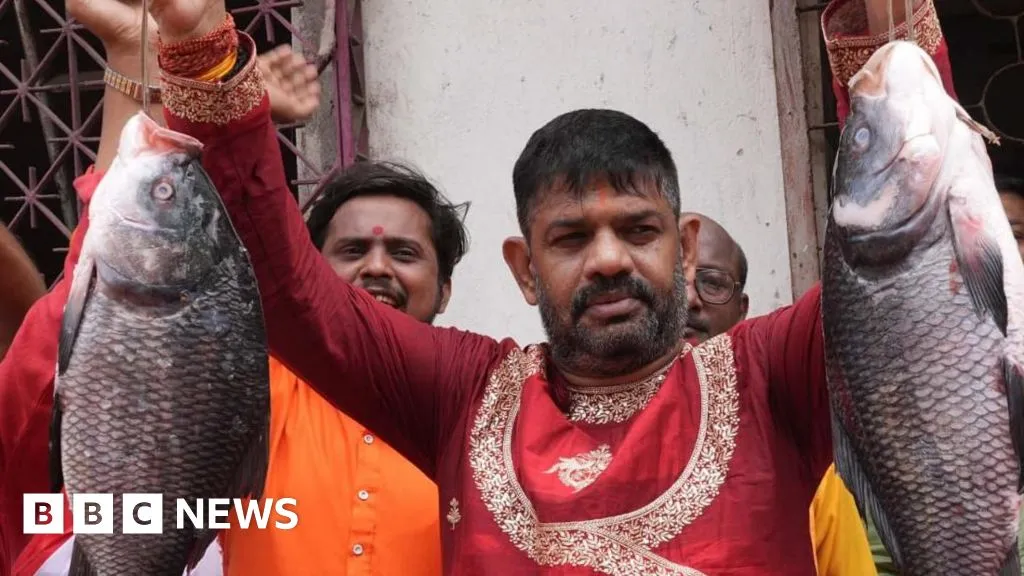
Swapan Dasgupta, the party's candidate from Kolkata's Rashbehari seat, said Banerjee's charge was a distraction: "They are trying to divert public attention from their corruption with this false narrative that we will prohibit fish consumption. This is rubbish."On the campaign trail, Modi himself has turned to fish as a political talking point, recasting it as a marker of governance failure. A vegetarian, he accused Banerjee's government of failing to make Bengal self-reliant in fish."Even after 15 years in power, the Trinamool Congress has failed to provide you with even something as basic as fish. Even fish has to be sourced from outside the state," Modi said.Banerjee hit back instantly, saying 80% of Bengal's fish needs are met locally."You [BJP] do not allow fish consumption in Bihar, Uttar Pradesh and Rajasthan, states that you govern, and organise attacks on fish shops in Delhi. Aren't you ashamed?" she told a campaign meeting.BJP workers campaigning with fish in West BengalBetween cultural anxiety and economic critique, fish has become more than a staple; it is now shorthand for everything the rivals say is at stake.India is the world's third-largest fish producer and second in aquaculture, yet ranks a low 129th globally in per capita fish consumption. But in West Bengal, fish isn't just food - it's near-universal. A 2024 joint study by ICAR and WorldFish found that about 65.7% of people in West Bengal consume fish weekly.It sits alongside eastern and southern states where more than 90% of people eat fish, even as India overall sees a steady rise in fish consumption, now reaching over 70% of the population, according to the report. In Bengal, fish has always carried meanings far beyond the plate, and its political afterlife feels almost inevitable. In his acclaimed Bengali novel Padma Nadir Majhi (The Boatman of the Padma), Manik Bandopadhyay turns fish into fate and survival along a restless river. In The Hungry Tide, novelist Amitav Ghosh binds it to ecology and precarity in the Sundarban delta on the Bay of BengalThe prized hilsa fish, writes Samanth Subramanian in his book Following Fish, is so central that "if Bengali cuisine were Wimbledon, the hilsa would always play on Centre Court". To eat it properly - deboning it deftly in the mouth - is, in his telling, almost a rite of belonging. In Bengal, fish also carries layers of meaning beyond food.It signals geography (river systems like the Ganges River versus the Padma River), history (the legacy of Partition of India separating East and West Bengal), and class - who can afford prized varieties, who prepares them, and who has the cultural know-how to do so.Even Bengal's fiercest football rivalry carries fish: fans of East Bengal FC - many with roots in what is now Bangladesh - are stereotypically partial to hilsa, while Mohun Bagan Super Giant supporters are said to favour prawns. It's a playful shorthand for deeper histories of migration, class and taste.Sociologists believe it is possibly this dense symbolism that has made fish so politically useful. Parties aren't just invoking it; they are folding it into the choreography of the campaign to bait opponents.NurPhoto via Getty ImagesAbout 65.7% of people in West Bengal consume fish weeklyFor historian Jayanta Sengupta, fish is "inseparable from Bengali cuisine, shaped by geography and its long role as an affordable source of protein"."As the BJP has, at times, been associated with a push toward vegetarian norms, Bengal's ruling party has folded food into a broader pitch around cultural pride," says Sengupta."Knowing the symbolic significance of fish, the BJP could not ignore the issue. That's how we see both sides countering each other's campaign over one of Bengal's favourite foods."Last week, the BJP's state President Samik Bhattacharya offered journalists in Kolkata an invitation for results day on 4 May - when, he said, the party would welcome them with fried fish. In another interview, he went further.
SRCBBC News - World
LANGEN
LEANCenter
WORDS645
ENT8
MON · 2026-04-20 · 21:01 GMTBRIEF NSR-2026-0420-71095
NSR-2026-0420-71095News Report·EN·Political Strategy
Indian politicians are campaigning while holding fish. What is going on?
Indian politicians are campaigning while holding fish as a symbol of governance and economic issues. Swapan Dasgupta, a candidate from Kolkata's Rashbehari seat, accused Trinamool Congress leader Mamata Banerjee of diverting public attention with her claim that the BJP will prohibit fish consumption.
BBC News - WorldFiled 2026-04-20 · 21:01 GMTLean · CenterRead · 3 min
BBC News - WorldFIG 01
Reading time
3min
Word count
645words
Sources cited
6cited
Entities identified
8entities
Quality score
75%
§ 01
Briefing Summary
AI-generatedNEWSAR · AI
Indian politicians are campaigning while holding fish as a symbol of governance and economic issues. Swapan Dasgupta, a candidate from Kolkata's Rashbehari seat, accused Trinamool Congress leader Mamata Banerjee of diverting public attention with her claim that the BJP will prohibit fish consumption. Meanwhile, Prime Minister Narendra Modi criticized Banerjee's government for failing to make Bengal self-reliant in fish production, stating that 80% of Bengal's fish needs are met locally. The issue highlights cultural anxiety and economic critique surrounding fish consumption in West Bengal, where it is a staple food item. India is the world's third-largest fish producer, but ranks low globally in per capita fish consumption. The debate has been fueled by regional differences in fish consumption patterns, with West Bengal being one of the states where fish is almost universally consumed.
Confidence 0.90Sources 6Claims 5Entities 8
§ 02
Article analysis
Model · rule-basedFraming
Political Strategy
Human Interest
Tone
Measured
AI-assessed
CalmNeutralAlarmist
Factuality
0.70 / 1.00
Factual
LowHigh
Sources cited
6
Well sourced
FewMany
§ 03
Key claims
5 extracted01
India is the world's third-largest fish producer and second in aquaculture.
factual
Confidence
1.00
02
About 65.7% of people in West Bengal consume fish weekly.
statistic2024 joint study by ICAR and WorldFish
Confidence
1.00
03
80% of Bengal's fish needs are met locally.
quoteBanerjee
Confidence
0.90
04
Even after 15 years in power, the Trinamool Congress has failed to provide you with even something as basic as fish.
quoteModi
Confidence
0.90
05
They are trying to divert public attention from their corruption with this false narrative that we will prohibit fish consumption.
quoteSwapan Dasgupta
Confidence
0.90
§ 04
Full report
3 min read · 645 words§ 05
Entities
8 identifiedKey playerOppositionContextPositiveNeutralNegative
People3
Organizations1