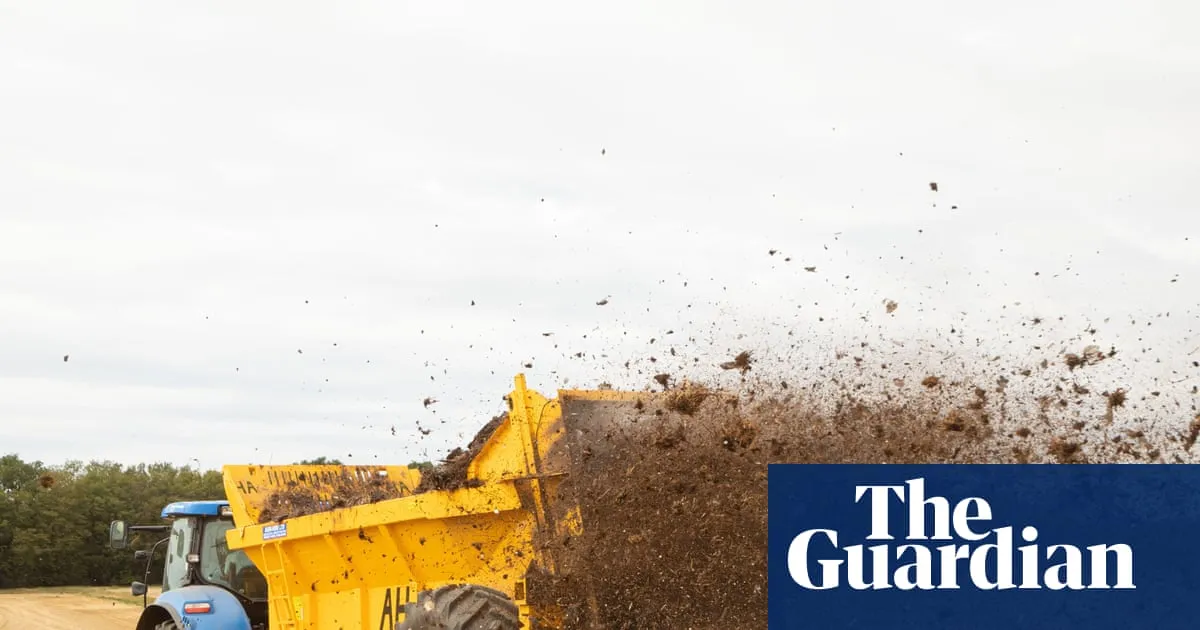
More than 520 chemicals have been found in English soils, including pharmaceutical products and toxins that were banned decades ago, because of the practice of spreading human waste to fertilise arable land.Research by scientists at the University of Leeds, published as a preprint in the Journal of Hazardous Materials, found a worrying array of chemicals in English soils. Close to half (46.4%) of the pharmaceutical substances detected had not been reported in previous global monitoring campaigns.The anticonvulsants lamotrigine and carbamazepine were among the human-use medicines reported for the first time in English soils.A category of chemicals of particular concern to scientists are emerging contaminants, which are pharmaceuticals and other chemicals which have not been widely studied for their impacts on the environment or human health when they re-enter the food chain.Water companies treat human faeces and remove some of the contaminants from wastewater at their treatment centres. The resulting product is treated biosolids, the organic matter from the human waste, and this is often disposed of by being spread on fields as fertiliser.However, it appears that despite decontamination, hundreds of chemicals are leaching into the soil and in some cases staying there for many years. Several chemicals banned or withdrawn from use decades ago were found to persist in agricultural soils.One of the researchers, Laura Carter, a professor of environmental chemistry at the University of Leeds, said: “Some of the chemicals were banned for use decades ago and their presence suggests that they are really persistent … so soils are a long-term sink of these pollutants.”It is possible these chemicals will enter the food chain and be ingested by humans who eat food grown in these fields, she said. It could also harm farm productivity if the chemicals inhibit plant growth or negatively affect soil health.“Some of the work which we did before this monitoring campaign was focused on the uptake and accumulation into crops and looking at effects on soil health and plant health,” she said. “What we need to understand is the subsequent pathway moving from the crops to consumption. Some of these contaminants can [affect] the soil health, and inhibit the nutrients taken up into crops.”To conduct the research, Carter and her team asked farmers to send soil samples to their lab, and also visited some farms themselves. They took a variety of measures to detect what she calls a “chemical fingerprint” of the soil, using methods including mass spectrometry.skip past newsletter promotionafter newsletter promotionThe EU is working to remove these emerging contaminants from wastewater across the continent by passing legislation requiring countries to implement “quaternary treatment”, which is an advanced pollution removal method that can get rid of micropollutants such as these chemicals. The UK has no plans to do this, and for now is sticking with the less precise tertiary treatment systems.“Wastewater treatment processes can remove some contaminants,” Carter said. “We found that the processes are not as efficient as they need to be to remove them.“These chemicals aren’t regulated for so there isn’t a drive to develop or to focus on technologies that can remove them. More advanced treatment like the EU’s planned quaternary treatment will typically remove more.”Soil pollution is understudied compared with wastewater and river research, despite soil being so important for human and environmental health, and the fact contaminants can persist for decades.“This is because of a combination of factors. There are analytical challenges, the chemicals are often at trace levels so you need to develop methods to extract them; the soil and the biosolids and the more agricultural focus means you have the complexity of the environmental metrics to contend with when you are trying to monitor them. And there is a lack of awareness about the pathways in which they enter the environment,” Carter said.The contaminants can be removed, she said: “You can do processes such as actively planting crops so they take up the contaminants and that is a way of removing contaminants from the soil. But then you’d be left with trying to dispose of that contaminated plant.”She was most surprised to find the banned chemicals, because this showed the long-term persistence of contaminants in soil. “They have been prohibited for use for quite some years so we were surprised by their persistence in the soils,” Carter said.“We were also able to detect some anti-cancer drugs which was surprising because there isn’t very much research in this space so we haven’t seen those detected before.”It is not the fault of farmers for spreading this, she said, as it is what they have been told to do in order to be sustainable.“We need to regulate for them properly and we need education to make sure that everybody knows what is being applied and what the potential risks are that are associated with that,” Carter said.
SRCThe Guardian - World News
LANGEN
LEANCenter-Left
WORDS797
ENT1
WED · 2025-12-03 · 09:00 GMTBRIEF NSR-2025-1203-717
NSR-2025-1203-717News Report·EN·Environmental
More than 520 chemicals found in English soil, including long-banned medical substances
A recent study by the University of Leeds found over 520 chemicals, including pharmaceuticals and banned toxins, in English soils. The research, published in the Journal of Hazardous Materials, suggests the chemicals originate from the practice of using treated human waste (biosolids) as fertilizer on arable land.
Helena Horton Environment reporterThe Guardian - World NewsFiled 2025-12-03 · 09:00 GMTLean · Center-LeftRead · 4 min
The Guardian - World NewsFIG 01
Reading time
4min
Word count
797words
Sources cited
1cited
Entities identified
1entities
Quality score
100%
§ 01
Briefing Summary
AI-generatedNEWSAR · AI
A recent study by the University of Leeds found over 520 chemicals, including pharmaceuticals and banned toxins, in English soils. The research, published in the Journal of Hazardous Materials, suggests the chemicals originate from the practice of using treated human waste (biosolids) as fertilizer on arable land. Worryingly, nearly half of the pharmaceutical substances detected were previously unreported in global monitoring. Researchers found that even chemicals banned decades ago persist in the soil, raising concerns about long-term contamination. Scientists are concerned about these chemicals entering the food chain, potentially harming human health and impacting farm productivity by affecting plant growth and soil health. The study highlights the need to understand the pathway of these contaminants from crops to human consumption.
Confidence 0.90Sources 1Claims 5Entities 1
§ 02
Article analysis
Model · rule-basedFraming
Environmental
Public Health
Tone
Mixed Tone
AI-assessed
CalmNeutralAlarmist
Factuality
0.80 / 1.00
Factual
LowHigh
Sources cited
1
Limited
FewMany
§ 03
Key claims
5 extracted01
The UK has no plans to implement quaternary treatment for wastewater.
factual
Confidence
1.00
02
46.4% of the pharmaceutical substances detected had not been reported in previous global monitoring campaigns.
statistic
Confidence
1.00
03
The chemicals include pharmaceutical products and toxins banned decades ago.
factual
Confidence
1.00
04
More than 520 chemicals have been found in English soils.
factual
Confidence
1.00
05
Soils are a long-term sink of these pollutants.
quoteLaura Carter, a professor of environmental chemistry at the University of Leeds
Confidence
0.90
§ 04
Full report
4 min read · 797 words§ 05
Entities
1 identifiedKey playerOppositionContextPositiveNeutralNegative
Organizations1
§ 06
Keywords & salience
9 termssoil contamination
0.90
chemical pollutants
0.80
pharmaceutical substances
0.70
human waste
0.70
emerging contaminants
0.60
agricultural soils
0.60
biosolids
0.50
food chain
0.50
environmental chemistry
0.40
§ 07
Topic connections
Interactive graph Network visualization showing 2 related topics
View Full Graph Person Organization Location Event|Click node to navigate|Edge numbers = shared articles