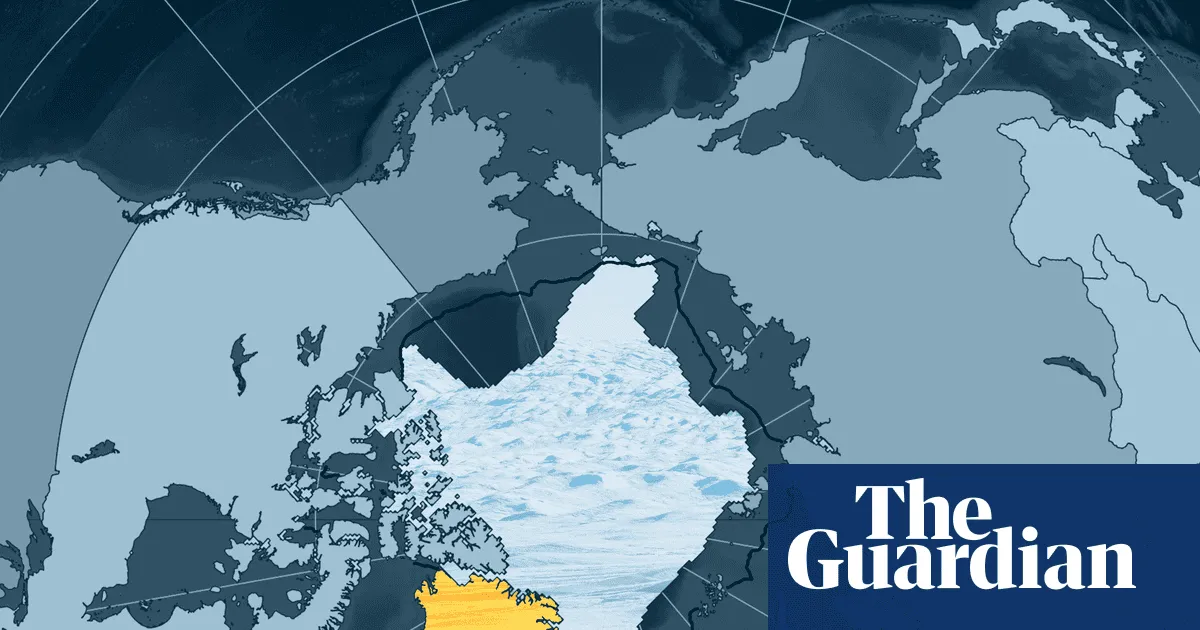
Lying between the US and Russia, Greenland has become a critical frontline as the Arctic opens up because of global heating.Its importance has been underscored by Donald Trump openly considering the US taking the island from its Nato partner Denmark, either by buying it, or by force.The climate crisis is shrinking Greenland’s ice sheet, along with the wider Arctic sea ice, opening new sea routes and exposing valuable resources.Trump’s threats, previously dismissed as bluster, are now being seen as an early signal of how melting ice is turning Greenland into a valuable geopolitical flashpoint. The maps below show how this is developing.Sea ice is meltingThe average extent of sea ice in the Arctic over the last five years was 4.6m sq km. This is roughly equivalent to the size of the EU.But this is a 27% drop compared with the average of 6.4m sq km between 1981 and 2010, according to data from the National Snow and Ice Data Center. The sea ice lost is roughly equivalent to the size of Libya.Sea ice mapThe shrinking Arctic ice means that, in the summer, the ice cap no longer reaches the Russian and Canadian coasts. And because there is no land beneath the north pole it is exposing seas that were once inaccessible.Arctic shipping routes are becoming more viableThis is opening up new shipping routes. As the polar seas become navigable for longer periods, routes once limited to icebreakers have become commercial corridors.The Russian nuclear icebreaker Yamal breaking through sea ice in the Arctic. Photograph: Sue Flood/AlamyThe most developed is the northern sea route, which overlaps the north-east passage and runs along Russia’s Arctic coast from Europe to Asia. It is central to Moscow’s ambitions.Further west, the north-west passage cuts through Canada’s Arctic archipelago, while a central Arctic route across the north pole is also emerging in long-term planning.Shipping routes mapThis is redrawing the global trade map, adding routes that could provide alternatives to the Suez canal and cut the journey from western Europe to east Asia by almost half.In 2025, the container ship Istanbul Bridge became the first liner vessel to travel from China to Europe via the northern sea route, also known as the “Polar Silk Road” shortcut.Istanbul bridge mapThe ship travelled from Ningbo, China, to Felixstowe, UK, in about 20 days.Data from the Marine Exchange of Alaska, a maritime monitoring organisation, showed there were 665 transits through the Bering trait, which separates Russia from the US, in 2024, a 175% rise from 242 in 2010.Chart showing more ships are travelling through the Bering straitThese routes are not without risks, which affect their commercial viability.Serafima Andreeva, a researcher at the Norway-based Fridtjof Nansen Institute, says Moscow is aiming for “year-round” use of the north-east passage from Europe to Asia and is investing heavily in nuclear icebreakers.But ships are still getting stuck in the ice, Andreeva says, adding: “Even now there are occasional issues with use of the route even in the ‘summer’.”Rising tensions around the ArcticSeveral Arctic nations have claims in the Arctic: Canada, Denmark, Norway, Russia and the US.The UN’s Commission on the Limits of the Continental Shelf (CLCS) makes recommendations to coastal states on these claims.Continental shelf claimThe US already has a military presence in the Arctic and in Greenland specifically.The remote Pituffik base in north-west Greenland hosts missile warning, missile defence and space operations for the US and Nato.Pituffik space base in northern Greenland. Photograph: Thomas Traasdahl/Ritzau Scanpix/AFP/Getty ImagesRussia has opened several military bases in the last decade, as well as restoring old Soviet infrastructure and airfields.In 2018, China declared itself a “near-Arctic state” in an effort to gain more influence in the region.Andreeva says: “There has been an increased military interest in the Arctic over the last 10 to 15 years, and the landscape has changed significantly since 2022 [when Russia invaded Ukraine].”She adds that Finland and Sweden’s recent accession to Nato has reshaped the security landscape, increasing the focus on the Nordics as a collective. This has entrenched Russia’s desire to assert control over areas such as the Kola peninsula and the Barents bastion. Map of regionEven though Russia’s focus has been on Ukraine since 2022, it has maintained its presence in the Arctic.Nato countries have been reinforcing their Arctic naval presence and there have been announcements on increased icebreaker building. With Nato’s Nordic expansion, Denmark’s air force has become more integrated with Finland, Norway and Sweden. In 2024, China deployed three icebreaking vessels to the Arctic.Interest in Greenland’s critical mineralsGreenland is also important in the global race for critical minerals. The island ranks eighth in the world for rare earth reserves, estimated at 1.5 million tonnes by the US Geological Survey.It hosts two of the largest known deposits, at Kvanefjeld and Tanbreez. Foreign interest in these is growing. China’s Shenghe Resources is the largest shareholder in the Kvanefjeld project, holding a 12.5% stake, according to the Center for Strategic and International Studies.Chart showing how Greenland is thought to have one of the world’s largest rare earth reservesNo rare earth mining has taken place as yet because of inaccessibility. Only about 20% of Greenland is ice-free, and much of the island is inaccessible for large parts of the year.But as with the shipping lanes becoming more viable, global heating is also beginning to alter this equation, and retreating ice is exposing new mineral resources.
SRCThe Guardian - World News
LANGEN
LeanCenter-Left
WORDS889
ENT11
THU · 2026-01-15 · 12:10 GMTBRIEF NSR-2026-0115-7713
NSR-2026-0115-7713News Report·EN·National Security
Greenland: new shipping routes, hidden minerals – and a frontline between the US and Russia?
Greenland is emerging as a geopolitical hotspot between the US and Russia due to the climate crisis. The melting Arctic ice sheet is opening new sea routes and exposing valuable resources.
Ashley Kirk, Lucy Swan, Tural Ahmedzade, Harvey Symons and Oliver HolmesThe Guardian - World NewsFiled 2026-01-15 · 12:10 GMTLean · Center-LeftRead · 4 min
The Guardian - World NewsFIG 01
Reading time
4min
Word count
889words
Sources cited
2cited
Entities identified
11entities
NEWSAR · AI
Greenland is emerging as a geopolitical hotspot between the US and Russia due to the climate crisis. The melting Arctic ice sheet is opening new sea routes and exposing valuable resources. The average extent of sea ice in the Arctic has dropped 27% between 1981 and 2010. This is making the Northern Sea Route along Russia's coast, the Northwest Passage through Canada, and a potential Central Arctic Route viable for shipping. These routes could significantly shorten travel times between Europe and Asia, offering alternatives to traditional routes like the Suez Canal. The container ship Istanbul Bridge became the first liner vessel to travel from China to Europe via the Northern Sea Route in 2025.
Confidence 0.90Sources 2Claims 5Entities 11
Framing
National Security
Environmental
Tone
Mixed Tone
AI-assessed
CalmNeutralAlarmist
Factuality
0.70 / 1.00
Factual
LowHigh
Sources cited
2
Limited
FewMany
01
Data showed there were 665 transits through the Bering trait in 2024, a 175% rise from 242 in 2010.
statisticMarine Exchange of Alaska
Confidence
1.00
02
In 2025, the container ship Istanbul Bridge became the first liner vessel to travel from China to Europe via the northern sea route.
factualnull
Confidence
1.00
03
This is a 27% drop compared with the average of 6.4m sq km between 1981 and 2010.
statisticNational Snow and Ice Data Center
Confidence
1.00
04
The average extent of sea ice in the Arctic over the last five years was 4.6m sq km.
statisticNational Snow and Ice Data Center
Confidence
1.00
05
Moscow is aiming for “year-round” use of the north-east passage from Europe to Asia.
quoteSerafima Andreeva, Fridtjof Nansen Institute
Confidence
0.90
§ 04
Full report
4 min read · 889 wordsKey playerOppositionContextPositiveNeutralNegative
Organizations1
greenland
1.00
arctic
0.90
shipping routes
0.80
sea ice
0.70
climate change
0.70
united states
0.60
russia
0.60
geopolitics
0.60
northern sea route
0.50
mineral resources
0.50
§ 07
Connections
Who appears together in the newsIn this articleWider coverageLine weight = articles in common
Laying out network…
Strongest ties articles in common
- 15,001
- 4,854
- 2,491
- 2,429
- 1,765
- 1,261
Recurring context not named in this article
- LWashingtonlinks 11
- LIranlinks 11
- ONATOlinks 11
- PVladimir Putinlinks 11
- LBeijinglinks 11
- LVenezuelalinks 11
- LFrancelinks 11
- LUkrainelinks 11