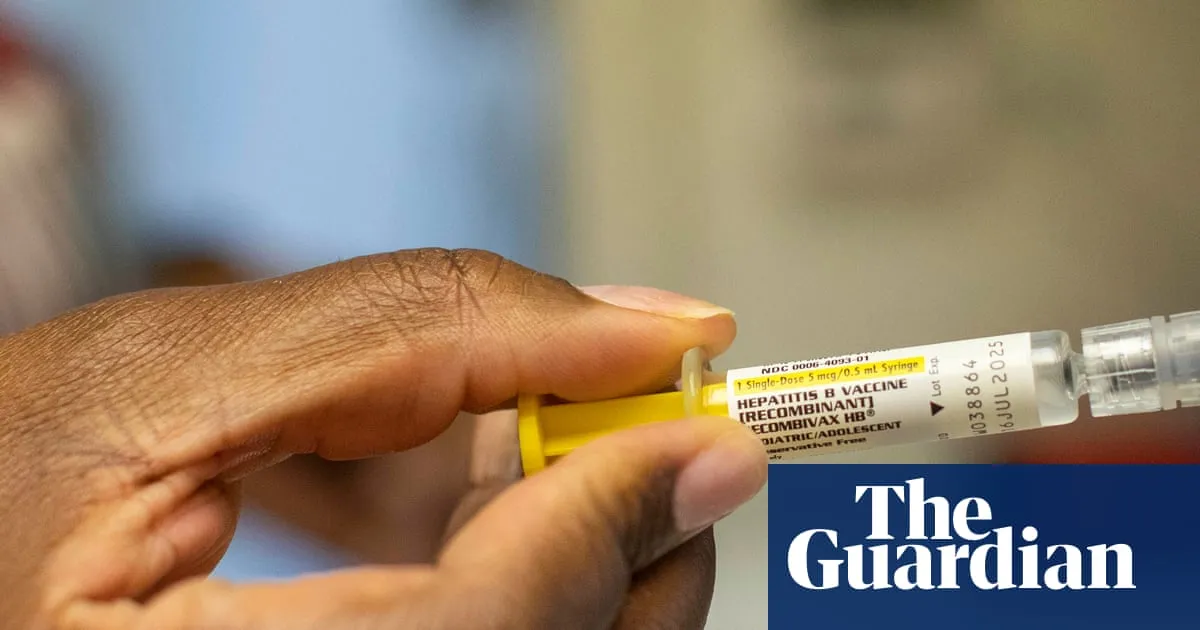
The controversial US-funded study on hepatitis B vaccines among newborns in Guinea-Bissau has been halted, according to Yap Boum, a senior official at the Africa Centres for Disease Control and Prevention (CDC).“The study has been cancelled,” Boum told journalists at a press conference on Thursday morning.The $1.6m study, funded under the purview of Robert F Kennedy Jr, longtime vaccine skeptic and secretary of the US Department of Health and Human Services (HHS) , drew outrage and criticism over ethical questions about withholding vaccines proven to prevent hepatitis B in a country with a very high burden of the disease.“It’s of importance for Africa CDC to have evidence that can be translated in policy, but this has to be done within the norm. So we are glad that at this point the study is being cancelled,” Boum said. The study was halted because it raised critical questions on the ethics of the trial, he said, adding: “The way the study was designed was a big challenge.”Officials in Guinea-Bissau say the trial will still happen, according to one journalist on the press call. But Africa CDC officials said the trial would only move forward once it has been redesigned to address ethical issues. There were “still some conversations happening” between Guinea-Bissau officials and the US on how to conduct a trial like this ethically, and Africa CDC had assembled a team to make sure Guinea-Bissau officials “receive the adequate support to ensure that this study, if it has to happen, will also fit the ethical regulations”, Boum said.Guinea-Bissau, which underwent a coup in November, appears to have replaced all top officials, including at the ministry of health. Previous officials did not respond to media inquiries, and the number and email address for the health ministry appear to be disconnected.“The good guys won,” said Paul Offit, an infectious diseases physician at Children’s Hospital of Philadelphia and a former member of the Vaccines and Related Biological Products Advisory Committee for the US Food and Drug Administration (FDA). The cancellation news was “extremely heartening”, he said, adding that except for the birth of his children, he had “never been happier”.“This administration did not see people in Africa as valuable,” Offit said. “You can’t treat children like this, you can’t treat people like this. We were able to stand up for them. We were able to convince people about the fact that this was unethical.”The HHS did not respond to the Guardian’s inquiries about why the trial was cancelled.The news could represent a turning point for Guinea-Bissau and other countries where researchers are conducting work that critics say is unethical. It shows that “the institutions are getting stronger” by pushing back on unethical and exploitative studies in Africa, said Boghuma Titanji, an assistant professor of medicine at Emory University who is currently studying vaccine misinformation in Africa.The halt was “a win for advocacy and upholding the ethics of research”, said Titanji, who called the trial as it seems to be designed a “damaging” study. “It can lead to damage that lasts for several decades after the study has been completed,” said Titanji.The researchers argued that the trial would make the vaccine available to 7,000 newborns when they would “not otherwise receive it”. But that means the other 7,000 children in the trial wouldn’t have access to the vaccine “due to the flip of a coin”, which would “knowingly deprive 7,000 children of a vaccine that could save their lives”, Offit said. Instead, he said, “take the $1.6m and vaccinate as many children as you can at birth”.About 18% of adults and about 11% of children under the age of one in Guinea-Bissau have hepatitis B. Children are much more likely to develop long-term effects, such as liver cirrhosis that can lead to cancer and death, if they catch the virus when they are very young.Guinea-Bissau currently recommends the hepatitis B vaccine to all babies at six weeks of age because of issues accessing the vaccine, but that recommendation will change to all newborns at birth in 2027 when more doses roll out.Offit likened the trial to the Tuskegee experiment, in which US researchers knowingly withheld an effective antibiotic from African American men suffering from syphilis.The Danish researchers conducting the trial have also been criticized for not publishing the results of a study on the DTP vaccine, potentially because it contradicted their belief that the vaccine is dangerous, according to the Danish journalist Gunver Lystbæk Vestergård.The protocols for the study have not been made public by the researchers or health officials, but a leaked version was published by Inside Medicine. Frederik Schaltz-Buchholzer, one of the Danish researchers, also shared some details on social media. Titanji didn’t find his argument compelling. “It actually just raises even more concerns in my mind,” she said.The researchers argue that live vaccines may bring nonspecific effects – improving overall health, not just against the disease the vaccine is targeting. But, they say, adding an attenuated vaccine like hepatitis B could interfere with these possible effects. Yet the evidence to support possible overall health effects is based upon the researchers’ prior research, which has been called into question.Other Danish researchers analyzed these studies and found no statistically significant effects, according to their new preprint study, which has not been peer-reviewed or published yet. One of the researchers on that study, Anders Hviid, said on LinkedIn that these findings were especially important given recent decisions in the US to limit several vaccines for children.The Danish researchers also argued that trials should be done in Africa in order to study their effects on African children.Titanji agreed that there needed to be more randomized controlled trials done in Africa on Africans, but said that they should be led by African scientists and powered by questions from Africans. Projects like the Danish study “basically exploit the scarcity of a proven beneficial vaccine in a context where that vaccine is needed”, Titanji said. The study, as it is currently designed, would be “exploiting a window where the government is not able to provide that intervention to its citizens”, Titanji said. “You are not solving the problem. You’re actually being part of the problem.”The trial was slated to begin on 5 January. When reached last week about whether the trial had begun, the lead researchers, Peter Aaby and Christine Stabell Benn, disputed the Guardian’s previous story that cited ethical concerns.“That article was totally wrong,” Aaby said. “The report had virtually no evidence-based content about vaccines to transmit to the readers, only a lot of ethical condemnations from those who might potentially be questioned by the future results of the study.”Aaby and other researchers on the project did not respond to further inquiries about the project’s cancellation.Aaby and Stabell Benn, who are Danish researchers, have close ties with Trump administration health officials. Stabell Benn hosted a podcast with Tracy Beth Høeg, now an FDA official who has worked to find deaths after Covid vaccination and advocated for the US to slash vaccine recommendations to align with Denmark’s schedule.On Joe Rogan’s podcast in 2023 Kennedy praised Aaby as a “very famous” researcher whose work showed the diphtheria-tetanus-pertussis (DTP) vaccine was deadly, he said – research Kennedy also cited when he ended funding to Gavi, the Vaccine Alliance. But he didn’t mention that the year before, in 2022, the researchers found completely different results when they conducted the same trial.
SRCThe Guardian - World News
LANGEN
LEANCenter-Left
WORDS1 228
ENT5
THU · 2026-01-15 · 15:26 GMTBRIEF NSR-2026-0115-7735
NSR-2026-0115-7735News Report·EN·Human Rights
Controversial US study on hepatitis B vaccines in Africa is cancelled
A controversial US-funded study on hepatitis B vaccines in Guinea-Bissau has been cancelled, according to the Africa Centres for Disease Control and Prevention (CDC). The $1.6 million study, funded under the purview of Robert F Kennedy Jr., faced criticism for ethical concerns regarding the withholding of proven hepatitis B vaccines from newborns in a country with a high disease burden.
Melody SchreiberThe Guardian - World NewsFiled 2026-01-15 · 15:26 GMTLean · Center-LeftRead · 5 min
The Guardian - World NewsFIG 01
Reading time
5min
Word count
1 228words
Sources cited
4cited
Entities identified
5entities
Quality score
100%
§ 01
Briefing Summary
AI-generatedNEWSAR · AI
A controversial US-funded study on hepatitis B vaccines in Guinea-Bissau has been cancelled, according to the Africa Centres for Disease Control and Prevention (CDC). The $1.6 million study, funded under the purview of Robert F Kennedy Jr., faced criticism for ethical concerns regarding the withholding of proven hepatitis B vaccines from newborns in a country with a high disease burden. The Africa CDC halted the study due to its problematic design and ethical issues. While officials in Guinea-Bissau expressed interest in continuing the trial, the Africa CDC stated it would only proceed if redesigned to meet ethical standards. The US Department of Health and Human Services (HHS) did not respond to requests for comment.
Confidence 0.90Sources 4Claims 5Entities 5
§ 02
Article analysis
Model · rule-basedFraming
Human Rights
Public Health
Tone
Measured
AI-assessed
CalmNeutralAlarmist
Factuality
0.70 / 1.00
Factual
LowHigh
Sources cited
4
Well sourced
FewMany
§ 03
Key claims
5 extracted01
The study was halted because it raised critical questions on the ethics of the trial.
factualYap Boum, Africa CDC
Confidence
1.00
02
The $1.6m study was funded under the purview of Robert F Kennedy Jr.
factualnull
Confidence
1.00
03
US-funded study on hepatitis B vaccines among newborns in Guinea-Bissau has been halted.
factualYap Boum, Africa CDC
Confidence
1.00
04
This administration did not see people in Africa as valuable.
quotePaul Offit, Children’s Hospital of Philadelphia
Confidence
0.90
05
Officials in Guinea-Bissau say the trial will still happen.
factualnull
Confidence
0.80
§ 04
Full report
5 min read · 1 228 words§ 05
Entities
5 identifiedKey playerOppositionContextPositiveNeutralNegative
§ 06
Keywords & salience
9 termshepatitis b vaccine
1.00
ethical concerns
0.90
clinical trial
0.80
africa cdc
0.70
guinea-bissau
0.70
vaccine skepticism
0.60
us study
0.50
public health
0.50
ethical regulations
0.40
§ 07
Topic connections
Interactive graph No topic relationship data available yet. This graph will appear once topic relationships have been computed.