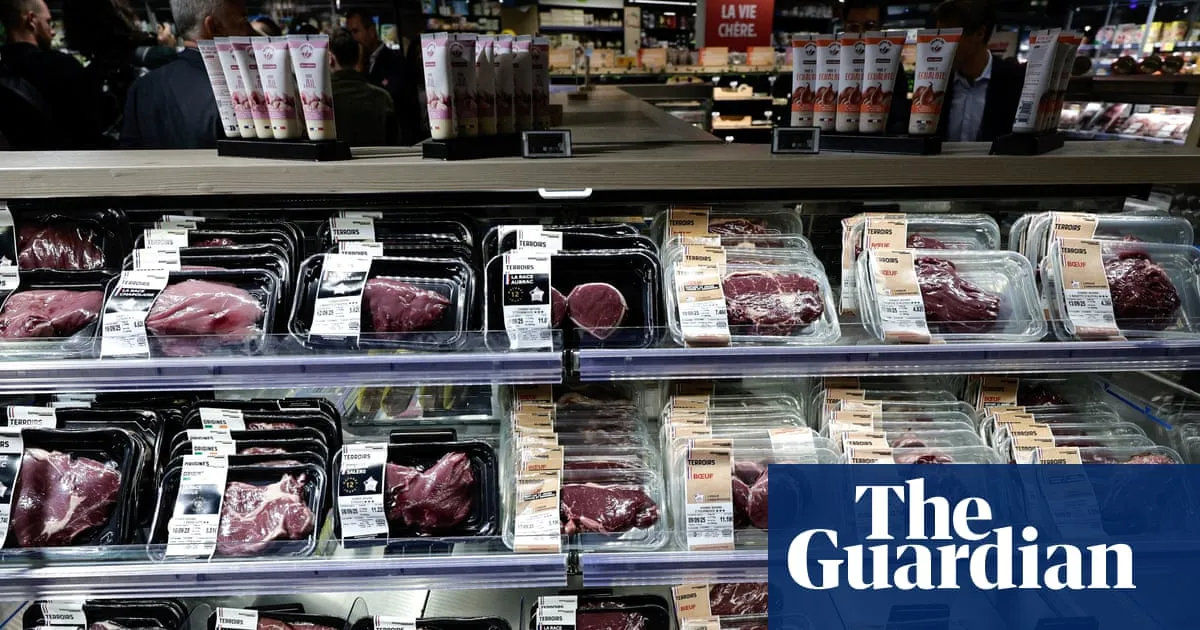
The environmental impacts of meat consumption could be rapidly and cheaply reduced if governments applied full VAT on products such as beef, pork, lamb and chicken, a study has shown.Depending on how the additional tax revenues were redistributed, such a change could cost households as little as €26 (£23) a year, while cutting ecological destruction by between 3% and 6%, the paper found.Animal-based products have the biggest share of the EU’s ecological footprint related to household diet, which is responsible for almost a quarter of greenhouse gas emissions, more than half of biodiversity loss and phosphorus pollution, and almost three-quarters of water consumption.Despite this, 22 of the 27 EU member states levy a reduced tax rate on meat purchases, compared with the general level of VAT. In effect this price signal screens citizens from the environmental and social costs of their consumption.The new study by the Potsdam Institute for Climate Impact Research calculated some of those hidden costs and examined how two possible policy reforms – full VAT levies or a carbon price on food – could affect prices, consumption levels, environmental impacts and costs.Published in the journal Nature Food on Tuesday, the paper found that the global environmental footprint of meat was substantially higher than plant-based foods in terms of climate impact, biodiversity loss, land use and pollution. The only exception was water use.The difference in these environmental costs is not adequately reflected in the price of goods on the shelves because such calculations are complex. To overcome this obstacle, the authors of the study said the simplest first step would be to remove tax breaks on the most damaging food – meat.Those tax breaks vary from country to country. The biggest break for meat consumption is in Ireland, where meat has zero tax compared with a general VAT rate of 23%. Raw meat in the UK is zero-rated compared with the 20% standard for cooked meat in restaurants or processed products. The gap is 20 percentage points in Croatia. In France, it is 15 points, Germany and Italy 12 points, and Spain 11 points. Within the EU, only Bulgaria, Denmark, Estonia, Latvia and Lithuania tax meat at the general VAT rate.If EU governments ended meat’s VAT privileges, the paper calculates the environmental damage caused by food consumption would be reduced by 3.48% to 5.7%, depending on the type of impact. In the case of the climate, for example, it would cut greenhouse gas emissions by 29.9 megatons of CO2 equivalent per year, which is about 5% of the total.The burden on consumers would depend on what is done with the extra tax revenues. Average annual food expenditure per EU household would have to rise by €109 (£95) as a result of the additional VAT. But if the revenues were redistributed through payments to citizens, the overall cost would fall to €26 per year.An even cheaper system for consumers would be the levying of a carbon price of €52 (£45) on food products, which would bring down net household costs to about €12 a year and have greater environmental benefits. But the authors recognise this will require more complex economic and political calculations, which makes the VAT change a more feasible option in the short term.In both cases, society would be significantly better off once the costs of reducing environmental destruction are factored in, the researchers said. “Our numbers show the policies we investigated can be effective, but they also reveal that we do not yet fully price in the environmental impacts of meat,” said Charlotte Plinke, an author of the study: “It’s important to have exact information of what the impacts actually are, and then to be transparent about the goals of the policy and the use of revenues.”
SRCThe Guardian - World News
LANGEN
LEANCenter-Left
WORDS621
ENT12
TUE · 2026-01-20 · 10:00 GMTBRIEF NSR-2026-0120-8931
NSR-2026-0120-8931News Report·EN·Environmental
‘Meat tax’ could have significant impact on environmental footprint, study finds
A new study by the Potsdam Institute for Climate Impact Research, published in Nature Food, found that applying standard VAT rates to meat products in the EU could significantly reduce the environmental impact of food consumption. The study highlights that meat production contributes substantially to greenhouse gas emissions, biodiversity loss, and pollution, yet most EU countries apply reduced tax rates to meat.
Jonathan WattsThe Guardian - World NewsFiled 2026-01-20 · 10:00 GMTLean · Center-LeftRead · 3 min
The Guardian - World NewsFIG 01
Reading time
3min
Word count
621words
Sources cited
1cited
Entities identified
12entities
Quality score
100%
§ 01
Briefing Summary
AI-generatedNEWSAR · AI
A new study by the Potsdam Institute for Climate Impact Research, published in Nature Food, found that applying standard VAT rates to meat products in the EU could significantly reduce the environmental impact of food consumption. The study highlights that meat production contributes substantially to greenhouse gas emissions, biodiversity loss, and pollution, yet most EU countries apply reduced tax rates to meat. Researchers calculated that ending these tax breaks could lower environmental damage by 3% to 6% at a minimal cost to households, around €26 annually. The study suggests that removing tax breaks on meat is a simple first step to reflect the true environmental costs of food production.
Confidence 0.90Sources 1Claims 5Entities 12
§ 02
Article analysis
Model · rule-basedFraming
Environmental
Economic Impact
Tone
Measured
AI-assessed
CalmNeutralAlarmist
Factuality
0.80 / 1.00
Factual
LowHigh
Sources cited
1
Limited
FewMany
§ 03
Key claims
5 extracted01
22 of the 27 EU member states levy a reduced tax rate on meat purchases.
factual
Confidence
1.00
02
Average annual food expenditure per EU household would have to rise by €109 as a result of the additional VAT.
statistic
Confidence
0.90
03
Ending meat’s VAT privileges would reduce the environmental damage caused by food consumption by 3.48% to 5.7%.
statisticthe paper
Confidence
0.90
04
Animal-based products have the biggest share of the EU’s ecological footprint related to household diet.
factual
Confidence
0.90
05
Applying full VAT on meat products could reduce ecological destruction by between 3% and 6%.
statisticstudy by the Potsdam Institute for Climate Impact Research
Confidence
0.90
§ 04
Full report
3 min read · 621 words§ 05
Entities
12 identifiedKey playerOppositionContextPositiveNeutralNegative
Organizations2
§ 06
Keywords & salience
9 termsmeat tax
1.00
environmental impact
0.90
vat
0.80
meat consumption
0.70
ecological footprint
0.60
greenhouse gas emissions
0.60
carbon price
0.50
biodiversity loss
0.50
food policy
0.40
§ 07
Topic connections
Interactive graph Network visualization showing 51 related topics
View Full Graph Person Organization Location Event|Click node to navigate|Edge numbers = shared articles