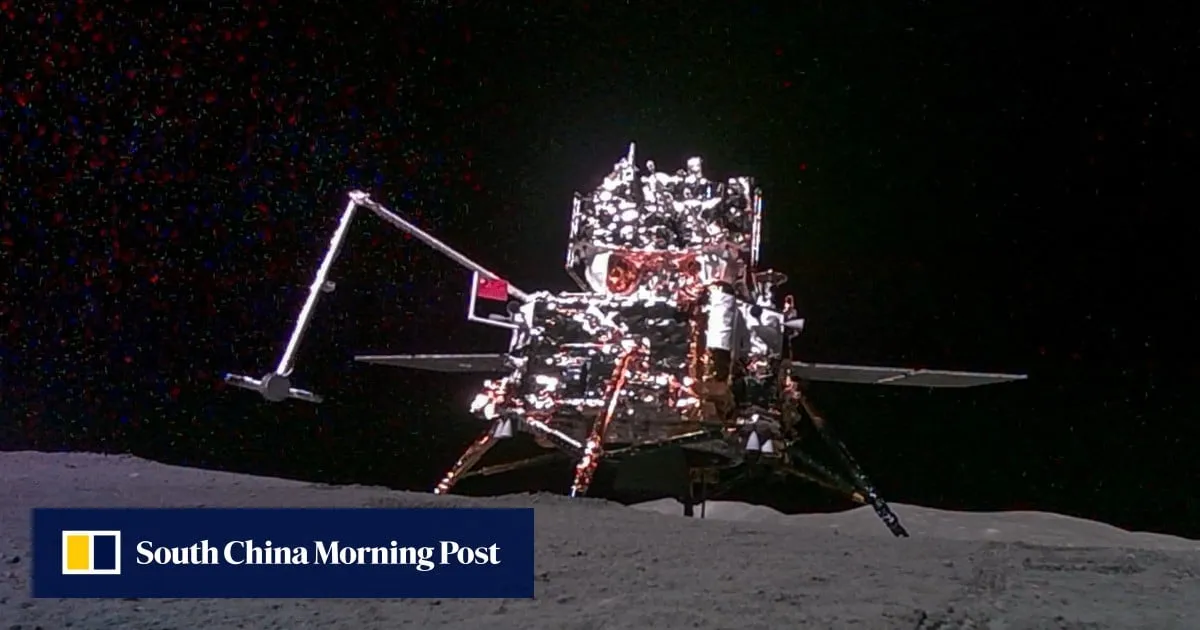
Tiny carbon nanotubes with walls just one atom thick found on the far side of the Moon have provided the first confirmed evidence that a material long thought to require sophisticated human engineering could also be produced naturally.They were found in rocks collected by China’s 2024 Chang’e-6 mission, the first probe to land on the far side of the Moon and bring samples back to Earth.Using high-resolution electron microscopes, a team from Jilin University in northeastern China detected the straw-shaped, ultra-thin tubes in samples collected by the mission.The researchers said the structures had probably formed under extreme conditions created jointly by micrometeorite impacts, solar wind exposure and ancient volcanic activity.Although multilayered nanotubes that formed naturally have been found on Earth as a result of natural phenomena such as forest fires or ice cores, there had been a long debate about whether single-layer carbon nanotubes could form naturally.Producing them in laboratories needed precisely controlled temperatures and catalysts, but the Chinese team’s findings, published online in the journal Nano Letters last month, have settled the debate.
SRCSouth China Morning Post
LANGEN
LEANCenter-Right
WORDS174
ENT4
THU · 2026-01-22 · 01:00 GMTBRIEF NSR-2026-0122-9523
NSR-2026-0122-9523News Report·EN·Technology
China found something strange on far side of moon no one ever saw occur naturally before
Chinese scientists have discovered single-layer carbon nanotubes on the far side of the moon, a material previously believed to require human engineering to produce. The discovery was made in samples collected by China's Chang'e-6 mission in 2024, the first probe to retrieve samples from the moon's far side.
Ling XinSouth China Morning PostFiled 2026-01-22 · 01:00 GMTLean · Center-RightRead · 1 min
South China Morning PostFIG 01
Reading time
1min
Word count
174words
Sources cited
1cited
Entities identified
4entities
Quality score
100%
§ 01
Briefing Summary
AI-generatedNEWSAR · AI
Chinese scientists have discovered single-layer carbon nanotubes on the far side of the moon, a material previously believed to require human engineering to produce. The discovery was made in samples collected by China's Chang'e-6 mission in 2024, the first probe to retrieve samples from the moon's far side. Researchers from Jilin University identified the nanotubes using high-resolution electron microscopes. Their analysis suggests the structures likely formed due to extreme conditions caused by micrometeorite impacts, solar wind, and volcanic activity. This finding, published in Nano Letters, provides the first confirmed evidence that single-layer carbon nanotubes can form naturally, resolving a long-standing debate.
Confidence 0.90Sources 1Claims 5Entities 4
§ 02
Article analysis
Model · rule-basedFraming
Technology
Tone
Measured
AI-assessed
CalmNeutralAlarmist
Factuality
0.90 / 1.00
Factual
LowHigh
Sources cited
1
Limited
FewMany
§ 03
Key claims
5 extracted01
Single-layer carbon nanotubes can form naturally.
factualArticle
Confidence
1.00
02
The nanotubes were detected by a team from Jilin University.
factualArticle
Confidence
1.00
03
China’s 2024 Chang’e-6 mission collected the rocks where the nanotubes were found.
factualArticle
Confidence
1.00
04
Tiny carbon nanotubes were found on the far side of the moon.
factualArticle
Confidence
1.00
05
The structures probably formed under extreme conditions.
factualResearchers
Confidence
0.80
§ 04
Full report
1 min read · 174 words§ 05
Entities
4 identifiedKey playerOppositionContextPositiveNeutralNegative
Events1
§ 06
Keywords & salience
8 termscarbon nanotubes
1.00
far side of the moon
0.90
natural formation
0.80
chang'e-6 mission
0.70
micrometeorite impacts
0.60
volcanic activity
0.50
solar wind
0.50
single-layer nanotubes
0.40
§ 07
Topic connections
Interactive graph Network visualization showing 51 related topics
View Full Graph Person Organization Location Event|Click node to navigate|Edge numbers = shared articles