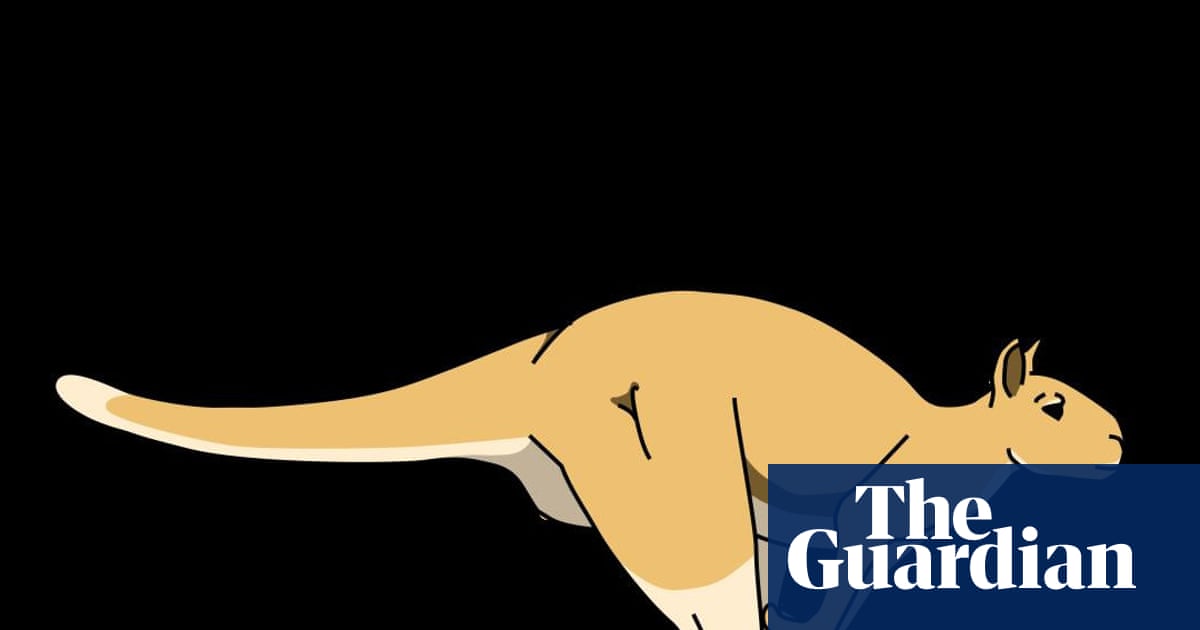
Giant 250kg kangaroos that once roamed Australia would probably have been able to hop despite their enormous size, researchers have said.While modern kangaroos are known for their ability to travel large distances by jumping with both hind legs at the same time, it has long been debated whether their extinct relatives would have been so springy.“When [modern kangaroos] hop, the achilles tendon gets really, really pulled and stressed,” said Dr Megan Jones of the University of Manchester, the lead researcher on the study. “And that’s great because it stores a lot of energy so when they go to the next hop, it’s quite energetically efficient.“But it does imply that if [kangaroos] get bigger and they don’t change anything else, then you will get to the point where you just snap that tendon.”Unlike many previous studies, which have explored whether giant kangaroos might have hopped by extrapolating from the anatomy of today’s species, Jones and colleagues took a different approach.Writing in the journal Scientific Reports the team describe how they studied fossils from a range of giant kangaroos including species of sthenurine – short-nosed, browsing kangaroos that lived between 13m and 30,000 years ago.Heel bone of the largest giant kangaroo species, Procoptodon goliah. Photograph: Megan Jones /UCMP“They get up to 250kg, whereas the most we get today in the red kangaroos is 90kg at the absolute most,” said Jones.The team also looked at fossils from species of Protemnodon, longer-faced animals that lived between 5m and 40,000 years ago, and species of giant Macropus – animals that resembled larger versions of kangaroos living today.For each giant kangaroo species the researchers estimated strength of the achilles tendon in the ankle – a band of tissue that is required for hopping – as well as the bone strength of the fourth metatarsal, the least robust bone in the hindlimb.“It’s no use if their tendon is fine, but their bones are going to start breaking [if they hop],” said Jones.The results reveal that all of the giant kangaroos studied had fourth metatarsals strong enough to support hopping, as well as heel bones with enough space to accommodate a thick enough tendon for such movement.While some researchers have previously suggested thicker tendons could have made hopping less feasible, the researchers say this is unlikely to be the case, noting some hopping creatures alive today – including kangaroo rats – have relatively thick tendons yet use hopping to navigate difficult terrain and escape predators.Jones said it was possible giant kangaroos would have used hopping for similar purposes, adding it was unlikely they would have been able to hop for long distances or durations.“It is entirely possible that, as well as using hopping more infrequently, or over shorter distances, the giant kangaroos may have reduced stresses by hopping more slowly,” the authors add.However, Jones said the new study only suggested it was feasible for giant kangaroos to hop, not that they necessarily did so, and did not rule out other modes of getting around: for example studies have previously suggested sthenurine kangaroos strode forth on their tiptoes.“Any kangaroo is going to be using a combination of gaits, some for going slow, some for going fast,” said Jones.Dr Gilbert Price, a palaeontologist at the University of Queensland, Australia, who was not involved in the work, said the big jump from earlier research was that the new study was based on fossils from giant kangaroos themselves.“It shows that the giant kangaroos changed their proportions in ways that made hopping mechanically possible, even if it was less efficient than in modern species,” he said.But, he added, the study did not overclaim: “It doesn’t say these animals hopped across the landscape like modern red kangaroos, just that hopping wasn’t off the table, and that’s an important distinction.”Price said the study could also help to shed light on the fate of giant kanagaroos. “If you want to understand why these animals went extinct, you first have to understand what they were actually like,” he said. “Bringing the focus back to their biology and ecology isn’t just extra detail, but is central to understanding what happened.”
SRCThe Guardian - World News
LANGEN
LEANCenter-Left
WORDS682
ENT3
THU · 2026-01-22 · 16:00 GMTBRIEF NSR-2026-0122-9768
NSR-2026-0122-9768News Report·EN·Technology
Kangaroos’ giant ancestor probably able to hop despite 250kg weight, scientists say
A new study suggests that giant kangaroos, weighing up to 250kg and extinct for thousands of years, were likely capable of hopping. Researchers at the University of Manchester analyzed fossils from various giant kangaroo species, including sthenurines, Protemnodon, and giant Macropus, to assess the strength of their Achilles tendons and metatarsal bones.
Nicola Davis Science correspondentThe Guardian - World NewsFiled 2026-01-22 · 16:00 GMTLean · Center-LeftRead · 3 min
The Guardian - World NewsFIG 01
Reading time
3min
Word count
682words
Sources cited
1cited
Entities identified
3entities
Quality score
100%
§ 01
Briefing Summary
AI-generatedNEWSAR · AI
A new study suggests that giant kangaroos, weighing up to 250kg and extinct for thousands of years, were likely capable of hopping. Researchers at the University of Manchester analyzed fossils from various giant kangaroo species, including sthenurines, Protemnodon, and giant Macropus, to assess the strength of their Achilles tendons and metatarsal bones. The team estimated the strength of the achilles tendon in the ankle and the bone strength of the fourth metatarsal. Published in Scientific Reports, the study found that the metatarsals were strong enough to support hopping, and the heel bones could accommodate tendons thick enough for the movement. This challenges previous assumptions that their size would have made hopping impossible, indicating that these ancient marsupials likely used hopping as a means of locomotion.
Confidence 0.90Sources 1Claims 5Entities 3
§ 02
Article analysis
Model · rule-basedFraming
Technology
Environmental
Tone
Measured
AI-assessed
CalmNeutralAlarmist
Factuality
0.80 / 1.00
Factual
LowHigh
Sources cited
1
Limited
FewMany
§ 03
Key claims
5 extracted01
Sthenurine are short-nosed, browsing kangaroos that lived between 13m and 30,000 years ago.
factual
Confidence
1.00
02
The team studied fossils from a range of giant kangaroos including species of sthenurine.
factual
Confidence
1.00
03
Modern kangaroos travel large distances by jumping with both hind legs at the same time.
factual
Confidence
1.00
04
Giant 250kg kangaroos that once roamed Australia would probably have been able to hop.
factualresearchers
Confidence
0.80
05
It is entirely possible that giant kangaroos may have reduced stresses by hopping more slowly.
predictionauthors
Confidence
0.60
§ 04
Full report
3 min read · 682 words§ 05
Entities
3 identifiedKey playerOppositionContext
§ 06
Keywords & salience
8 termsgiant kangaroos
1.00
hopping
0.90
achilles tendon
0.70
fossils
0.60
bone strength
0.60
sthenurine
0.50
procoptodon goliah
0.40
macropus
0.40
§ 07
Topic connections
Interactive graph Network visualization showing 51 related topics
View Full Graph Person Organization Location Event|Click node to navigate|Edge numbers = shared articles