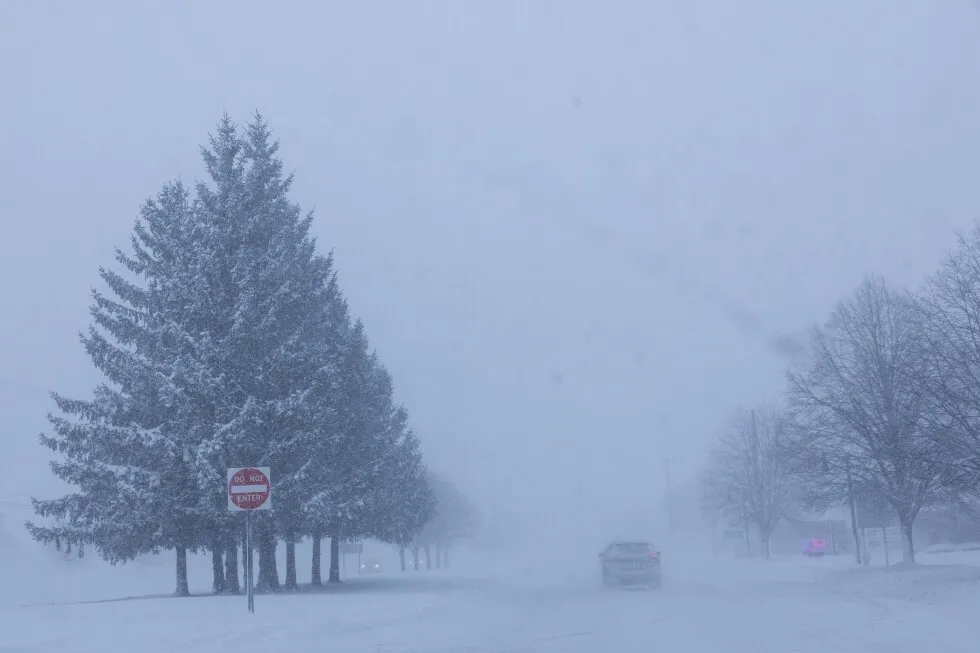
Vehicles are driven through whiteout conditions along Michigan" class="entity-link entity-location" data-entity-id="919" data-entity-type="location">Lake Michigan Drive during a winter storm warning in Ottawa County, Mich. on Monday, Jan. 19, 2026. (Joel Bissell/Kalamazoo Gazette via AP) Updated [hour]:[minute] [AMPM] [timezone], [monthFull] [day], [year] When big winter storms move in, they can bring nasty weather that ranges from snow to sleet and freezing rain — or maybe extreme and dangerous cold.Here’s a look at some weather conditions and how they vary from place to place.How snow might become ice or sleet on the groundTo stick, snow needs consistent cold air all the way from where flakes form in the clouds to the ground. If it’s below freezing the whole way, the snowflakes never melt, so nothing turns to ice.“The further north, the deeper that Arctic layer is, the more likely to support snow,” said MIT research scientist Judah Cohen.Farther south, the atmosphere may include a sandwich of warm air between cold layers. That’s how sleet and freezing rain happen. “The snowflakes form, they fall and then they meet a warm layer, a layer above freezing, and they will melt. But then there’s another layer near the surface that’s below freezing again, so they will refreeze before they hit the ground,” Cohen said. A person bundles up as take a walk during a cold weather day in Evanston, Ill., Thursday, Jan. 22, 2026. (AP Photo/Nam Y. Huh) A person bundles up as take a walk during a cold weather day in Evanston, Ill., Thursday, Jan. 22, 2026. (AP Photo/Nam Y. Huh) Add AP News on Google Add AP News as your preferred source to see more of our stories on Google. Sleet requires the lowest layer to be cold enough that raindrops refreeze when they hit the ground, creating bouncy ice pellets. If that lower cold layer is shallow, the rain doesn’t have enough time to freeze in the air. So it hits the ground as raindrops that freeze when they make contact. Then there’s graupel, which is a rarer mix between snow and sleet. Not quite fluffy, and not quite hard.“It’s snow that has tried to melt on its way down, but not quite melted,” said David Robinson, New Jersey state climatologist at Rutgers University. “It’s out of that six-point crystalline shape and has begun to look more like a cotton ball. So it hasn’t gotten to the point of full melt that it could then refreeze as sleet.” There’s also hail, which Robinson said some people mistakenly use to describe sleet. But real hail probably isn’t happening in a winter storm. That usually happens in the summer because it requires warmer air that’s closer to the surface. That creates an updraft that allows rain to move up, freeze, fall, and move up again, forming layers of ice similar to the layers of an onion. A sign visible from the eastbound lanes of Highway 121 warns of road preparations ahead of inclement weather expected in the region Wednesday, Jan. 21, 2026, in Fort Worth, Texas. (AP Photo/Julio Cortez) A sign visible from the eastbound lanes of Highway 121 warns of road preparations ahead of inclement weather expected in the region Wednesday, Jan. 21, 2026, in Fort Worth, Texas. (AP Photo/Julio Cortez) Add AP News on Google Add AP News as your preferred source to see more of our stories on Google. Different precipitation, different hazardsSnow can be dangerous — sufficient to send cars skidding into ditches and be life-threatening in whiteout conditions. But at least it can be plowed.The ice in sleet makes it much more difficult to move. But the most devastating moisture is freezing rain, Cohen said, because it turns roads into skating rinks and can be so heavy it has the power to bring down power lines.And then there’s extreme cold.When the National Weather Service deems expected temperatures and wind chills are low enough to be dangerous, they issue alerts. A cold weather advisory means dangerous weather is likely. An extreme cold watch means life-threatening weather is possible. An extreme cold warning means life-threatening weather is likely.___The Associated Press’ climate and environmental coverage receives financial support from multiple private foundations. AP is solely responsible for all content. Find AP’s standards for working with philanthropies, a list of supporters and funded coverage areas at AP.org. Wells reports on how people’s choices impact the environment for The Associated Press. She is based in Cleveland.
SRCAssociated Press (AP)
LANGEN
LEANCenter
WORDS727
ENT7
THU · 2026-01-22 · 20:53 GMTBRIEF NSR-2026-0122-9822
NSR-2026-0122-9822News Report·EN·Environmental
How big winter storms create snow, sleet and freezing rain
Winter storms can bring various forms of precipitation, including snow, sleet, and freezing rain, depending on atmospheric conditions. Snow requires consistently cold air from the clouds to the ground, while sleet and freezing rain form when snowflakes melt in a warm air layer and then refreeze in a cold layer near the surface.
By
CALEIGH WELLSAssociated Press (AP)Filed 2026-01-22 · 20:53 GMTLean · CenterRead · 3 min
Associated Press (AP)FIG 01
Reading time
3min
Word count
727words
Sources cited
2cited
Entities identified
7entities
Quality score
100%
§ 01
Briefing Summary
AI-generatedNEWSAR · AI
Winter storms can bring various forms of precipitation, including snow, sleet, and freezing rain, depending on atmospheric conditions. Snow requires consistently cold air from the clouds to the ground, while sleet and freezing rain form when snowflakes melt in a warm air layer and then refreeze in a cold layer near the surface. Sleet occurs when raindrops refreeze into ice pellets before hitting the ground, while freezing rain happens when rain freezes upon contact with a cold surface. Graupel is a mix of snow and sleet, partially melted and refrozen, while hail is more common in summer storms. The type of precipitation depends on the temperature profile of the atmosphere.
Confidence 0.90Sources 2Claims 5Entities 7
§ 02
Article analysis
Model · rule-basedFraming
Environmental
Human Interest
Tone
Measured
AI-assessed
CalmNeutralAlarmist
Factuality
0.90 / 1.00
Factual
LowHigh
Sources cited
2
Limited
FewMany
§ 03
Key claims
5 extracted01
Graupel is snow that has tried to melt on its way down, but not quite melted.
quoteDavid Robinson, New Jersey state climatologist at Rutgers University
Confidence
1.00
02
Hail usually happens in the summer because it requires warmer air that’s closer to the surface.
quoteDavid Robinson, New Jersey state climatologist at Rutgers University
Confidence
1.00
03
Sleet requires the lowest layer to be cold enough that raindrops refreeze when they hit the ground.
factual
Confidence
1.00
04
Farther south, the atmosphere may include a sandwich of warm air between cold layers, causing sleet and freezing rain.
quoteJudah Cohen, MIT research scientist
Confidence
1.00
05
To stick, snow needs consistent cold air all the way from where flakes form in the clouds to the ground.
quoteJudah Cohen, MIT research scientist
Confidence
1.00
§ 04
Full report
3 min read · 727 words§ 05
Entities
7 identifiedKey playerOppositionContextPositiveNeutralNegative
§ 06
Keywords & salience
9 termswinter storms
1.00
snow
0.90
sleet
0.80
freezing rain
0.80
ice
0.70
cold weather
0.60
atmosphere
0.50
graupel
0.40
hail
0.40
§ 07
Topic connections
Interactive graph Network visualization showing 51 related topics
View Full Graph Person Organization Location Event|Click node to navigate|Edge numbers = shared articles