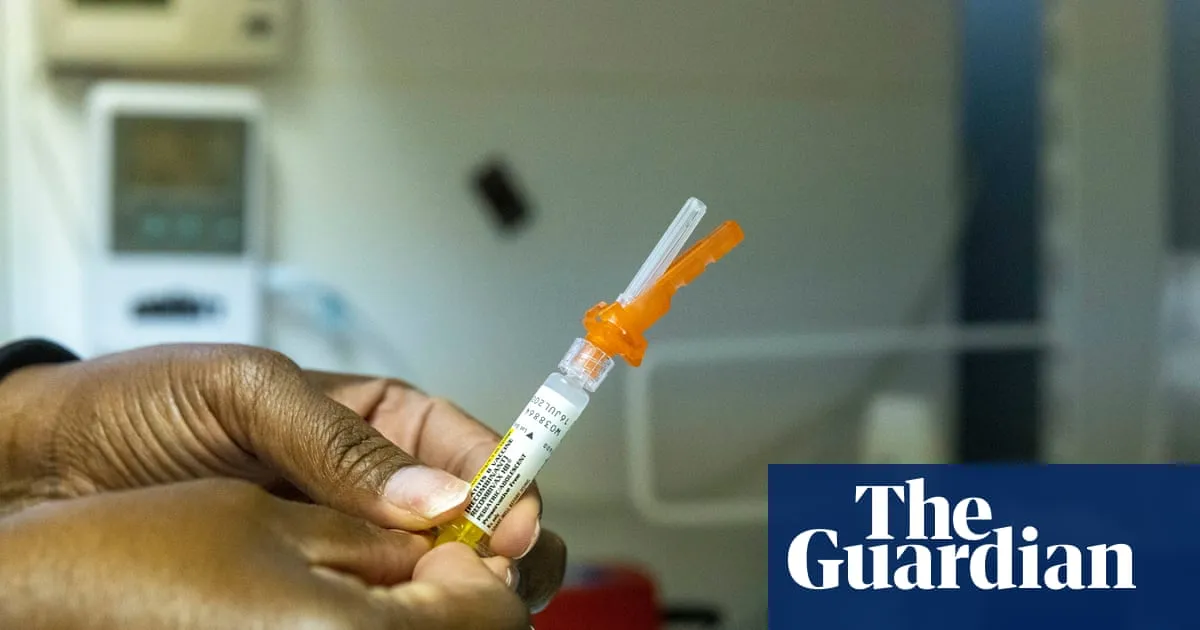
US health officials insisted it was still on. African health leaders said it was cancelled. At the heart of the controversy is the west African nation of Guinea-Bissau – one of the poorest countries in the world and the proposed site of a hotly debated US-funded study on vaccines.The study on hepatitis B vaccination, to be led by Danish researchers, became a flashpoint after major changes to the US vaccination schedule and prompted questions about how research is conducted ethically in other countries.On Thursday, Quinhin Nantote, a military doctor and the recently appointed minister of health in Guinea-Bissau, confirmed to journalists that the trial has been “cancelled or suspended” because the science was not well-reviewed. Guinea-Bissau experienced a coup in November, and top leaders were recently replaced.A team of research experts at the Africa Centres for Disease Control and Prevention, at Nantote’s request, will travel to Guinea-Bissau to help officials review the study. Officials from Denmark and the US have also been invited to review the trial, Jean Kaseya, director-general of the Africa CDC, said at the press meeting.The decision to halt the trial is not for international organizations or foreign countries to determine, Kaseya said.“It’s the sovereignty of the country,” he said. “I don’t know what will be this decision, but I will support the decision that the minister will make.”Officials with the US Department of Health and Human Services (HHS) have called into question the credibility of the Africa CDC, after officials with the organization confirmed the study was cancelled.“To be clear, the trial will proceed as planned,” Andrew Nixon, an HHS spokesperson, said in a statement on Wednesday. He said the Africa CDC was waging “a public-relations campaign aimed to shape public perception rather than engaging with the scientific facts”. When asked by the Guardian, he offered no proof of either claim.An HHS official also called the Africa CDC “a powerless, fake organization attempting to manufacture credibility by repeating its claims publicly”, adding that the organization was “not a reliable source”.Kaseya said he had spoken to senior HHS officials, who were unaware of the statement, and he pointed to the Africa CDC’s key role in responding to outbreaks with global implications.“It’s very important to fund research that Africans actually want,” said Abdulhammad Babatunde, a medical doctor and global health researcher in Nigeria. “Africans want to solve Africa’s problems, not satisfy the curiosity of the funders.”The researchers would have given hepatitis B vaccines to 7,000 infants at birth and withheld the vaccines for another 7,000 infants until six weeks of age in order to study the overall health effects of giving the vaccines alongside other shots. Nearly one in five adults and about 11% of young children in Guinea-Bissau have hepatitis B – putting them at high risk of severe illness and death.“This is not acceptable,” said Babatunde of the study’s design. “To prevent things like the Tuskegee study and others, the control group has to get the standard of care, and the intervention group should get [potentially] better care.”The World Health Organization recommends giving the hepatitis B vaccine to all newborns within 24 hours of birth. Infants in Guinea-Bissau currently receive the shot at six weeks of age, but the doses will roll out to all newborns in 2028 in order to close gaps in care standards. “The current reason why the vaccine is not achieving coverage in Guinea-Bissau is because there’s no funding, and the funding should try to promote the vaccine, not use children as lab rats,” Babatunde said.Officials in an imbalanced power structure may be intimidated, he said. “It might be a very tough call for the officials in Guinea-Bissau, depending on what they stand to lose if they restrict the study. At this moment, it’s [time] for other African member states to come support Guinea-Bissau, to maintain their sovereignty and protect the children of Guinea-Bissau.”When deciding whether a revised version of the study will move forward, “the most important voice” is that of Guinea-Bissau’s ministry of health, which is responsible for protecting the health of all Bissau-Guineans, said Gavin Yamey, professor of global health at the Duke Global Health Institute. “So hearing from ministry officials today is hugely important.”The confusion in Guinea-Bissau comes back to how the trial was given the green light, said Nantote, who spoke in Portuguese through a translator.An early version of the study was approved by Guinea-Bissau’s six-person ethics committee, Comité Nacional de Ética em Pesquisa em Saúde (CNEPS), on 5 November, according to the Danish researchers. The researchers have since made updates that have not been approved by the committee.The Guinea-Bissau ethics committee, CNEPS, initially approved the study, according to an individual who identified himself to the Guardian as the interim director of CNEPS. The study did not mention that infants would go unvaccinated, he said – but the ethical concern is that the vaccine would be withheld from some newborns at birth, when it is most needed. No further changes have been made to the design of the trial because it was “suspended” by the country’s ministry of health, he said.“We think that they did not meet and they did not address this issue adequately,” Nantote said of the ethics committee.The Danish researchers did not appear to seek approval from ethics boards in Denmark or the US, though the Helsinki declaration requires approval from research ethics committees in both the sponsoring and host countries.The HHS did not respond to the Guardian’s questions on ethical concerns and its characterization of the Africa CDC. The researchers did not respond to inquiries about the trial’s cancellation or questions about their research. The HHS, the researchers, and the University of Southern Denmark did not respond to inquiries about whether US or Danish ethical committees were consulted.Nantote and Kaseya both highlighted the challenges to health in Guinea-Bissau. Less than a quarter of the country has access to basic services such as water and sanitation. Poverty and food insecurity are persistent. With limited access to healthcare, maternal mortality is high, and malaria is a leading cause of death.“The authorities of Guinea-Bissau, they know that,” Kaseya said. “They are doing their best to address that.”
SRCThe Guardian - World News
LANGEN
LEANCenter-Left
WORDS1 021
ENT5
FRI · 2026-01-23 · 11:00 GMTBRIEF NSR-2026-0123-9978
NSR-2026-0123-9978News Report·EN·Public Health
‘It’s the sovereignty of the country’: Guinea-Bissau says US vaccine study suspended
Guinea-Bissau has suspended a US-funded study on hepatitis B vaccination, citing concerns over the science being well-reviewed. The study, led by Danish researchers and funded by the US Department of Health and Human Services, was proposed for Guinea-Bissau despite major changes to the US vaccination schedule sparking questions about research ethics in other countries.
Melody SchreiberThe Guardian - World NewsFiled 2026-01-23 · 11:00 GMTLean · Center-LeftRead · 5 min
The Guardian - World NewsFIG 01
Reading time
5min
Word count
1 021words
Sources cited
6cited
Entities identified
5entities
Quality score
100%
§ 01
Briefing Summary
AI-generatedNEWSAR · AI
Guinea-Bissau has suspended a US-funded study on hepatitis B vaccination, citing concerns over the science being well-reviewed. The study, led by Danish researchers and funded by the US Department of Health and Human Services, was proposed for Guinea-Bissau despite major changes to the US vaccination schedule sparking questions about research ethics in other countries. Minister of Health Quinhin Nantote confirmed the trial's cancellation at a press meeting, stating it was due to concerns over the study's methodology. The Africa Centres for Disease Control and Prevention has been invited to review the trial, along with officials from Denmark and the US. Guinea-Bissau's decision is being seen as a move to assert its sovereignty in conducting research on its own territory. The US Department of Health and Human Services has disputed this claim, stating the trial will proceed as planned.
Confidence 0.90Sources 6Claims 5Entities 5
§ 02
Article analysis
Model · rule-basedFraming
Public Health
Political Strategy
Tone
Mixed Tone
AI-assessed
CalmNeutralAlarmist
Factuality
0.70 / 1.00
Factual
LowHigh
Sources cited
6
Well sourced
FewMany
§ 03
Key claims
5 extracted01
Nearly one in five adults and about 11% of young children in Guinea-Bissau have hepatitis B.
statisticnull
Confidence
1.00
02
The study involves giving hepatitis B vaccines to 7,000 infants at birth and withholding them for another 7,000 until six weeks of age.
factualnull
Confidence
1.00
03
US Department of Health and Human Services (HHS) says the trial will proceed as planned.
quoteAndrew Nixon, an HHS spokesperson
Confidence
0.90
04
Guinea-Bissau says US vaccine study has been “cancelled or suspended”.
quoteQuinhin Nantote, minister of health in Guinea-Bissau
Confidence
0.90
05
The Africa CDC was waging “a public-relations campaign aimed to shape public perception rather than engaging with the scientific facts”.
quoteAndrew Nixon, an HHS spokesperson
Confidence
0.80
§ 04
Full report
5 min read · 1 021 words§ 05
Entities
5 identifiedKey playerOppositionContextPositiveNeutralNegative
§ 06
Keywords & salience
9 termsvaccine study
0.90
guinea-bissau
0.80
africa cdc
0.70
sovereignty
0.70
hepatitis b vaccination
0.60
ethical research
0.60
public health
0.50
us department of health and human services
0.50
international relations
0.40
§ 07
Topic connections
Interactive graph Network visualization showing 20 related topics
View Full Graph Person Organization Location Event|Click node to navigate|Edge numbers = shared articles