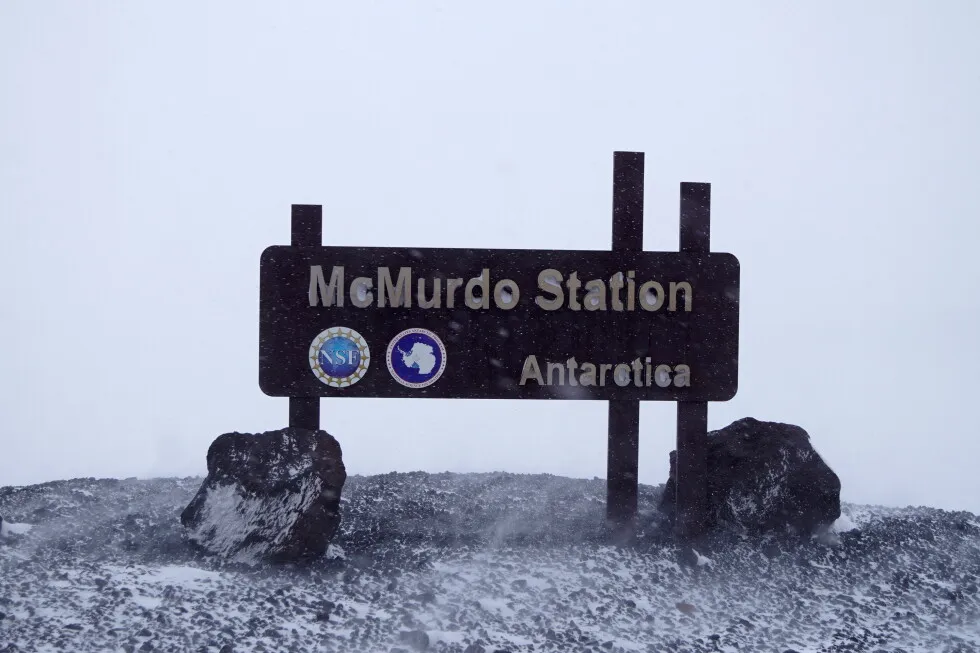
American flown to a New Zealand hospital in a rare midwinter Antarctic rescue mission 1 of 2 | A sign is photographed at McMurdo Station, a United States Antarctic research station, on Dec. 4, 2018. (National Science Foundation via AP, File) 2 of 2 | McMurdo Station, Antarctica, is photographed from the air on Oct. 27, 2014. (National Science Foundation via AP, File) 1 of 2 | A sign is photographed at McMurdo Station, a United States Antarctic research station, on Dec. 4, 2018. (National Science Foundation via AP, File) 1 of 2 A sign is photographed at McMurdo Station, a United States Antarctic research station, on Dec. 4, 2018. (National Science Foundation via AP, File) Add AP News on Google Add AP News as your preferred source to see more of our stories on Google. Share 2 of 2 | McMurdo Station, Antarctica, is photographed from the air on Oct. 27, 2014. (National Science Foundation via AP, File) 2 of 2 McMurdo Station, Antarctica, is photographed from the air on Oct. 27, 2014. (National Science Foundation via AP, File) Add AP News on Google Add AP News as your preferred source to see more of our stories on Google. Share Updated [hour]:[minute] [AMPM] [timezone], [monthFull] [day], [year] MELBOURNE, Australia (AP) — An Australian air crew flew an American from an Antarctic base to a New Zealand hospital in a rare midwinter rescue.The Airbus A319 Long Range aircraft, with the call sign Snowbird 1, flew from the Australian city of Hobart to the U.S. McMurdo Station in Antarctica on July 31 in response to an “urgent request for assistance,” the jet’s Melbourne-based owner Skytraders said in a statement Thursday.The jet landed after a five hour and 30 minute flight at the Phoenix Airfield near McMurdo in darkness and with temperatures as low as minus 43 C (minus 45.4 F), the statement said.The American was flown on the same day to a hospital in Christchurch, New Zealand, as weather conditions at the Antarctic air strip worsened, said Skytraders, which is contracted by the Australian Antarctic Program.The U.S. National Science Foundation told the Australian Broadcasting Corp. that the patient was admitted to the Christchurch Hospital in a “serious condition.” New Zealand’s Health Ministry on Friday would not comment on the American’s condition or say whether the American remained in hospital.The mission’s copilot, Louise Robertson, said conditions were close to the limit of the aircraft’s capabilities. 3 MIN READ 1 MIN READ 2 MIN READ “We had some what’s called nautical twilight, which is a very minimal amount of light that is pretty much pitch blackness and also the extreme cold temperatures. We are right on the verge of the limitation of the aircraft,” Robertson told ABC.“It was very close to being too cold,” she said.” It got down to minus 43 (Celsius), which is the coldest I’ve ever felt. It was about 8 knots of wind, so quite a bit of wind-chill as well.” Robertson said plans to fly to the base on the Ross Ice Shelf a day earlier were aborted due to a snow storm.“There … was really just such a narrow window of opportunity,” Robertson said.“To get there in complete darkness in these extreme cold temperatures is very, very rare. I believe it hasn’t been done before,” she added. The sun last set at the geographic South Pole on March 23 and will not rise until Sept. 21.The New Zealand Air Force evacuated a New Zealand citizen working on the U.S. Antarctic Program from the Phoenix Airfield in a C-130 Hercules in a medical emergency in April, which is the Southern Hemisphere autumn.In August last year, the final month of the Southern Hemisphere winter, New Zealand used the same type of four-engine turboprop transport aircraft to evacuate three people on a flight from McMurdo for medical treatment.Graham-McLay reported from Wellington, New Zealand.
SRCAssociated Press (AP)
LANGEN
LEANCenter
WORDS643
ENT12
FRI · 2026-08-07 · 04:53 GMTBRIEF NSR-2026-0807-100004
NSR-2026-0807-100004News Report·EN·Human Interest
American flown to a New Zealand hospital in a rare midwinter Antarctic rescue mission
An Australian air crew conducted a rare midwinter rescue mission, flying an American from McMurdo Station in Antarctica to a hospital in Christchurch, New Zealand. The flight, undertaken on July 31 in response to an urgent request, occurred in darkness and extreme cold, with temperatures reaching minus 43 degrees Celsius.
By
ROD MCGUIRK and CHARLOTTE GRAHAM-MCLAYAssociated Press (AP)Filed 2026-08-07 · 04:53 GMTLean · CenterRead · 3 min
Associated Press (AP)FIG 01
Reading time
3min
Word count
643words
Sources cited
3cited
Entities identified
12entities
Quality score
100%
§ 01
Briefing Summary
AI-generatedNEWSAR · AI
An Australian air crew conducted a rare midwinter rescue mission, flying an American from McMurdo Station in Antarctica to a hospital in Christchurch, New Zealand. The flight, undertaken on July 31 in response to an urgent request, occurred in darkness and extreme cold, with temperatures reaching minus 43 degrees Celsius. The aircraft, an Airbus A319 Long Range operated by Skytraders, landed at Phoenix Airfield near McMurdo. The American patient was admitted to Christchurch Hospital in a serious condition. The mission was near the aircraft's operational limits due to the challenging conditions, which included a prior aborted attempt due to a snowstorm.
Confidence 0.90Sources 3Claims 5Entities 12
§ 02
Article analysis
Model · rule-basedFraming
Human Interest
Technology
Tone
Mixed Tone
AI-assessed
CalmNeutralAlarmist
Factuality
0.90 / 1.00
Factual
LowHigh
Sources cited
3
Well sourced
FewMany
§ 03
Key claims
5 extracted01
Conditions were close to the limit of the aircraft's capabilities due to extreme cold and minimal light.
quoteLouise Robertson
Confidence
1.00
02
The flight landed at Phoenix Airfield near McMurdo in darkness with temperatures as low as minus 43 C (minus 45.4 F).
factualSkytraders
Confidence
1.00
03
An Airbus A319 Long Range aircraft, call sign Snowbird 1, flew from Hobart, Australia to McMurdo Station, Antarctica on July 31.
factualSkytraders
Confidence
1.00
04
An American was flown from an Antarctic base to a New Zealand hospital in a rare midwinter rescue mission.
factual
Confidence
1.00
05
The patient was admitted to Christchurch Hospital in a 'serious condition'.
factualU.S. National Science Foundation
Confidence
0.90
§ 04
Full report
3 min read · 643 words§ 05
Entities
12 identifiedKey playerOppositionContextPositiveNeutralNegative
Organizations4
§ 06
Keywords & salience
8 termsantarctic rescue mission
1.00
midwinter rescue
0.90
mcmurdo station
0.80
medical evacuation
0.70
extreme conditions
0.60
antarctic operations
0.50
new zealand hospital
0.40
australian air crew
0.40
§ 07
Topic connections
Interactive graph No topic relationship data available yet. This graph will appear once topic relationships have been computed.