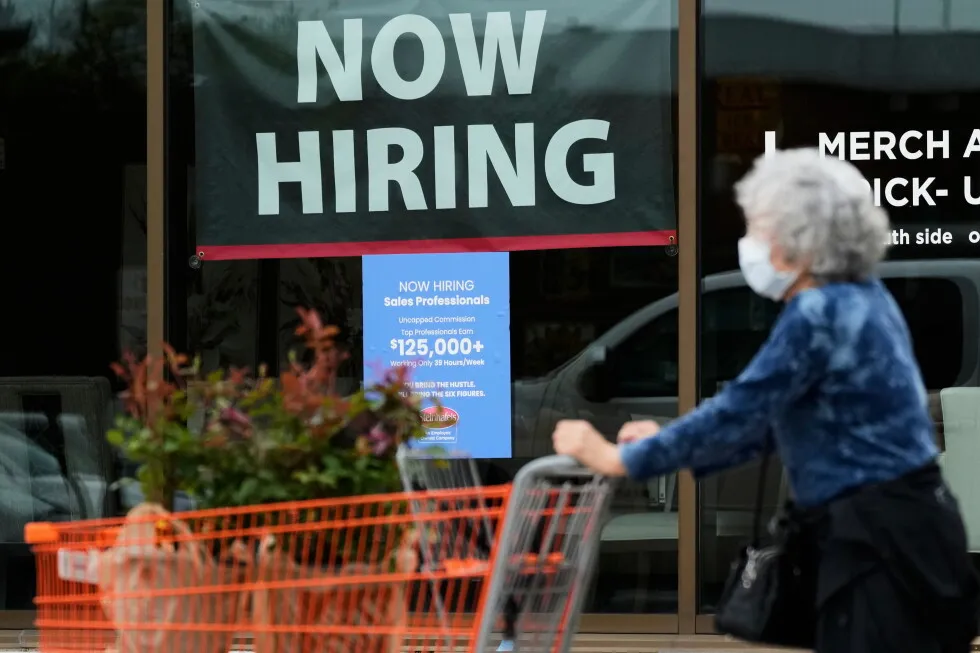
US likely added nearly 100,000 jobs in July, but market is still tough for young and unemployed 1 of 2 | Hiring sign for sales professionals is displayed at a store, in Vernon Hills, Ill., Wednesday, April 15, 2026. (AP Photo/Nam Y. Huh, file) 2 of 2 | A job seeker waits to talk to a recruiter at a job fair Aug. 28, 2025, in Sunrise, Fla. (AP Photo/Marta Lavandier, File) By Paul Wiseman Updated 6:01 AM MESZ, August 7, 2026 Add AP News on Google Add AP News as your preferred source to see more of our stories on Google. Share Share Facebook Copy Link copied Print Email X LinkedIn Bluesky Flipboard Pinterest Reddit WASHINGTON (AP) — On the face of it, the U.S. job market has looked pretty stable this year. Hiring has been solid – if not exactly spectacular – after a lackluster 2025. But underneath the headline numbers, the job market is sending mixed and confusing signals. Companies in some industries can’t find enough workers and have to pay premium wages to fill vacancies. Others are making such efficient use of technology that they don’t need to hire much at all. Normally, the American labor market looks either good or bad. Lately, it’s been a bit of both. Layoffs are rare — but times are tough for jobseekers Americans who have jobs are enjoying unusual job security. Layoffs are low by historical standards. Companies, scarred by the surprise labor shortages that followed COVID-19 lockdowns a few years ago, don’t want to risk giving up the staff they have. One week in July the number of Americans filing for unemployment benefits dropped to the lowest level in more than 50 years. The jobless rate tumbled to 4.2% in June, the lowest in a year, and is expected to have stayed there last month, according to a survey of forecasters by the data firm FactSet. But Americans who have lost their jobs – or are seeking to bust into the job market for the first time – are struggling to catch a break. One sign of their trouble: In May 27.5% of the unemployed had been out of work for six months, the most in four and a half years; the share dipped slightly but remained high in June. Economists have used the term “no hire, no fire’’ to describe the unusual job market conditions. US filings for jobless benefits rise to 199,000 last week, but layoffs remain historically low 5 MIN READ US filings for jobless benefits rise to 197,000 last week, but layoffs remain historically low 5 MIN READ 14 US jobless claims dip modestly to 215,000 last week as layoffs remain at historically healthy levels 5 MIN READ 14 The Labor Department releases July employment numbers on Friday. They are expected to show that companies, government agencies and nonprofits added nearly 98,000 jobs last month, according to the FactSet survey. That would be an improvement on the disappointing 57,000 jobs employers created in June. And it would mark a continued rebound from 2025 when the economy generated fewer than 10,000 new jobs a month – the weakest hiring outside a recession since 2002. Last year, high interest rates and uncertainty over President Donald Trump’s economic policies discouraged companies from adding staff. So far in 2026, employers have added an average 92,000 jobs a month. In the past, that would have been an unimpressive level of hiring. But the United States doesn’t need as many jobs as it used to keep the unemployment rate from rising. Trump’s immigration crackdown and the ongoing retirement of baby boomers mean fewer people are competing for work. So the “break-even’’ rate of monthly hiring, 155,000 in 2023-2024, has dropped, perhaps to nearly zero, according to a Federal Reserve study. “There are just fewer people available to hire,’’ said Sal Guatieri, senior economist at BMO Capital Markets. For some, labor shortages translate into higher wages. The payroll processor ADP reported Wednesday that people who changed jobs last month pocketed a 7% raise, the biggest year-over-year gain in almost a year and a premium over a 4.4% increase for workers who stayed where they were. At the same time, companies have become more productive in recent years, using technology to do the work that humans used to do. “We are seeing companies produce more with their current staff,’’ Guatieri said. “So there’s less need to take on new workers.’’ Shortages of available workers and rising productivity, he said, “will keep the lid on the rate of hiring and monthly job growth.’’ Moreover, the outlook for hiring is clouded by the ongoing fighting in the Persian Gulf, which has pushed up energy prices and squeezed family budgets, and by the rise of artificial intelligence, which could either make workers more efficient and better-paid -- or take their jobs. The June jobs report contained an oddity that might have reversed in July. The Labor Department numbers showed that 720,000 people dropped out of the labor force in June – and a surprising 700,000 (97%) of them were ages 25 to 34. A smaller labor force means fewer people are competing for work and tends to push the unemployment rate lower. If the June drop was a statistical quirk – and the labor force rebounded last month and increased the number of people vying for jobs – the unemployment rate could surprise and tick back up. In a report out this week, researchers Ingrid Chen, Marianna Kudlyak and Riva Mikhlin of the Federal Reserve Bank of San Francisco found that landing a job has gotten tougher in the past couple of years – surprisingly so. Normally, this deep into an economic expansion – it’s been more than six years since the last recession – employers would need workers so badly that they’d be taking chances on young people and on those with less education. Not this time. “Instead of being pulled in, the pipeline into employment is shrinking such that the recovery is no longer reaching workers at the margins,’’ Chen, Kudlyak and Mikhlin write. Moreover, the unemployed people who normally get back to work the fastest – those in their prime working years (25 to 54) and with college educations – are struggling to find new jobs. The San Francisco Fed researchers aren’t sure what’s making the job search so tough. They suspect it might have to do with the immigration crackdown, hiring slowdowns specifically at tech companies and government contractors, uncertainty over the direction of government policy or “early signals of broader labor market deterioration.’’
SRCAssociated Press (AP)
LANGEN
LEANCenter
WORDS1 092
ENT12
FRI · 2026-08-07 · 04:23 GMTBRIEF NSR-2026-0807-100006
NSR-2026-0807-100006News Report·EN·Human Interest
US likely added nearly 100,000 jobs in July, but market is still tough for young and unemployed
The U.S. job market in July is expected to show nearly 100,000 jobs added, a rebound from a weak June and a significant improvement from 2025.
Associated Press (AP)Filed 2026-08-07 · 04:23 GMTLean · CenterRead · 5 min
Associated Press (AP)FIG 01
Reading time
5min
Word count
1 092words
Sources cited
2cited
Entities identified
12entities
Quality score
100%
§ 01
Briefing Summary
AI-generatedNEWSAR · AI
The U.S. job market in July is expected to show nearly 100,000 jobs added, a rebound from a weak June and a significant improvement from 2025. Despite low layoff rates and high job security for those employed, individuals seeking jobs, particularly young people, are facing a challenging market. This "no hire, no fire" environment is attributed to companies' caution after past labor shortages, increased productivity through technology, and a shrinking labor force due to factors like immigration crackdowns and retirements. While some workers changing jobs are seeing substantial wage increases, the overall hiring rate is expected to remain constrained. The job market's mixed signals also include a puzzling drop in the labor force in June, with a significant portion being young adults.
Confidence 0.90Sources 2Claims 5Entities 12
§ 02
Article analysis
Model · rule-basedFraming
Human Interest
Economic Impact
Tone
Measured
AI-assessed
CalmNeutralAlarmist
Factuality
0.80 / 1.00
Factual
LowHigh
Sources cited
2
Limited
FewMany
§ 03
Key claims
5 extracted01
The jobless rate tumbled to 4.2% in June, the lowest in a year.
statisticFactSet
Confidence
1.00
02
Americans who have lost their jobs or are seeking to enter the market are struggling.
factual
Confidence
0.90
03
Americans who have jobs are enjoying unusual job security, with layoffs being rare.
factual
Confidence
0.90
04
The job market is sending mixed and confusing signals.
factual
Confidence
0.90
05
US likely added nearly 100,000 jobs in July.
prediction
Confidence
0.80
§ 04
Full report
5 min read · 1 092 words§ 05
Entities
12 identifiedKey playerOppositionContextPositiveNeutralNegative
People3
Organizations2
Locations5
§ 06
Keywords & salience
8 termsjob market
1.00
unemployment rate
0.90
job security
0.80
layoffs
0.70
hiring
0.60
job seekers
0.50
us economy
0.40
no hire, no fire
0.40
§ 07
Topic connections
Interactive graph Network visualization showing 51 related topics
View Full Graph Person Organization Location Event|Click node to navigate|Edge numbers = shared articles