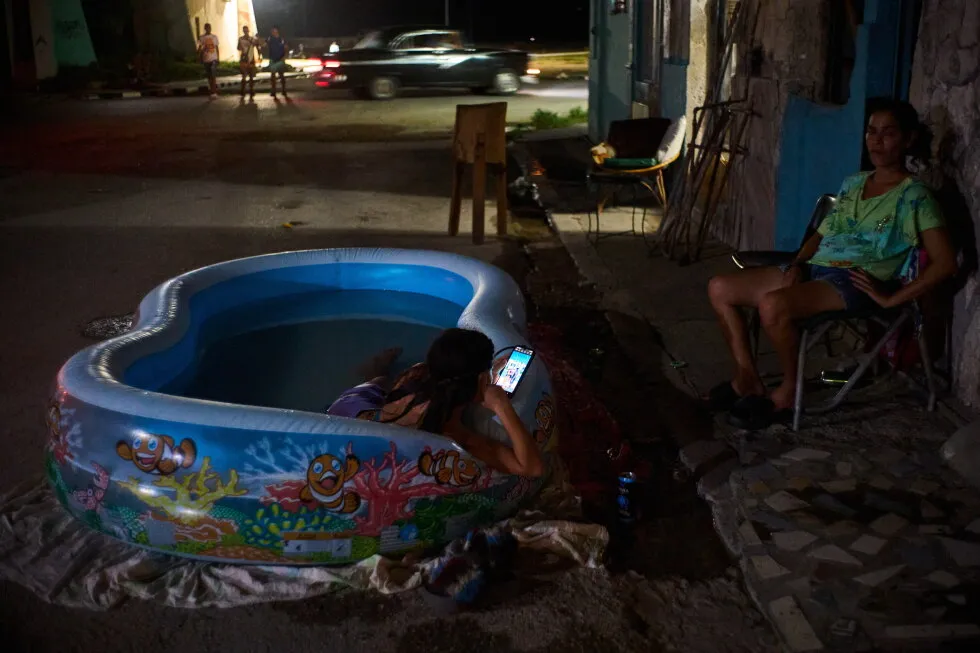
As blackouts stretch for days, life in Cuba revolves around small bursts of electricity 0 seconds of 1 minute, 4 secondsVolume 0% Press shift question mark to access a list of keyboard shortcuts Keyboard ShortcutsEnabledDisabled Shortcuts Open/Close/ or ? Play/PauseSPACE Increase Volume↑ Decrease Volume↓ Seek Forward→ Seek Backward← Captions On/Offc Fullscreen/Exit Fullscreenf Mute/Unmutem Decrease Caption Size- Increase Caption Size+ or = Seek %0-9 Next Up AP top stories August 5 01:00 00:00 01:04 01:04 More Videos 01:00 AP top stories August 5 00:52 AP Top Stories April 5 00:57 AP top stories August 6 00:59 AP Top Stories August 7 01:50 Last Jews in Indian city of Kochi seek to preserve community's history 00:50 'Spider-Man: Brand New Day' makes box office history 00:46 UEFA declares no confidence in FIFA President over failed World Cup equity plan 02:33 New Latter-day Saints temple rises near Mormonism's oldest Close 1 of 6 | Cubans are using every last second of electricity as the U.S blockade continues. (AP/Ariel Fernández and Milexsy Durán) 2 of 6 | A girl cools off in a plastic pool in the street in Havana, Cuba, Tuesday, Aug. 4, 2026. (AP Photo/Ramon Espinosa) 3 of 6 | People carry water during a power outage in Havana, Cuba, Monday, Aug. 3, 2026. (AP Photo/Ramon Espinosa) 4 of 6 | A man maneuvers his electric tricycle alongside his small dog in Havana, Cuba, Wednesday, July 29, 2026. (AP Photo/Ramon Espinosa) 5 of 6 | A man sells fruit during a power outage in Havana, Cuba, Monday, Aug. 3, 2026. (AP Photo/Ramon Espinosa) 6 of 6 | People sleep on the Malecón seawall to escape the heat of their homes during a power outage in Havana, Cuba, Wednesday, Aug. 5, 2026. (AP Photo/Ramon Espinosa) By Andrea Rodriguez Updated 12:05 PM MESZ, August 7, 2026 Add AP News on Google Add AP News as your preferred source to see more of our stories on Google. Share Share Facebook Copy Link copied Print Email X LinkedIn Bluesky Flipboard Pinterest Reddit Havana (AP) — A 20-minute burst of electricity is a small miracle in Havana nowadays — a miracle that sometimes comes at 3 a.m. That’s when 72-year-old Leidis Rodríguez frantically cooked beans after the lights switched on this week following hours of uninterrupted blackouts. “The power has come back on, everyone go!” Rodríguez shouted. In the wake of sometimes dayslong blackouts in Cuba — fueled by the oil blockade imposed by the Trump administration in January — Cubans are planning their lives around the lights turning back on. Those small bursts of relief last a few minutes or a few hours. They come at any time, day or night. Increasingly, electricity flicks on when Rodríguez and her 41-year-old daughter, Yaimara Matos, would normally be asleep. When the power comes on, the family stops everything they’re doing. “You want to do everything at the same time — wash clothes, iron, cook, tidy the rooms, because it’s impossible in the dark, and even get a little relief from the heat,” Matos said. “What we used to do in 10 hours, we now have to do in two.” That’s the case for Cubans across the island, whose lives have been transformed by one of the worst crises the island has seen since the Cuban revolution. Daily life has turned into a tangle of compounding crises families have to unravel. Public transportation and cultural events have come to a standstill. So has tourism, the country’s economic engine, especially as tourism companies have withdrawn, leaving 25,000 hospitality jobs vacant. Flights to the island are regularly canceled and workdays have been shortened to adjust to the new reality of a Cuba without power. Medicine shortages have worsened and food rots in fridges without power. “If there’s no electricity, there’s no water because it doesn’t get pumped to the tank. When there’s water, there’s no electricity,” Rodríguez lamented. Cuba plunged into 3rd nationwide blackout in 2 weeks as fuel runs low 7 MIN READ Cubans sleep on seaside boardwalk to seek relief from crippling blackouts and summer heat 1 MIN READ 11 Solar-powered tricycles help Cubans navigate fuel shortages and blackouts 1 MIN READ 11 Power outages are nothing new to the Caribbean nation. Endemic blackouts began to worsen five years ago as a result of a crumbling energy grid, decades-long U.S. sanctions and failed economic reforms by the communist-run government. But the quality of life began to rapidly deteriorate when U.S. President Donald Trump threatened to impose a tariff on any goods from countries that sell or provide it with oil, Cuba’s main source of power. The move, combined with even more rigid sanctions, was aimed at pressuring Cuba’s government into political change. The worst effects have been felt by average Cubans. Previously, most blackouts were scheduled by the government to save power, so each family knew how long they would be without electricity — usually two or three hours. Now there is no longer any predictability: an outage can last 12 hours, 30 hours or longer. Increasingly, the entire island goes dark. Last weekend’s grid collapse marked the sixth time this year. Cubans like Rodríguez and Matos, long accustomed to adapting to crisis, have found ways to cope. The family bought a small power generator, which they’re only able to run a few hours a day. Others install solar panels — often sent by relatives abroad. Some purchase rechargeable fans or solar-powered vehicles since gasoline is also unavailable. Lianet Barroso once cooked with a gas stove. Now she cooks over a wood fire. Unsure of when she will next get water when the power does go on, she fills up as many plastic bottles as she can. “Life for Cubans has become difficult, harsh and sad,” Barroso said. In several municipalities, particularly in Havana, residents staged neighborhood protests after blackouts lasting more than 48 hours, banging pots and pans and burning garbage piled up on street corners. Meanwhile, with inflation surging as Cuba’s currency is increasingly devalued against the dollar, many people are struggling to even pay for food that could later go bad in a blackout. At 10 p.m. on Tuesday, 64-year-old Caridad Delgado was preparing food for her cat during a blackout under the light of a rechargeable lamp, something the family bought with remittances from her three children, who had emigrated from the island. Months ago at this hour, she said, “ I’d probably be watching a soap opera. Now I can’t even dream of it.” “There’s just too much anguish, too much desperation,” she said. “I try to carry on with life.” Associated Press writers Megan Janetsky in Mexico City and Milexsy Durán and Ariel Fernández in Havana contributed to this report.
SRCAssociated Press (AP)
LANGEN
LEANCenter
WORDS1 116
ENT9
FRI · 2026-08-07 · 10:23 GMTBRIEF NSR-2026-0807-100102
NSR-2026-0807-100102News Report·EN·Human Interest
As blackouts stretch for days, life in Cuba revolves around small bursts of electricity
Cuba is experiencing prolonged and unpredictable blackouts, sometimes lasting for days, significantly disrupting daily life. These power outages, fueled by an oil blockade imposed by the Trump administration, force Cubans to adapt by completing tasks in brief, often inconvenient, bursts of electricity.
Associated Press (AP)Filed 2026-08-07 · 10:23 GMTLean · CenterRead · 5 min
Associated Press (AP)FIG 01
Reading time
5min
Word count
1 116words
Sources cited
2cited
Entities identified
9entities
Quality score
100%
§ 01
Briefing Summary
AI-generatedNEWSAR · AI
Cuba is experiencing prolonged and unpredictable blackouts, sometimes lasting for days, significantly disrupting daily life. These power outages, fueled by an oil blockade imposed by the Trump administration, force Cubans to adapt by completing tasks in brief, often inconvenient, bursts of electricity. The crisis has led to the standstill of public transportation, tourism, and has worsened medicine shortages and food spoilage. Residents are resorting to alternative methods like cooking with wood fires and using rechargeable devices. Previously scheduled blackouts have been replaced by unpredictable outages, impacting essential services like water pumping. The situation is described as one of the worst crises since the Cuban revolution, with residents protesting the extended periods without power.
Confidence 0.90Sources 2Claims 5Entities 9
§ 02
Article analysis
Model · rule-basedFraming
Human Interest
Economic Impact
Tone
Measured
AI-assessed
CalmNeutralAlarmist
Factuality
0.70 / 1.00
Factual
LowHigh
Sources cited
2
Limited
FewMany
§ 03
Key claims
5 extracted01
People are sleeping on the Malecón seawall to escape the heat during power outages.
factual
Confidence
1.00
02
A 20-minute burst of electricity is considered a small miracle, sometimes occurring at 3 a.m.
quoteLeidis Rodríguez
Confidence
1.00
03
Residents use short bursts of electricity to perform essential tasks like cooking, washing, and ironing.
factual
Confidence
1.00
04
Blackouts in Cuba are stretching for days, forcing residents to plan their lives around brief periods of electricity.
factual
Confidence
1.00
05
The blackouts are fueled by the oil blockade imposed by the Trump administration in January.
factual
Confidence
0.90
§ 04
Full report
5 min read · 1 116 words§ 05
Entities
9 identifiedKey playerOppositionContextPositiveNeutralNegative
§ 06
Keywords & salience
7 termsblackouts
1.00
electricity
0.90
cuba
0.80
oil blockade
0.70
havana
0.60
daily life
0.50
trump administration
0.40
§ 07
Topic connections
Interactive graph Network visualization showing 51 related topics
View Full Graph Person Organization Location Event|Click node to navigate|Edge numbers = shared articles