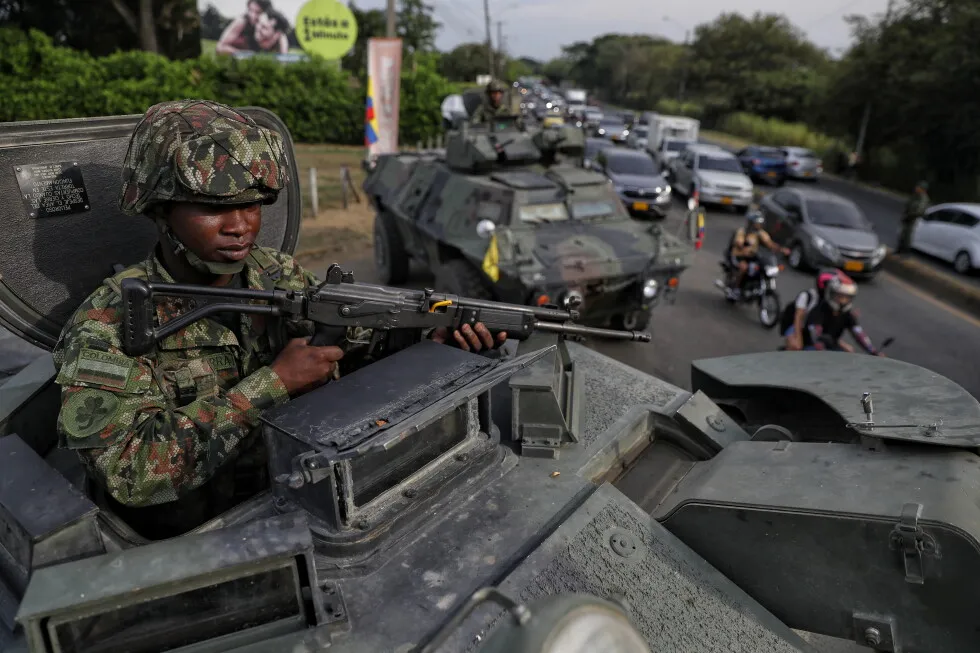
Colombia’s new president to take office in ceremony in Cali highlighting hard line on armed groups 1 of 5 | A soldier keeps watch from the turret of an armored vehicle ahead of the inauguration of President-elect Abelardo de la Espriella in Cali, Colombia, Wednesday, Aug. 5, 2026. (AP Photo/Santiago Saldarriaga) 2 of 5 | Police inspect vehicles at a checkpoint ahead of the inauguration of President-elect Abelardo de la Espriella in Cali, Colombia, Thursday, Aug. 6, 2026. (AP Photo/Ivan Valencia) (AP Photo/Ivan Valencia) 3 of 5 | Soldiers stand guard along a road ahead of the inauguration of President-elect Abelardo de la Espriella in Cali, Colombia, Wednesday, Aug. 5, 2026. (AP Photo/Santiago Saldarriaga) 4 of 5 | A soldier keeps watch from the turret of an armored vehicle ahead of the inauguration of President-elect Abelardo de la Espriella in Cali, Colombia, Wednesday, Aug. 5, 2026. (AP Photo/Santiago Saldarriaga) 5 of 5 | Soldiers inspect a car at a security checkpoint ahead of the inauguration of President-elect Abelardo de la Espriella in Cali, Colombia, Wednesday, Aug. 5, 2026. (AP Photo/Santiago Saldarriaga) By ASTRID SUÁREZ Updated 2:53 PM MESZ, August 7, 2026 Add AP News on Google Add AP News as your preferred source to see more of our stories on Google. Share Share Facebook Copy Link copied Print Email X LinkedIn Bluesky Flipboard Pinterest Reddit BOGOTA, Colombia (AP) — Conservative Abelardo de la Espriella will be sworn in as Colombia’s president Friday under heavy security in Cali, a city in the country’s volatile southwest, breaking with the tradition of holding the ceremony in the capital, in a move meant to signal his hard-line approach to illegal armed groups De la Espriella, 48, will succeed Gustavo Petro after winning a close runoff election on June 21 against the outgoing president’s ally, Sen. Iván Cepeda. De la Espriella, who has never held public office before, ran as an outsider, financing his campaign with the fortune he amassed as a lawyer and businessman. His inauguration, to be held at a university auditorium before Congress, marks a further shift to the right in the region. King Felipe VI of Spain and Latin American presidents including Argentina’s Javier Milei, Ecuador’s Daniel Noboa and Chile’s José Antonio Kast are expected to attend. After the ceremony, de la Espriella will travel to a military battalion in Cali to address the troops. He aims to boost the morale of the service members and simultaneously warn the illegal armed groups operating in the area that they must surrender or face being declared “military targets.” De la Espriella, who calls himself “El Tigre” or “The Tiger,” has pledged to tackle the persistent violence in Colombia by breaking with Petro’s policy of negotiating with armed groups, arguing that the peace process has failed. Illegal economies, such as drug trafficking and illegal mining, are disputed among groups like the dissident factions of the now-defunct Revolutionary Armed Forces of Colombia that did not accept the peace agreement signed a decade ago, the Clan del Golfo cartel, and the National Liberation Army guerrilla group. As Colombia prepares for presidential inauguration, outgoing leader doubles down on fraud claims 4 MIN READ Truck explodes outside Colombia police base, injuring 11 officers and killing a dog 3 MIN READ 15 Colombia’s Petro calls on supporters to defend economic reforms in his last presidential speech 3 MIN READ 15 Impact on the region De la Espriella, a Colombian-American citizen, comes to power after receiving the backing of U.S. President Donald Trump and as regional concerns grow about crime, immigration and the economy. “His rise to power will reinforce this rightward shift across much of Latin America and consolidate a regional bloc of conservative governments against a dwindling number of left-wing administrations,” Glaeldys González, an analyst with the International Crisis Group for the Andes, told The Associated Press. De la Espriella has said that his government will unite Colombia with the “Shield of the Americas,” a regional coalition to fight drug trafficking that emerged from the summit held by Trump in March. He also announced that he will resume diplomatic relations with Israel and sever them with Cuba and Nicaragua, which he considers “tyrannies.” De la Espriella will face robust opposition from Petro, who refused to recognize his electoral victory and insisted on alleged fraud, claiming that results from thousands of tally sheets were manipulated by programmers. The accusations of fraud have been dismissed by international observers as well as electoral authorities in Colombia. Petro will be “relentless” and “acerbic” as an opponent, seeking to strengthen his leadership, said political analyst Sergio Guzmán. Petro has urged social movements in the southwest of the country to organize “people’s militias” to defend themselves against potential attacks from what he called the “fascists,” and called on his supporters to prepare for a general strike should they try to imprison him after he leaves office. Petro was named a “priority target” by the U.S. Drug Enforcement Agency, the AP reported in March. These kinds of calls from Petro, coupled with the hard-line approach de la Espriella intends, increase the likelihood of “confrontations during demonstrations or more forceful responses from the authorities,” according to Andrés Macías, a researcher specializing in conflict and peace at Externado University. In Cali, where Petro has a large following, social and student organizations have called for demonstrations during the inauguration ceremony. Protests are also expected in Bogota and Barranquilla. Follow the AP’s Latin America coverage at https://apnews.com/hub/latin-america
SRCAssociated Press (AP)
LANGEN
LEANCenter
WORDS908
ENT11
FRI · 2026-08-07 · 13:23 GMTBRIEF NSR-2026-0807-100128
NSR-2026-0807-100128News Report·EN·National Security
Colombia’s new president to take office in ceremony in Cali highlighting hard line on armed groups
Conservative Abelardo de la Espriella will be sworn in as Colombia's president in Cali on Friday, August 7, 2026, a move intended to signal his hard-line stance against illegal armed groups. De la Espriella, a lawyer and businessman with no prior public office, won a close runoff election against an ally of the outgoing president.
Associated Press (AP)Filed 2026-08-07 · 13:23 GMTLean · CenterRead · 4 min
Associated Press (AP)FIG 01
Reading time
4min
Word count
908words
Sources cited
0cited
Entities identified
11entities
Quality score
100%
§ 01
Briefing Summary
AI-generatedNEWSAR · AI
Conservative Abelardo de la Espriella will be sworn in as Colombia's president in Cali on Friday, August 7, 2026, a move intended to signal his hard-line stance against illegal armed groups. De la Espriella, a lawyer and businessman with no prior public office, won a close runoff election against an ally of the outgoing president. His inauguration ceremony will be held under heavy security, with international leaders expected to attend. Following the ceremony, de la Espriella plans to address troops and warn armed groups to surrender or face being declared military targets, breaking with the previous administration's policy of negotiation. His presidency is seen as a further shift to the right in Latin America, and he plans to form a regional coalition to combat drug trafficking. Outgoing President Gustavo Petro has alleged fraud in the election and called for social movements to organize defenses.
Confidence 0.90Claims 4Entities 11
§ 02
Article analysis
Model · rule-basedFraming
National Security
Political Strategy
Tone
Measured
AI-assessed
CalmNeutralAlarmist
Factuality
0.80 / 1.00
Factual
LowHigh
Sources cited
0
No named sources
FewMany
§ 03
Key claims
4 extracted01
De la Espriella pledged to tackle persistent violence by breaking with Petro’s policy of negotiating with armed groups.
factualAbelardo de la Espriella
Confidence
1.00
02
De la Espriella aims to boost morale of troops and warn illegal armed groups they must surrender or face being declared 'military targets.'
quoteAbelardo de la Espriella
Confidence
1.00
03
Conservative Abelardo de la Espriella will be sworn in as Colombia’s president Friday under heavy security in Cali.
factual
Confidence
1.00
04
King Felipe VI of Spain and Latin American presidents including Argentina’s Javier Milei, Ecuador’s Daniel Noboa and Chile’s José Antonio Kast are expected to attend the inauguration.
factual
Confidence
0.90
§ 04
Full report
4 min read · 908 words§ 05
Entities
11 identifiedKey playerOppositionContextPositiveNeutralNegative
People7
§ 06
Keywords & salience
9 termspresidential inauguration
1.00
armed groups
1.00
colombia
0.90
abelardo de la espriella
0.90
hard-line approach
0.80
security
0.70
shift to the right
0.60
cali
0.50
latin american presidents
0.40
§ 07
Topic connections
Interactive graph Network visualization showing 28 related topics
View Full Graph Person Organization Location Event|Click node to navigate|Edge numbers = shared articles