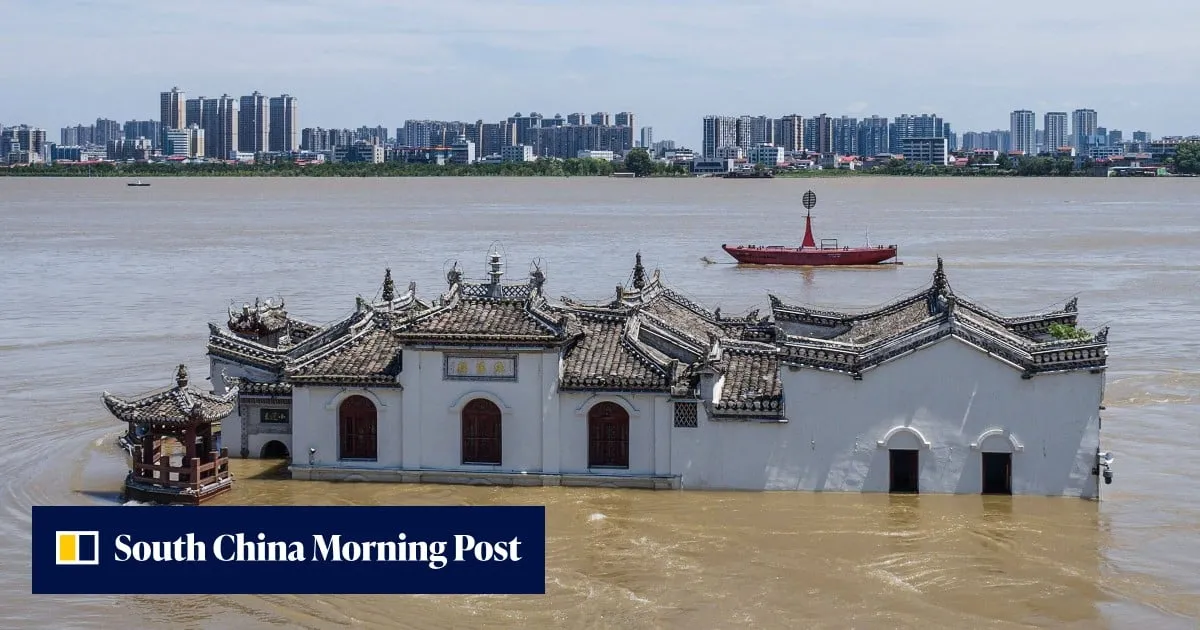
For centuries, the Yangtze River has been China’s vital lifeblood, yet its floods have claimed countless lives. To tame its waters, flood-control systems have evolved from ancient dykes to the engineering marvel of the Three Gorges Dam.But a new study has uncovered a paradox: some human interventions may have inadvertently worsened the very flood risks they were built to mitigate.“We show that flood frequency peaked during the Little Ice Age [1500−1850] … and that human interventions, particularly embankments and lake reclamation, amplified climate-driven flood magnitudes,” a group of scientists in China and Europe wrote in a paper published on Monday in the Proceedings of the National Academy of Sciences of the United States of America.
SRCSouth China Morning Post
LANGEN
LEANCenter-Right
WORDS115
ENT9
SAT · 2026-08-08 · 04:00 GMTBRIEF NSR-2026-0808-100290
NSR-2026-0808-100290News Report·EN·Environmental
Chinese scientists find some Yangtze flood controls may do more harm than good
A new study by Chinese and European scientists, published in the Proceedings of the National Academy of Sciences, reveals that some flood control measures on China's Yangtze River may have unintentionally increased flood risks. The research indicates that human interventions, specifically the construction of embankments and the reclamation of lakes, amplified flood magnitudes that were already driven by climate changes.
Holly ChikSouth China Morning PostFiled 2026-08-08 · 04:00 GMTLean · Center-RightRead · 1 min
South China Morning PostFIG 01
Reading time
1min
Word count
115words
Sources cited
1cited
Entities identified
9entities
Quality score
100%
§ 01
Briefing Summary
AI-generatedNEWSAR · AI
A new study by Chinese and European scientists, published in the Proceedings of the National Academy of Sciences, reveals that some flood control measures on China's Yangtze River may have unintentionally increased flood risks. The research indicates that human interventions, specifically the construction of embankments and the reclamation of lakes, amplified flood magnitudes that were already driven by climate changes. This occurred during periods like the Little Ice Age (1500-1850), when flood frequency was at its peak. The study highlights a paradox where efforts to control the Yangtze's historically devastating floods, ranging from ancient dykes to modern structures like the Three Gorges Dam, may have exacerbated the problem.
Confidence 0.85Sources 1Claims 4Entities 9
§ 02
Article analysis
Model · rule-basedFraming
Environmental
Human Interest
Tone
Measured
AI-assessed
CalmNeutralAlarmist
Factuality
0.80 / 1.00
Factual
LowHigh
Sources cited
1
Limited
FewMany
§ 03
Key claims
4 extracted01
Embankments and lake reclamation amplified climate-driven flood magnitudes on the Yangtze.
factualscientists in China and Europe
Confidence
0.90
02
Flood frequency on the Yangtze River peaked during the Little Ice Age (1500-1850).
statisticscientists in China and Europe
Confidence
0.90
03
Some human interventions on the Yangtze River may have inadvertently worsened flood risks.
factualscientists in China and Europe
Confidence
0.90
04
The Yangtze River has been China’s vital lifeblood, yet its floods have claimed countless lives.
factual
Confidence
0.80
§ 04
Full report
1 min read · 115 words§ 05
Entities
9 identifiedKey playerOppositionContextPositiveNeutralNegative
Organizations1
Locations5
§ 06
Keywords & salience
8 termsyangtze river floods
1.00
flood control systems
0.90
human interventions
0.80
three gorges dam
0.70
little ice age
0.60
lake reclamation
0.50
embankments
0.50
climate-driven flood
0.40
§ 07
Topic connections
Interactive graph Network visualization showing 2 related topics
View Full Graph Person Organization Location Event|Click node to navigate|Edge numbers = shared articles