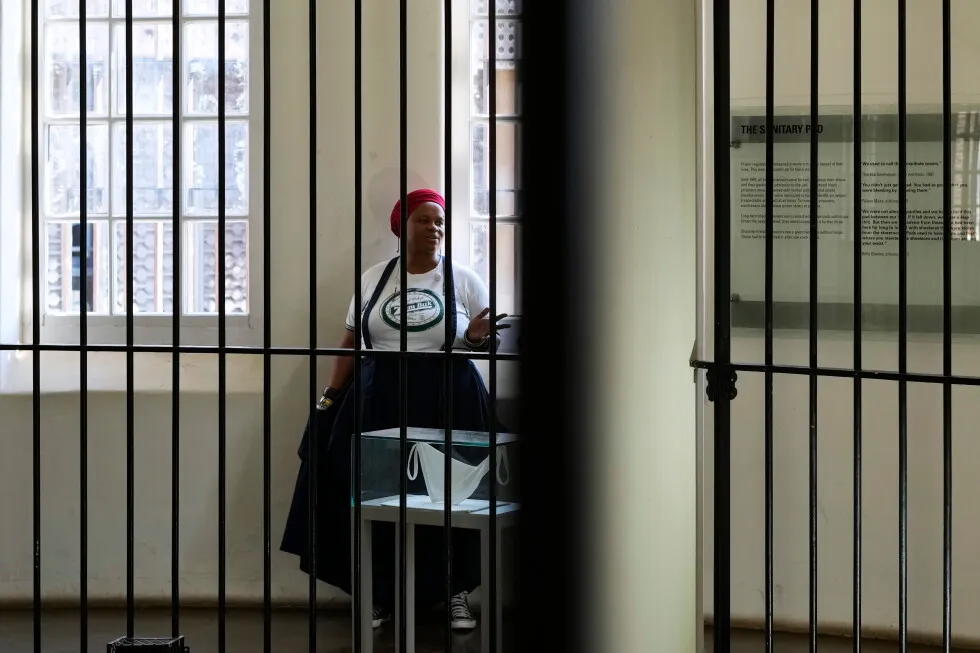
70 years after South Africa’s women challenged apartheid, some say their freedom isn’t complete 1 of 5 | Nolubabalo Memese speaks during an interview while standing in the foyer of Women’s Jail, a museum that stands near the Constitutional Court, in Johannesburg, South Africa, Wednesday, July 22, 2026. (AP Photo/Themba Hadebe) 2 of 5 | Nolubabalo Memese speaks during an interview while standing against a pillar inside a Women’s Jail, a museum that stands near the Constitutional Court, in Johannesburg, South Africa, Wednesday, July 22, 2026. (AP Photo/Themba Hadebe) 3 of 5 | Kgothatso Montjane, a South African Paralympic wheelchair tennis champion, watches the ball after playing a return shot during practice in Pretoria, South Africa, Saturday, Aug. 1, 2026. (AP Photo/Themba Hadebe) 4 of 5 | Kgothatso Montjane, a South African Paralympic wheelchair tennis champion, plays a return shot during practice in Pretoria, South Africa, Saturday, Aug. 1, 2026. (AP Photo/Themba Hadebe) 5 of 5 | Names of former prisoners are displayed at Women’s Jail, a museum that stands near the Constitutional Court, in Johannesburg, South Africa, Wednesday, July 22, 2026. (AP Photo/Themba Hadebe) By MICHELLE GUMEDE Updated 6:04 AM MESZ, August 8, 2026 Add AP News on Google Add AP News as your preferred source to see more of our stories on Google. Share Share Facebook Copy Link copied Print Email X LinkedIn Bluesky Flipboard Pinterest Reddit Johannesburg (AP) — South Africa commemorates on Sunday 70 years since the Women’s March of 1956, when around 20,000 women of all races marched to the administrative capital, Pretoria, to protest apartheid laws forcing Black women to carry passes that restricted their movement. It was a powerful moment in the fight against white minority rule. But seven decades after risking arrest, torture and even death to challenge racist laws, many women say their fight for freedom in South Africa is unfinished as they continue to grapple with high rates of gender-based violence, poverty and inequality. A United Nations Women-supported study in 2024 found more than one in three South African women have experienced physical or sexual violence in their lifetime. Ramnie Dinat, 84, was just a teenager during the Aug. 9, 1956 march. She recalled helping her mother, Ama Naidoo, an anti-apartheid activist, organize women ahead of the rally. Black women, women of Indian heritage like Naidoo, and even some white women marched that day. “Black women were organizing, and Indian women couldn’t be silent,” Dinart told The Associated Press, adding that nobody at the time imagined that “history would remember that day.” “We were ordinary women who believed we could make a difference. We simply believed it was the right thing to do.” More than 53,000 immigrants have been deported or repatriated by South Africa in a crackdown 2 MIN READ South Africa seeks tariff exemption as US probes forced labor tied to imports 4 MIN READ Oprah Winfrey says she will close her school for girls in South Africa next year 4 MIN READ A jail that has turned into a museum Perched on a ridge overlooking central Johannesburg, the Women’s Jail was a cornerstone of South Africa’s apartheid prison system. Today, it’s a museum that stands near the Constitutional Court as a reminder of the country’s journey from oppression to democracy. Many of the march’s leaders and participants were later imprisoned in the Women’s Jail, where activists were held separately according to their race just as apartheid enforced segregation everywhere in South Africa. “It was designed to break, humiliate, dehumanize,” said Nolubabalo Memese, Visitors Services Manager at Constitution Hill, the precinct that houses the former prison complex. She said Black women held at the prison weren’t allowed to wear underwear or have proper sanitary towels. Now, Memese says, the museum honors not only famous figures like Winnie Madikizela-Mandela — Nelson Mandela’s second wife — and Albertina Sisulu, who became icons of the anti-apartheid struggle, but also thousands of ordinary women whose names rarely appear in history books and whose sacrifices went unnoticed. “Our freedom is built on the shoulders of those kinds of women who were at this prison,” she said. South African Paralympic wheelchair tennis champion Kgothatso Montjane echoes the sentiment. Montjane, 40, is one of the country’s most successful para-athletes; she won the 2024 Wimbledon wheelchair doubles title. She says the fight the women took on 70 years ago has “paved the way for us.” “Today I’m the first Black South African woman to compete in all four major tennis tournaments,” she told the AP. Violence against women remains widespread in South Africa Memese said that while apartheid ended in 1994 and South African women are no longer restricted from moving, working or participating in society, gender violence can still deny them freedom. “There’s a different monster which precludes us from enjoying freedom of movement and economic participation. And that’s gender-based violence. That’s crime,” Memese said. “If you want to go jog at six o’clock and it’s a bit dark, you’d rather not,” she added. The U.N. has described the country’s high rates of violence against women and girls as a crisis and a “national wound.” Government data says women are more likely than men to be unemployed, shoulder unpaid care work and remain underrepresented in senior leadership. Montjane, the tennis star, said structural inequalities are also still evident in sport, where financial obstacles determine who gets access to elite competition, despite a select few reaching an elite level. “The barriers I had to overcome ... in a sport like tennis, it’s just a financial issue,” she said. “They don’t lie when they say tennis is a white sport, and you don’t really find people of color dominating in this sport.” Still, she believes the women of 1956 changed the course of history for her and generations to come. When South Africa broke down the old apartheid Women’s Jail, some of the same bricks were used to build the museum in its place, which resonates with Memese. “We are using the bricks of the past to build our future,” she said. “Once we forget the past, it’s very easy for us to make the same mistakes.” For Dinat, one of the few with living memories of the ’56 march, the lesson hasn’t changed in 70 years. “Every generation has its own struggles, and every generation has to decide whether it will stand up for what is right,” she said. MICHELLE GUMEDE Gumede is a Johannesburg-based text news reporter for The Associated Press. She covers a wide range of news topics, including health, climate change, and politics in South Africa. mailto
SRCAssociated Press (AP)
LANGEN
LEANCenter
WORDS1 094
ENT12
SAT · 2026-08-08 · 04:23 GMTBRIEF NSR-2026-0808-100298
NSR-2026-0808-100298News Report·EN·Social Justice
70 years after South Africa’s women challenged apartheid, some say their freedom isn’t complete
South Africa is commemorating 70 years since the 1956 Women's March, where approximately 20,000 women protested apartheid pass laws restricting Black women's movement. While this was a significant moment against white minority rule, many women today feel their freedom is incomplete due to ongoing issues of gender-based violence, poverty, and inequality.
Associated Press (AP)Filed 2026-08-08 · 04:23 GMTLean · CenterRead · 5 min
Associated Press (AP)FIG 01
Reading time
5min
Word count
1 094words
Sources cited
2cited
Entities identified
12entities
Quality score
100%
§ 01
Briefing Summary
AI-generatedNEWSAR · AI
South Africa is commemorating 70 years since the 1956 Women's March, where approximately 20,000 women protested apartheid pass laws restricting Black women's movement. While this was a significant moment against white minority rule, many women today feel their freedom is incomplete due to ongoing issues of gender-based violence, poverty, and inequality. A UN study found over one in three South African women have experienced physical or sexual violence. Despite progress since apartheid's end, gender violence and economic disparities continue to limit women's freedom and participation. The Women's Jail, now a museum, serves as a reminder of past struggles and the ongoing fight for full equality.
Confidence 0.90Sources 2Claims 4Entities 12
§ 02
Article analysis
Model · rule-basedFraming
Social Justice
Human Interest
Tone
Measured
AI-assessed
CalmNeutralAlarmist
Factuality
0.70 / 1.00
Factual
LowHigh
Sources cited
2
Limited
FewMany
§ 03
Key claims
4 extracted01
Ramnie Dinat, 84, helped organize women for the 1956 march, which included Black, Indian, and some white women.
quoteRamnie Dinat
Confidence
1.00
02
A 2024 UN Women-supported study found over one in three South African women have experienced physical or sexual violence in their lifetime.
statisticUnited Nations Women-supported study
Confidence
1.00
03
South Africa commemorates 70 years since the 1956 Women's March against apartheid laws restricting Black women's movement.
factual
Confidence
1.00
04
Many women in South Africa feel their fight for freedom is unfinished due to ongoing issues like gender-based violence, poverty, and inequality.
factual
Confidence
0.90
§ 04
Full report
5 min read · 1 094 words§ 05
Entities
12 identifiedKey playerOppositionContextPositiveNeutralNegative
People4
Organizations1
§ 06
Keywords & salience
8 termswomen's march
1.00
apartheid
1.00
gender-based violence
0.90
inequality
0.80
poverty
0.70
south africa
0.60
freedom
0.50
women's rights
0.50
§ 07
Topic connections
Interactive graph Network visualization showing 51 related topics
View Full Graph Person Organization Location Event|Click node to navigate|Edge numbers = shared articles