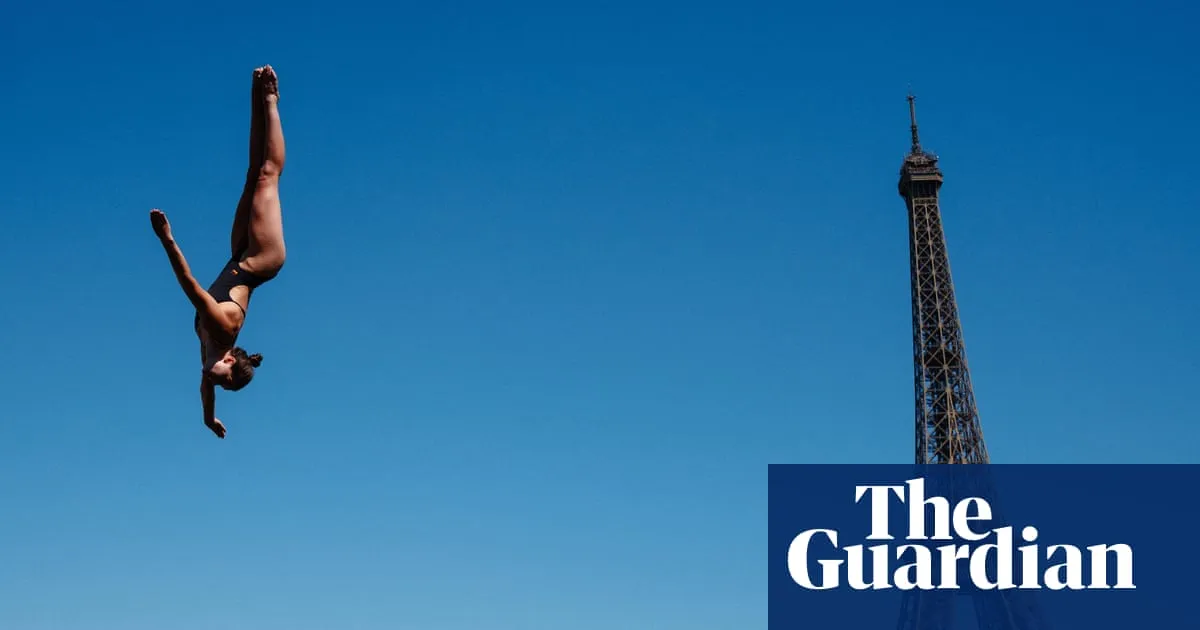
Paris is staging its first high-diving competition in the Seine, with athletes launching themselves from a 20-metre platform in front of the Eiffel Tower – a spectacular new test of the city’s effort to reclaim its river for sport. The event on the Pont de Bir-Hakeim has also exposed the fragility of that ambition.Organisers suspended training on Thursday when traces of hydrocarbons were detected upstream. By Friday, the French Swimming Federation said the affected area had been treated, allowing athletes to return to the water and the event to proceed as planned. High diving concludes on Saturday with the final two rounds and medal events, while the broader European Aquatics Championships run through to 16 August.France’s Gary Hunt in the men’s 20m high diving event. Photograph: Dimitar Dilkoff/AFP/Getty Images“There are things that are within our control, and there are uncertainties that are inevitably linked to any outdoor activity,” said Maxime Sauvage, the Paris deputy mayor in charge of sports, sports facilities and equal access to sport. Among the things within the city’s control, he said, are the massive investments made before the 2024 Olympic and Paralympic Games to make the river safe for swimming, from work to prevent sewage from flowing directly into the Seine to improvements in stormwater management. “There is always a small risk, but that is also part of what makes outdoor events special,” he added. “When they work, it is magical.”Hundreds of people gathered along the banks on Friday to watch the divers. Some stopped during their lunch break, while others stumbled across the competition by chance. Among them was Rebecca Kapogiannis, a 45-year-old visitor from London, Ontario, who was visiting Paris with her daughter to celebrate her graduation. Her daughter had even packed a bathing suit in case she got the chance to swim in the Seine.A diver during practice as the Eiffel Tower is seen in the background. Photograph: Aurélien Morissard/AP“We just headed down to the [Eiffel] Tower today and thought we would walk along the Seine and stumbled upon this and thought it was a really cool activity to watch,” she said. “I was not expecting a competition to take place in the Seine, but I think it’s such a cool use of this water that runs right through the city.”For Cynthia Matz, who was visiting with her husband, Sean, the setting itself was part of the draw. She said they probably would not have sought out the competition had it been held inside. “Anybody can go. I don’t have to know anything about diving. I can just say: ‘This is really cool to see,’” Matz said. “Having it out in public, people will just stop and go, ‘huh, what’s going on?’ and stop and spend some time and enjoy it.”Spectators watch the action from the riverbank. Photograph: Dimitar Dilkoff/AFP/Getty ImagesThat ability to stumble across elite sport in the middle of the city reflects a broader transformation Paris officials have been pushing for years: turning the Seine from a river associated largely with commerce, transport and tourism into a place where people can also swim, play and compete.The 38th European Aquatics Championships mark the centenary of the inaugural championships, held in Budapest in 1926. For Paris, they are a return of another kind: the capital last hosted the event in 1931. More than 1,000 athletes are competing across five disciplines: swimming, diving, artistic swimming, open-water swimming and high diving.skip past newsletter promotionafter newsletter promotionThe Seine is hosting both the open-water swimming and high diving, placing the river back at the centre of a major international sporting event two years after the Paris Games. Swimming in the Seine was officially banned in 1923 amid pollution and the dangers of river traffic. Public swimming returned only in 2025, after Paris and its partners mobilised €1.4bn to make the river swimmable, an effort accelerated by the Olympics.Swimmers compete in the men’s 10km open-water event earlier this week. Photograph: Dimitar Dilkoff/AFP/Getty ImagesFor many French people, making the Seine clean enough for swimming again seemed like a distant dream. But images of athletes competing – and now residents swimming – in the river have become almost familiar. “Paris is not just a postcard image, it is also a magnificent sporting venue,” said Sauvage.
SRCThe Guardian - World News
LANGEN
LEANCenter-Left
WORDS705
ENT12
SAT · 2026-08-08 · 09:00 GMTBRIEF NSR-2026-0808-100328
NSR-2026-0808-100328News Report·EN·Human Interest
High divers take the plunge in Paris for a new test of reclaimed Seine’s water
The European Aquatics Championships are being held in Paris, featuring a high-diving competition in the Seine River from a 20-meter platform near the Eiffel Tower. This event serves as a test of Paris's efforts to make the river swimmable again, a goal accelerated by the upcoming 2024 Olympic and Paralympic Games.
Associated PressThe Guardian - World NewsFiled 2026-08-08 · 09:00 GMTLean · Center-LeftRead · 3 min
The Guardian - World NewsFIG 01
Reading time
3min
Word count
705words
Sources cited
2cited
Entities identified
12entities
Quality score
100%
§ 01
Briefing Summary
AI-generatedNEWSAR · AI
The European Aquatics Championships are being held in Paris, featuring a high-diving competition in the Seine River from a 20-meter platform near the Eiffel Tower. This event serves as a test of Paris's efforts to make the river swimmable again, a goal accelerated by the upcoming 2024 Olympic and Paralympic Games. Training was temporarily suspended due to detected hydrocarbons upstream, but the French Swimming Federation treated the area, allowing the competition to proceed. The championships, which include swimming, diving, artistic swimming, open-water swimming, and high diving, run until August 16th. This marks a significant step in Paris's ambition to transform the Seine into a public sporting venue, a concept that has drawn spectators and visitors.
Confidence 0.90Sources 2Claims 5Entities 12
§ 02
Article analysis
Model · rule-basedFraming
Human Interest
Environmental
Tone
Measured
AI-assessed
CalmNeutralAlarmist
Factuality
0.70 / 1.00
Factual
LowHigh
Sources cited
2
Limited
FewMany
§ 03
Key claims
5 extracted01
France’s Gary Hunt is participating in the men’s 20m high diving event.
factualDimitar Dilkoff/AFP/Getty Images
Confidence
1.00
02
Organisers suspended training on Thursday when traces of hydrocarbons were detected upstream.
factual
Confidence
1.00
03
Paris is staging its first high-diving competition in the Seine, with athletes launching themselves from a 20-metre platform.
factual
Confidence
1.00
04
Hundreds of people gathered along the banks on Friday to watch the divers.
factual
Confidence
0.90
05
Paris has made massive investments to make the river safe for swimming, including work to prevent sewage and improve stormwater management.
quoteMaxime Sauvage
Confidence
0.90
§ 04
Full report
3 min read · 705 words§ 05
Entities
12 identifiedKey playerOppositionContextPositiveNeutralNegative
People4
Organizations1
Locations5
§ 06
Keywords & salience
8 termsreclaimed seine water
1.00
high diving competition
0.90
paris olympics
0.80
water quality
0.70
river sport
0.60
european aquatics championships
0.50
sewage management
0.40
hydrocarbons detection
0.40
§ 07
Topic connections
Interactive graph Network visualization showing 5 related topics
View Full Graph Person Organization Location Event|Click node to navigate|Edge numbers = shared articles