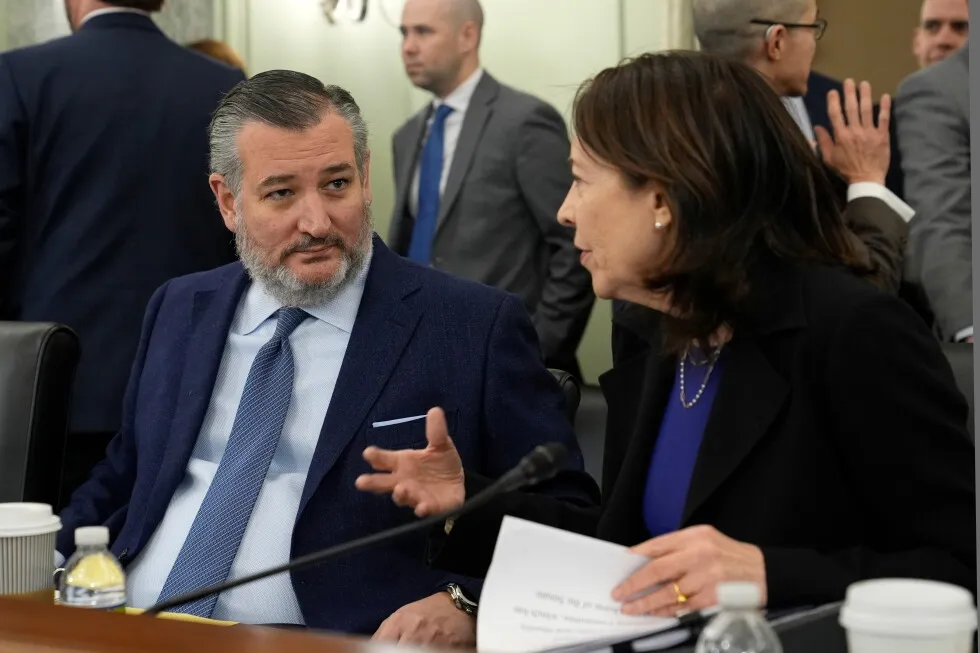
Senate Commerce, Science, and Transportation Committee Chair Sen. Ted Cruz, R-Texas, left, talks with ranking member Sen. Maria Cantwell, D-Wash., right, before the start a hearing on Capitol Hill in Washington, Wednesday, Jan. 15, 2025. (AP Photo/Susan Walsh,File) Updated [hour]:[minute] [AMPM] [timezone], [monthFull] [day], [year] The Protect College Sports Act failed to reach a vote during an all-night, pre-recess session in the Senate that ended early Saturday, though the bill did gain a spot on next month’s calendar after the chamber comes back from its summer break.The measure has been touted as one that would put guardrails around an escalating spending spree in college sports as the industry struggles to adapt to a new model in which teams can pay players.“College sports is something that needs to be fixed, they have a good solution,” said Majority Leader John Thune, R-S.D. “We got it teed up for next month.”The bill has been on a roller coaster since it was introduced in late May but quickly failed to gain support of the two biggest conferences: the Big Ten and SEC.Those conferences signed on and saved it from near death late last month after a flurry of negotiations. But as quickly as it was revived, it faced a reality check in the Senate, where lawmakers from SEC states, including Tommy Tuberville, R-Ala., and Josh Hawley, R-Mo., were among its biggest skeptics. Then, as the bill neared closer to a vote, the Congressional Black Caucus and AFL-CIO also came out against it. Amendments dealing with issues that were never part of the bill also started coming up.All that, combined with a packed list of votes including on a short-term funding bill and the narrow confirmation of Todd Blanche for Attorney General, pushed the PCSA toward the back of the Senate’s agenda. 1 MIN READ 1 MIN READ 2 MIN READ Bill co-sponsor Ted Cruz, R-Texas, said “my colleagues and I have worked hard to end the chaos” that surrounds college sports and predicted the bill would receive support of 60 or more Senators to keep it on path to becoming law. Co-sponsor, Sen. Maria Cantwell, D-Wash., said she was grateful Thune put it on the calendar.“This bipartisan bill is how we protect women’s and Olympic sports,” she said. “I look forward to its passage in September.”If it passes the Senate, the bill still figures to face a steep climb in the House, which is more narrowly divided and tried for months to bring the less athlete-friendly SCORE Act to a vote and failed repeatedly. A rethinking of third-party NILAmong the bill’s biggest features would be a redefinition of “third-party” NIL — the name, image, likeness sponsorship deals that most blame for spiraling costs. Under current rules, schools can share revenue of up to $21.3 million among all players across their athletic program.But there’s an uncapped amount of extra money to be made via these third-party deals, which are often brokered through multimedia rights companies labeled “associated entities” that sell a school’s promotional assets and move some of that cash to the players in exchange for their NIL.The law would presumably shift some of those arrangements under a newly expanded revenue share of up to $48.8 million while leaving open the possibility of “organic” third-party deals that don’t come from an existing arrangement with the school. A good example: Caitlin Clark got her sponsorship deal with State Farm because she was Caitlin Clark, not because she played for Iowa, which happened to have a deal with State Farm. (The Hawkeyes don’t have such a deal.)Sports leaders hope this new “retention pool” of money curtails runaway costs. The MMR groups aren’t promising it will. “It’s going to continue to grow,” Christy Hedgpeth, the president Playfly Sports Properties, said in an interview this week with The Associated Press. “We have a lot of data that proves that they don’t have to be nationally recognizable. On an average roster, you’re going to have far more than 20 (players) who are going to have several NIL deals.”AP Congressional Correspondent Lisa Mascaro contributed from Washington.
SRCAssociated Press (AP)
LANGEN
LEANCenter
WORDS675
ENT12
SAT · 2026-08-08 · 14:23 GMTBRIEF NSR-2026-0808-100426
NSR-2026-0808-100426News Report·EN·Legal & Judicial
College sports bill doesn’t get vote, but does get spot on the Senate’s September calendar
The Protect College Sports Act, intended to regulate escalating spending in college sports due to Name, Image, and Likeness (NIL) deals, failed to receive a vote in the Senate before a recess. However, the bill has been scheduled for consideration in September.
By
EDDIE PELLSAssociated Press (AP)Filed 2026-08-08 · 14:23 GMTLean · CenterRead · 3 min
Associated Press (AP)FIG 01
Reading time
3min
Word count
675words
Sources cited
5cited
Entities identified
12entities
Quality score
100%
§ 01
Briefing Summary
AI-generatedNEWSAR · AI
The Protect College Sports Act, intended to regulate escalating spending in college sports due to Name, Image, and Likeness (NIL) deals, failed to receive a vote in the Senate before a recess. However, the bill has been scheduled for consideration in September. The measure aims to redefine third-party NIL deals, potentially shifting some revenue under a new expanded share cap to control costs. Despite initial support from major conferences, the bill faced skepticism from some lawmakers and opposition from the Congressional Black Caucus and AFL-CIO. If passed by the Senate, the bill will still face challenges in the House.
Confidence 0.90Sources 5Claims 5Entities 12
§ 02
Article analysis
Model · rule-basedFraming
Legal & Judicial
Economic Impact
Tone
Measured
AI-assessed
CalmNeutralAlarmist
Factuality
0.70 / 1.00
Factual
LowHigh
Sources cited
5
Well sourced
FewMany
§ 03
Key claims
5 extracted01
Sen. Maria Cantwell stated, 'This bipartisan bill is how we protect women’s and Olympic sports. I look forward to its passage in September.'
quoteMaria Cantwell
Confidence
1.00
02
Majority Leader John Thune stated, 'College sports is something that needs to be fixed, they have a good solution. We got it teed up for next month.'
quoteJohn Thune
Confidence
1.00
03
The Protect College Sports Act failed to reach a vote during a pre-recess Senate session but was placed on the September calendar.
factual
Confidence
1.00
04
The bill aims to regulate escalating spending in college sports due to player compensation models.
factual
Confidence
0.90
05
Sen. Ted Cruz predicted the bill would receive support of 60 or more Senators.
predictionTed Cruz
Confidence
0.80
§ 04
Full report
3 min read · 675 words§ 05
Entities
12 identifiedKey playerOppositionContextPositiveNeutralNegative
People6
Organizations5
§ 06
Keywords & salience
10 termscollege sports act
1.00
senate calendar
0.90
player compensation
0.80
college sports spending
0.70
senate commerce committee
0.60
legislative process
0.50
sec conference
0.40
bipartisan bill
0.40
women's sports
0.40
big ten conference
0.40
§ 07
Topic connections
Interactive graph Network visualization showing 9 related topics
View Full Graph Person Organization Location Event|Click node to navigate|Edge numbers = shared articles