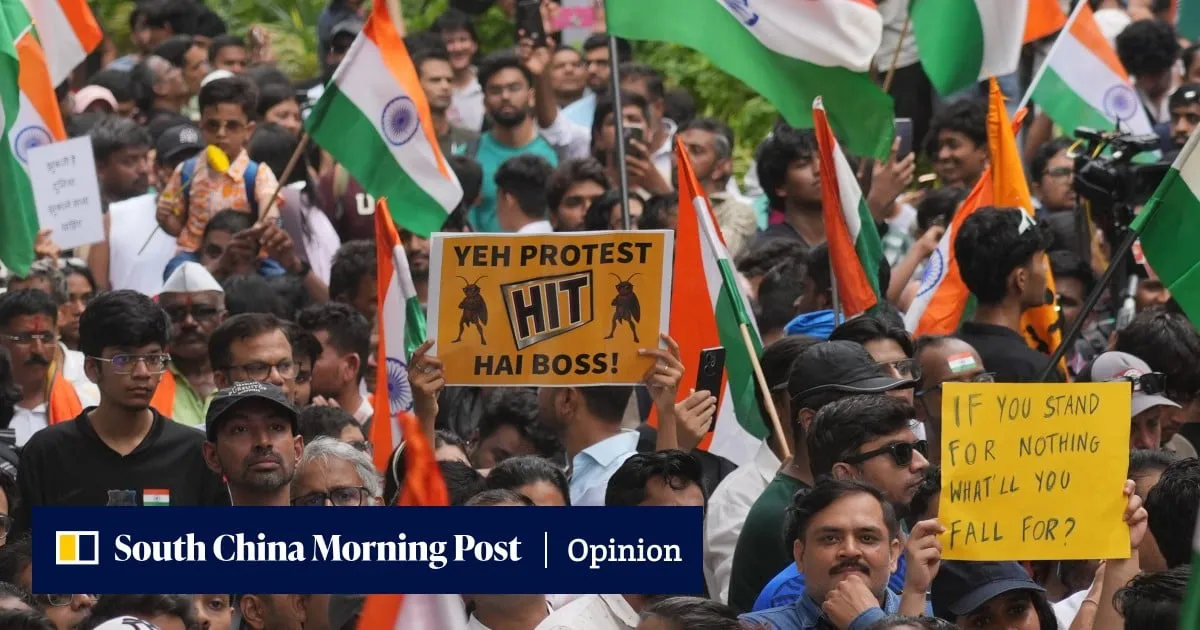
Last month, as thousands of young Indians led by a group calling itself the Cockroach Janta Party, marched towards Parliament in New Delhi, they were met with tear gas and struck with batons by the police. It appeared that India’s moment in South Asia’s Gen Z revolution had finally arrived.As one journalist observed, for the first time since 2014 when Prime Minister Narendra Modi took office, fear had “switched sides”. The protests began over paper leaks that resulted in the cancellation of the national examination for admission to medical schools. A few months ago, protests of this magnitude – with Rahul Gandhi, leader of the opposition in Parliament, demanding that Modi resign – were unthinkable.From Sri Lanka to Nepal, Bangladesh to India, South Asia has seen variants of youth protest movements, each producing its own unique results. The common theme for these protests is that they were essentially leaderless or horizontal movements and had no single political party behind them.
SRCSouth China Morning Post
LANGEN
LEANCenter-Right
WORDS160
ENT11
SAT · 2026-08-08 · 21:30 GMTBRIEF NSR-2026-0808-100478
NSR-2026-0808-100478Analysis·EN·Political Strategy
South Asia’s Gen Z protests offer one lesson in common
In New Delhi last month, thousands of young Indians, organized by the Cockroach Janta Party, protested against paper leaks that led to the cancellation of a national medical school entrance exam. The demonstration, which saw participants met with tear gas and batons, marked a significant shift in public sentiment, with fear perceived to have "switched sides" from the public to the government.
Jawad KhalidSouth China Morning PostFiled 2026-08-08 · 21:30 GMTLean · Center-RightRead · 1 min
South China Morning PostFIG 01
Reading time
1min
Word count
160words
Sources cited
1cited
Entities identified
11entities
Quality score
100%
§ 01
Briefing Summary
AI-generatedNEWSAR · AI
In New Delhi last month, thousands of young Indians, organized by the Cockroach Janta Party, protested against paper leaks that led to the cancellation of a national medical school entrance exam. The demonstration, which saw participants met with tear gas and batons, marked a significant shift in public sentiment, with fear perceived to have "switched sides" from the public to the government. This event is presented as India's entry into a broader trend of Gen Z-led protests across South Asia, including Sri Lanka, Nepal, and Bangladesh. A common characteristic of these movements is their leaderless, horizontal nature, lacking affiliation with any single political party.
Confidence 0.85Sources 1Claims 5Entities 11
§ 02
Article analysis
Model · rule-basedFraming
Political Strategy
Social Justice
Tone
Measured
AI-assessed
CalmNeutralAlarmist
Factuality
0.60 / 1.00
Mixed
LowHigh
Sources cited
1
Limited
FewMany
§ 03
Key claims
5 extracted01
Protests began over paper leaks that resulted in the cancellation of the national examination for admission to medical schools.
factual
Confidence
0.95
02
South Asia has seen variants of youth protest movements from Sri Lanka to Nepal, Bangladesh to India.
factual
Confidence
0.90
03
Thousands of young Indians led by the Cockroach Janta Party marched towards Parliament in New Delhi and were met with tear gas and batons by police.
factual
Confidence
0.90
04
The common theme for these protests is that they were essentially leaderless or horizontal movements with no single political party behind them.
factual
Confidence
0.85
05
Fear had 'switched sides' for the first time since Prime Minister Narendra Modi took office in 2014.
quotejournalist
Confidence
0.80
§ 04
Full report
1 min read · 160 words§ 05
Entities
11 identifiedKey playerOppositionContextPositiveNeutralNegative
Organizations1
Locations6
§ 06
Keywords & salience
8 termsgen z protests
1.00
south asia
0.90
youth movements
0.80
leaderless movements
0.70
paper leaks
0.60
political opposition
0.50
narendra modi
0.40
rahul gandhi
0.40
§ 07
Topic connections
Interactive graph Network visualization showing 16 related topics
View Full Graph Person Organization Location Event|Click node to navigate|Edge numbers = shared articles